
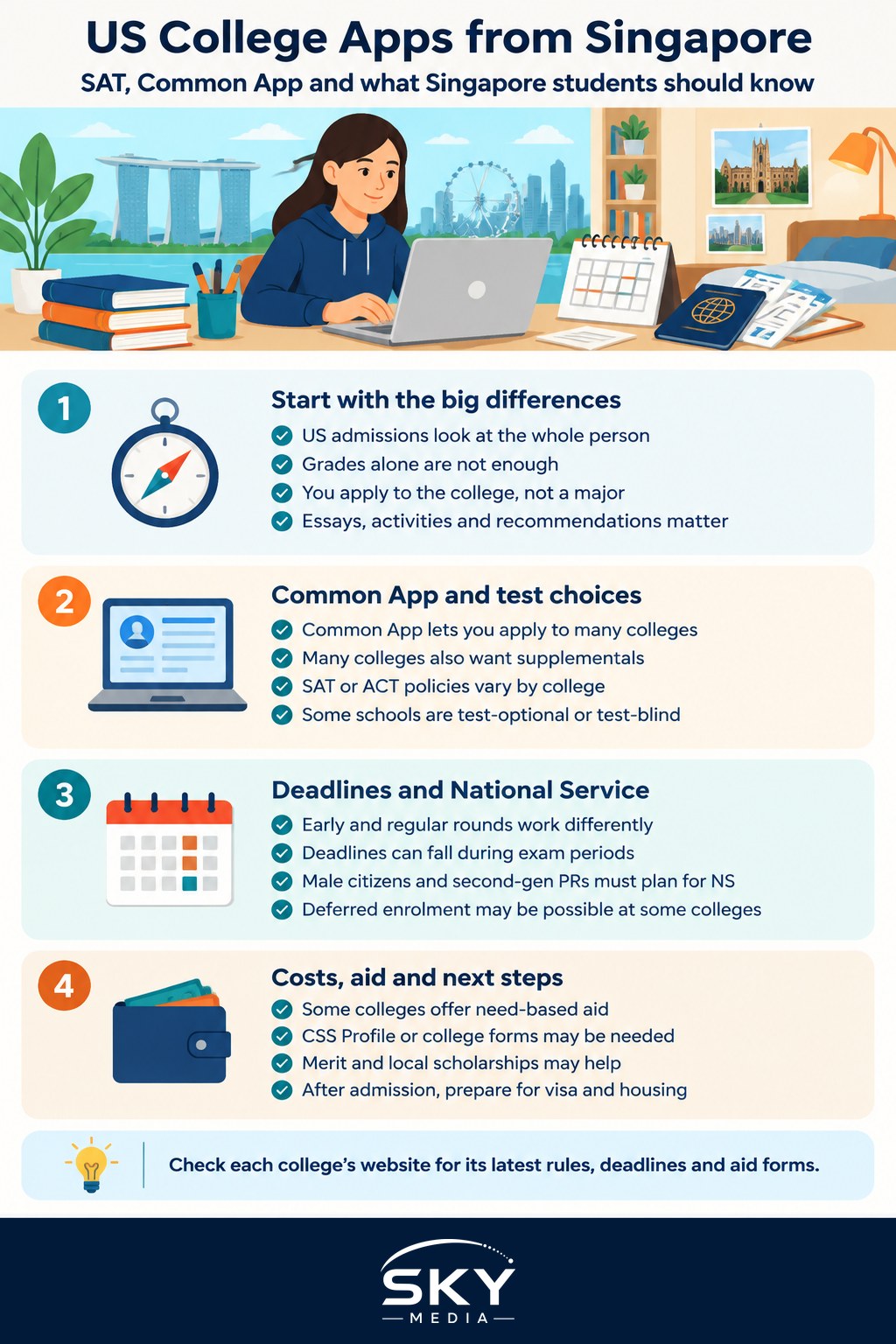
Every year, a steady stream of Singapore students set their sights on American universities, drawn by the liberal arts model, the flexibility to explore subjects before choosing a major, and campus life. But a US college application from Singapore works very differently from the local admissions exercise or the UK’s UCAS system. Grades alone are not enough; American colleges look at the whole applicant, through essays, activities, recommendations and, at many schools, test scores.
This guide walks through the main pieces: the Common App, the SAT or ACT, essays, the application timeline, how National Service affects timing for male students, and financial aid. Policies differ between colleges and change often, so always check each college’s admissions website for current requirements.
How US Admissions Differ From Singapore and the UK
In Singapore, university admission is driven heavily by A-Level, IB or polytechnic results. In the UK, you apply through UCAS for a specific course, and your personal statement focuses on that subject. Our guide to applying to UK universities through UCAS covers that route.
American colleges, by contrast, often use holistic admissions. They consider:
- Academic record (school grades and the rigour of your subjects)
- Standardised test scores, where required or submitted
- Personal essays
- Extracurricular activities, leadership and service
- Teacher and counsellor recommendations
- Sometimes interviews and demonstrated interest
You usually apply to the college as a whole, not to a specific major, and you can often declare your major later.
The Common App and Other Platforms
The Common Application (Common App) is an online platform accepted by hundreds of US colleges. You fill in your personal details, activities and main essay once, then add each college to your list. Many colleges also ask for their own supplemental essays.
Some universities use other systems, such as their own portals or the Coalition application, and the University of California has its own application. Check which platform each college on your list accepts.
Key parts of the Common App include:
- Activities section: up to a set number of activities, each with a short description. Singapore students often list CCAs (co-curricular activities), competitions, volunteer work, internships and family responsibilities.
- Honours section: awards and achievements.
- School report and transcripts: submitted by your school counsellor or a teacher acting as one. Some local schools have experience with this; others may need you to explain what is required.
- Recommendations: usually from two teachers and a counsellor.
SAT, ACT and Testing Policies
Many US colleges ask for an SAT or ACT score, though policies vary widely. Some require scores, some are test-optional (you choose whether to submit), and a few are test-blind (they will not consider scores). Policies have shifted in recent years, so check each college’s current stance.
- SAT: run by the College Board, now delivered digitally. It tests reading, writing and maths.
- ACT: an alternative test covering English, maths, reading and science, with an optional writing section depending on the college.
Both tests are offered at test centres in Singapore on set dates. Register early through the official College Board or ACT websites, as seats can fill up. Many students take the test more than once.
Students whose first language or medium of instruction is not English may also be asked for an English proficiency test. Singapore students educated in English are often exempt, but confirm with each college.
Comparing Application Rounds
| Round | How it works | Who it suits |
|---|---|---|
| Early Decision (ED) | Apply early to one college; if admitted, you are committed to attend | Students with a clear first choice who are comfortable with the aid offered |
| Early Action (EA) | Apply early and hear back early, without a binding commitment | Students who are ready early and want an earlier answer |
| Restrictive Early Action | Non-binding, but limits other early applications | Students set on one selective college that uses this round |
| Regular Decision (RD) | Standard deadline, with decisions in spring | Students who need more time or want to compare offers |
Early deadlines typically fall in autumn and regular deadlines around the start of the new year, but every college sets its own dates. For Singapore students, this often means working on applications during the A-Level or IB exam period, so planning ahead is essential.
Writing Strong Essays
The personal essay is where US admissions officers get to know you. Good essays from Singapore students tend to:
- Tell a specific story. A single experience, such as helping at a family hawker stall or leading a struggling CCA, says more than a list of achievements.
- Explain local context. Admissions officers may not know what a CCA, JC or NS is. Explain briefly without over-explaining.
- Sound like you. Avoid over-polished writing. Ask teachers or mentors for feedback, but keep the voice your own.
- Answer the prompt. Supplemental essays such as “Why this college?” need research about the specific college.
National Service and Timing for Male Students
For male Singapore citizens and second-generation PRs, NS is a major factor. Deferment from full-time NS for undergraduate studies is generally not granted, so most male students complete NS before starting university. Check the current deferment policy with the Central Manpower Base (CMPB) on the NS Portal.
Common approaches include:
- Applying during NS and starting college after your Operationally Ready Date (ORD).
- Applying in your final school year and then requesting a deferred enrolment (a gap period) from the college. Many US colleges allow this for national service, but policies vary, so ask the admissions office.
Pre-enlistees and NSmen may also need an exit permit for overseas travel or study. Check the requirements on the NS Portal before you go.
Financial Aid and Costs
US college costs can be very high, so plan finances early.
- Need-based aid: Some colleges offer aid to international students based on family finances. Colleges are either need-blind (finances do not affect admission) or need-aware (they may). Only a small number are need-blind for international applicants.
- CSS Profile and other forms: Many colleges ask international applicants to complete the CSS Profile or their own financial aid form.
- Merit scholarships: Some colleges award scholarships based on achievement.
- Local scholarships: Government agencies and statutory boards offer scholarships for overseas study, often with a bond. Read the bond terms carefully.
Use each college’s net price calculator to estimate costs.
After Admission: Visas and Preparation
Once you accept an offer, the college issues the form you need to apply for a US student visa, usually the F-1. Our guide on applying for US visas from Singapore explains the general process with the US Embassy. Plan for housing, health insurance requirements and orientation dates too.
A Simple Timeline to Follow
- Two years before: research colleges, build activities and plan test dates.
- Eighteen months before: take the SAT or ACT.
- Summer before applying: draft essays and ask teachers for recommendations.
- Autumn: submit early applications.
- Around the new year: submit regular applications and financial aid forms.
- Spring: compare offers and confirm.
Explore more: Applying to UK Universities Through UCAS · Applying for US and Schengen Visas From Singapore · A Guide to Junior Colleges in Singapore