

Waiting to be noticed rarely works. If you want to grow, one of the most effective moves is to ask for more responsibility before a promotion is even on the table. Taking on stretch work shows you can operate at the next level, builds new skills and gives your manager real evidence when promotion time comes. This guide focuses on how to earn and ask for that extra scope in a way that is welcomed rather than seen as overreaching.
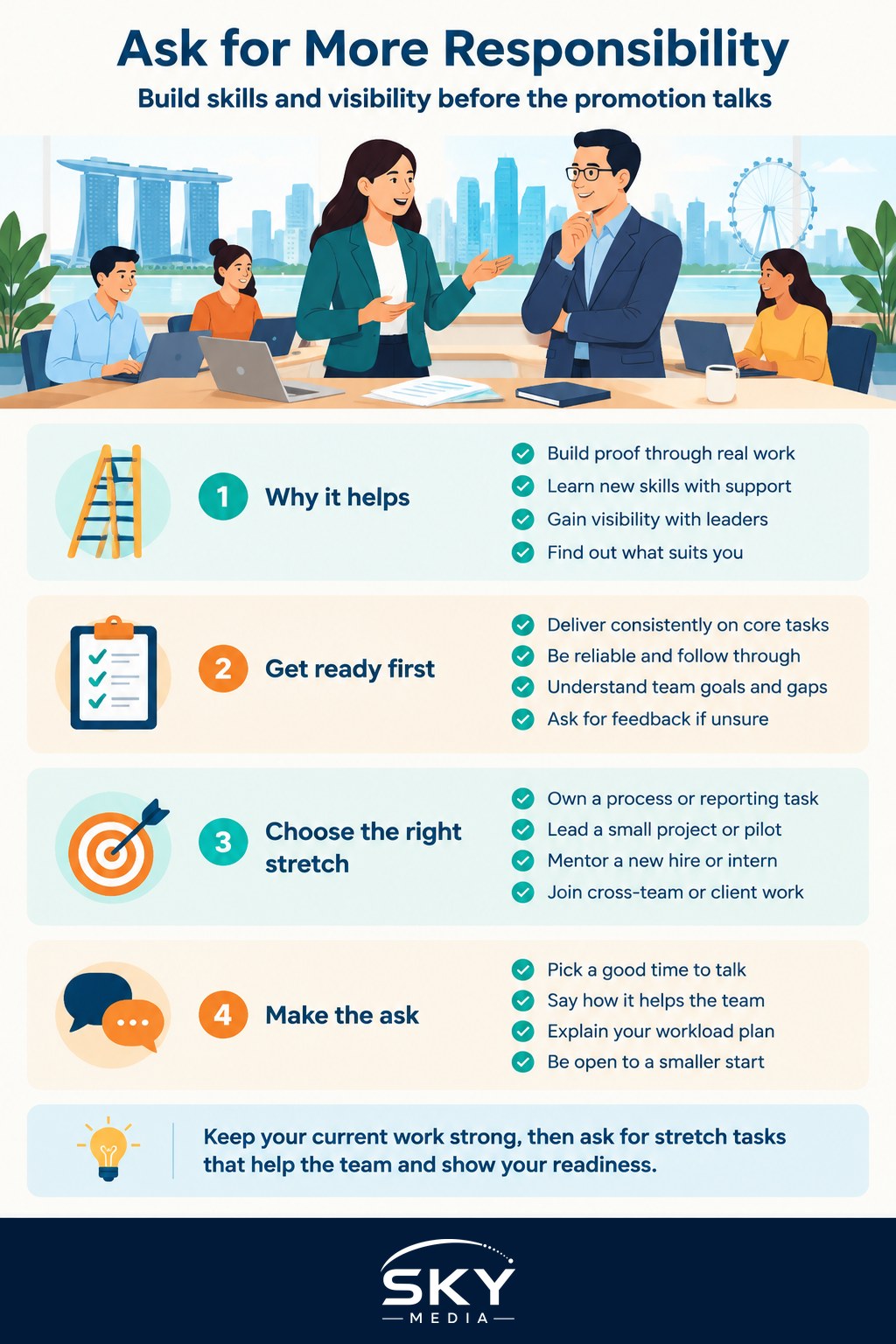
Why Expanding Your Scope Comes Before the Title
Many people treat promotion as the moment their job changes. In practice, many managers promote people who are already doing parts of the next role. Asking for more responsibility helps you:
- Build proof. You show what you can do instead of telling.
- Learn safely. You try new skills with support while still in your current role.
- Increase visibility. Stretch projects often involve other teams and senior leaders.
- Find direction. You may discover what you enjoy, or do not enjoy, before committing to a new path.
It also benefits your manager and team, which is why a well framed request is usually received positively.
Get Your Foundations Right First
Before you ask for more, make sure your current work is solid. Managers are wary of giving extra scope to someone who is already behind.
- Deliver consistently. Meet deadlines and keep quality high on your core tasks.
- Be reliable. Respond promptly, follow through on commitments and flag problems early.
- Understand the bigger picture. Learn your team’s goals, pain points and what your manager is measured on.
- Spot gaps. Notice tasks nobody owns, processes that could be improved or projects that need help.
If you are unsure where you stand, ask your manager for feedback first. It is a natural way to open the conversation later.
Choosing the Right Stretch Opportunity
Not all extra work is worth asking for. Aim for responsibility that grows your skills and matters to the business, rather than simply more of the same.
| Type of responsibility | Example | What it builds | Watch out for |
|---|---|---|---|
| Owning a process | Taking over the team’s monthly reporting | Accountability and attention to detail | Becoming stuck with admin that does not grow you |
| Leading a small project | Running a pilot or internal improvement | Planning, coordination and leadership | Scope creep without enough time or support |
| Mentoring or onboarding | Guiding a new hire or intern | People skills and communication | Neglecting your own deliverables |
| Cross-team work | Representing your team in a working group | Visibility and stakeholder management | Too many meetings with unclear outcomes |
| Client or stakeholder contact | Handling a smaller account or internal client | Relationship management and judgement | Taking on risk without clear escalation paths |
Choose one or two areas that connect to where you want to go. If you want to move into management, mentoring and leading small projects are useful. If you want to become a specialist, owning a complex process may be better.
How to Ask Your Manager
Treat the conversation as a proposal, not a complaint about being underused.
Pick the right moment. Regular one-to-ones, performance check-ins or after a successful piece of work are good times. Avoid busy deadline weeks.
Prepare your pitch. Be ready to explain:
- What you want to take on, as specifically as possible.
- Why it helps the team or business, not just you.
- How you will manage your current workload alongside it.
- What support you might need, such as training or introductions.
Use clear, positive language. For example: “I have been enjoying the reporting work and I would like to take on more. I noticed the onboarding process could use an owner. Would you be open to me leading it for the next quarter, while keeping my current tasks on track?”
Ask open questions. “What would you need to see from me to take on something like this?” invites your manager to share expectations. For ideas on how to frame questions well, see our guide on how to ask better questions.
Be flexible. Your manager may suggest a different task or a smaller first step. Saying yes to a starting point often leads to bigger opportunities.
Handling Workload and Boundaries
Taking on more should not mean burning out. Protect yourself and your performance.
- Agree on priorities. Ask your manager what can be dropped, delegated or slowed down if you take on new work.
- Set a review point. Suggest checking in after a few weeks or a month to see how it is going.
- Keep records. Note what you did, the results and any feedback. This becomes useful evidence for appraisals.
- Know your limits. If the extra work affects your health or core deliverables, raise it early rather than struggling silently.
- Be clear about pay and title. Extra responsibility does not automatically come with a raise. If the new scope becomes permanent and substantial, it is fair to ask later how it will be reflected in your role, grade or pay. Company policies differ, so ask HR or your manager how this works in your organisation.
If you need flexibility to balance new responsibilities with personal commitments, our guide on how to ask for flexible work arrangements covers how to frame that request.
If the Answer Is No
A “not now” is not the end of the conversation.
- Ask why. It may be about timing, budget or business priorities rather than your ability.
- Ask what would change it. Agree on what you need to show, and by when, to revisit the request.
- Look for smaller steps. Volunteer for a single task, a short project or a temporary cover role.
- Grow outside your team. Company committees, interest groups or learning programmes can also build skills.
- Reflect on fit. If opportunities never come despite strong performance, it may be time to think about your longer-term path. Thoughtful questions to ask your interviewer can help you assess growth opportunities at future employers.
Turning Responsibility Into Long-Term Growth
When you ask for more responsibility and deliver well, you build a track record that speaks for you. Share results with your manager, thank colleagues who helped and keep learning from each new task. Over time, those stretch opportunities add up to a bigger role, stronger skills and a much clearer case for your next step.
Frequently Asked Questions
How soon after joining a company can I ask for more responsibility? Once you have shown you can handle your core work reliably, which for many people is a few months. There is no fixed timeline. Use your early weeks to learn how the team works, then raise it in a one-to-one when you have a concrete suggestion.
Should I ask my manager for a raise when I take on extra work? Not on the first day. Start by proving you can deliver the extra scope, then raise pay once it becomes a regular part of your role. Bring notes of results and ask how your organisation handles grade or salary changes, since policies differ.
What if I do not want to manage people, only grow my skills? That is a perfectly good path. Ask for ownership of a complex process, a specialist project or a client-facing task rather than people management. Tell your manager plainly that you want to deepen expertise, so the stretch work you are offered fits.
Is it better to ask in person or by email? In person or on a call is usually better, because a request for new scope is a conversation. Follow up with a short email summarising what you agreed, the priorities and any review date, so both of you remember the same thing.
How do I stop extra responsibility turning into too much work? Agree up front what will be dropped, delegated or slowed down, and set a check-in after a few weeks. If your health or core deliverables start to suffer, tell your manager early. Taking on more should be a trade, not an addition on top of everything.