
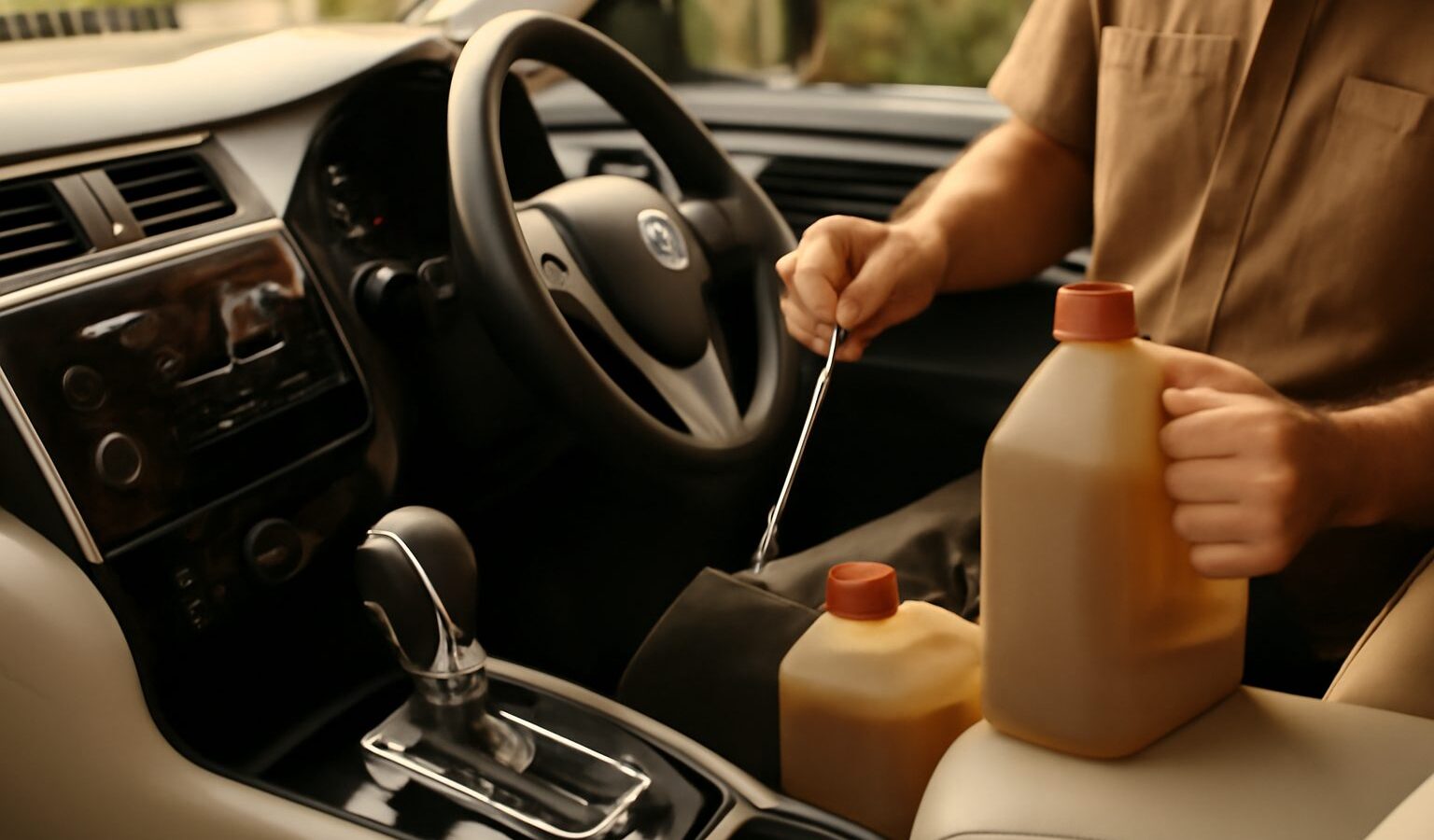
Almost every car on Singapore roads is an automatic, and most owners never think about the gearbox until something feels wrong. Regular servicing tends to focus on engine oil, filters and brakes, while the transmission quietly works through thousands of stop-start cycles in CTE jams and multi-storey car parks. This guide to CVT servicing Singapore drivers can use explains how the different automatic gearboxes work, when transmission fluid should be changed, and the warning signs that mean you should get the car checked before a small problem turns into an expensive repair.
If you want the bigger picture on routine maintenance, start with our car servicing and maintenance guide. This article zooms in on the gearbox only.
The Three Main Types of Automatic Gearbox
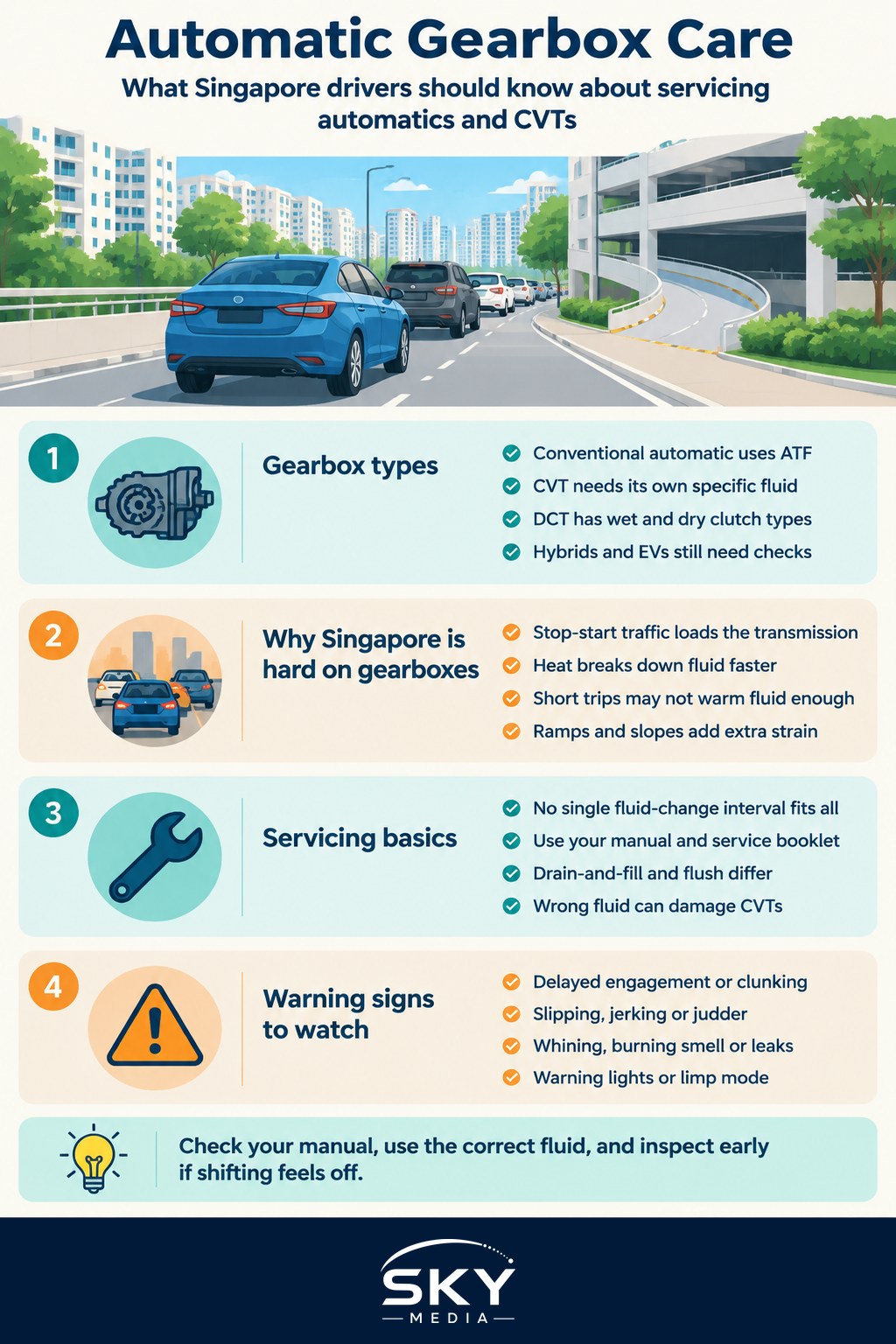
Not every “automatic” is built the same way, and the servicing needs differ. Your owner’s manual or the vehicle registration details will tell you which type your car has.
| Gearbox type | How it works | Common in | Servicing notes |
|---|---|---|---|
| Conventional automatic (torque converter) | Uses a fluid coupling and planetary gear sets to shift between fixed gears | Many Japanese, Korean and European sedans and SUVs | Uses automatic transmission fluid (ATF); some makers specify changes, others call it “lifetime” fill |
| CVT (continuously variable transmission) | A steel belt or chain runs between two variable pulleys, so there are no fixed gears | Many compact Japanese cars and hybrids | Needs its own specific CVT fluid; the wrong fluid can damage the belt and pulleys |
| Dual-clutch (DCT or DSG) | Two computer-controlled clutches pre-select the next gear for fast shifts | Many European and some Korean models | Wet-clutch types need fluid changes; dry-clutch types wear their clutches instead |
| Hybrid e-CVT or single-speed EV drive | Electric motors and a planetary set handle “gearing” | Full hybrids and electric cars | Usually low maintenance, but still check the schedule for gear oil or coolant |
If you drive a hybrid, our hybrid cars explainer covers how these drivetrains differ from a conventional car.
Why Singapore Driving Is Hard on Transmissions
Car manuals often list two service schedules: a normal one and a “severe conditions” one. Many Singapore drivers fall into the severe category without realising it, because of:
- Constant stop-and-go traffic. Each start from rest loads the torque converter, clutch packs or CVT belt.
- Heat. High ambient temperatures and long idling in queues raise fluid temperature, and heat is what breaks down transmission fluid fastest.
- Short trips. Many journeys are a few kilometres, so the fluid may rarely reach and hold its ideal temperature.
- Ramps and car parks. Crawling up spiral ramps and holding the car on slopes puts extra strain on the drivetrain, especially in CVTs and dual-clutch boxes.
The result is that fluid which might last a long time in gentle highway driving can degrade sooner here. That does not mean you must change it constantly, but it does mean “lifetime fluid” claims deserve a second look.
Transmission Fluid Changes Explained
Transmission fluid does several jobs at once: it lubricates, cools, cleans and, in conventional automatics, transmits power through hydraulic pressure. Over time it loses its friction properties, collects fine metal and clutch material, and darkens.
How often to change it
There is no single answer. The correct interval depends on the manufacturer, the gearbox type and how you drive. Some makers specify a fixed mileage or time interval, some say the fluid only needs inspection, and some describe it as filled for life. Your best sources are:
- The owner’s manual and service booklet, especially the severe-use schedule.
- The authorised dealer or agent, who can confirm any updated recommendations for your model.
- A reputable independent workshop that specialises in your make.
Many mechanics in Singapore suggest that drivers in heavy traffic consider changing fluid earlier than the “normal” schedule, but ask for the reasoning for your specific car rather than accepting a blanket rule.
Drain-and-fill versus flush
- Drain-and-fill removes the fluid that sits in the pan, then tops up with fresh fluid. It replaces only part of the total volume, so some workshops repeat it over several visits.
- Machine flush or exchange pushes old fluid out while feeding new fluid in, replacing more of it at once.
Opinions differ on which is better, especially for older, high-mileage gearboxes that have never had a change. A good workshop will explain its approach, inspect the fluid first and tell you if a filter or pan gasket also needs replacing.
Use the correct fluid
This is the single most important point for CVT servicing. CVT fluid is formulated for the specific friction behaviour between the belt and pulleys. Using generic ATF, or the wrong CVT fluid, can cause slipping and judder. Ask the workshop which specification it will use and check that it matches your manual. Dual-clutch gearboxes likewise need the correct DCT fluid.
Warning Signs Your Gearbox Needs Attention
Transmissions usually give clues before they fail. Get the car inspected if you notice any of these:
- Delayed engagement. A pause or clunk when shifting from Park to Drive or Reverse.
- Slipping. Engine revs rise but the car does not accelerate as expected, as if it is briefly in neutral.
- Harsh or jerky shifts. Thumps between gears in a conventional automatic, or a jolt when pulling away.
- Judder or shudder. A vibration when moving off gently, common in worn CVTs and dual-clutch units.
- Whining, humming or grinding. New noises that change with speed, particularly a whine from a CVT.
- Burning smell. Overheated fluid has a distinct sharp smell.
- Fluid leaks. Reddish or brownish spots under where you park.
- Warning lights or limp mode. A transmission or check-engine light, or the car holding one gear and refusing to rev, means the computer has detected a fault.
If the car goes into limp mode, drive gently to a safe stop or straight to a workshop, and avoid long trips until it has been checked. A diagnostic scan can read stored fault codes and often narrows the problem quickly.
Choosing Where to Service Your Gearbox
Your options broadly fall into authorised agents and independent workshops.
Authorised agents know the model well, use the specified fluids and parts, and keep records that can matter for warranty. They are often the safer choice while the car is still under warranty, because skipping or mishandling a required service could affect a claim. Check your warranty terms.
Independent workshops range from general garages to gearbox specialists. A specialist can be a good choice for older cars or tricky symptoms. When choosing one:
- Ask what fluid specification they will use and whether it matches your manual.
- Ask whether they will drain-and-fill or flush, and why.
- Ask if they reset or relearn the transmission settings afterwards, which some modern gearboxes require.
- Request an itemised quote before work starts.
- Keep receipts, as a documented history helps resale.
Prices vary widely by car model, fluid type and method, so get a quote rather than relying on figures you see online.
Transmission Care When Buying or Selling
A gearbox overhaul or replacement is one of the costliest repairs a car can need, so it matters at both ends of ownership. When buying a used car, ask for service records showing any transmission fluid changes, and ask an inspector to road test the car from cold, including slow manoeuvres and a ramp if possible. Our guide on how to buy a used car in Singapore covers inspections in more detail.
When selling or trading in, a smooth-shifting car with documented gearbox maintenance makes a stronger impression on buyers and dealers.
Simple Habits That Protect Your Gearbox
- Come to a complete stop before shifting between Drive and Reverse.
- Use the handbrake on slopes rather than letting the transmission hold the car.
- Avoid creeping forward repeatedly in jams in a dual-clutch car; leave a gap and move in one go.
- Do not ignore small changes in feel; early checks are cheaper.
- Follow the severe-use schedule if your driving is mostly short, slow urban trips.
A little attention to the gearbox, and the right fluid at the right time, goes a long way towards keeping an automatic or CVT running smoothly for the life of your COE.
Frequently Asked Questions
How much does a CVT fluid change cost in Singapore? Prices vary widely with car model, fluid type and method, so rely on a written quote rather than figures seen online. Ask the workshop for an itemised quote that names the fluid specification, whether it will drain-and-fill or flush, and whether a filter or gasket is included.
Is a CVT less reliable than a conventional automatic? Not inherently, but it is less forgiving of neglect. A CVT needs its own specific fluid, and the wrong fluid or heat-degraded fluid can cause slipping and judder. Reliability depends on the make, the model and how well it is serviced, so follow the severe-use schedule if your driving is mostly stop-and-go.
Can I check my own gearbox fluid at home? It depends on the car. Some gearboxes have a dipstick, but many modern ones are sealed and need a workshop with the right equipment and procedure. Check the owner’s manual rather than opening anything yourself, because the wrong fluid or level can harm a CVT or dual-clutch unit.
What should I do if the gearbox slips or judders after a service? Go back to the workshop promptly and describe the symptom. Ask which fluid specification was used and whether it matches your manual, and whether the transmission settings needed to be reset or relearned. Keep your receipts and the itemised quote in case you need to follow up with the authorised agent.
How do I get a second opinion on an expensive gearbox repair quote? Ask for an itemised written quote and the diagnosis behind it, including any stored fault codes from a scan. Then take the car to an authorised agent or a gearbox specialist for another view. Compare what each recommends, such as a fluid change versus an overhaul, before committing.