

A good back to school checklist in Singapore saves parents from the late-night scramble the day before term begins: the missing name labels, the unsigned form, the shoes that no longer fit. Whether your child is entering Primary 2 or Primary 6, the January restart brings the same four jobs: sort the admin, get the supplies ready, reset routines and prepare your child emotionally for a new class and teacher.
This checklist is written for all primary levels. If your child is starting Primary 1 for the first time, you will also find our guide to preparing your child for Primary One helpful, as the first year comes with extra steps.
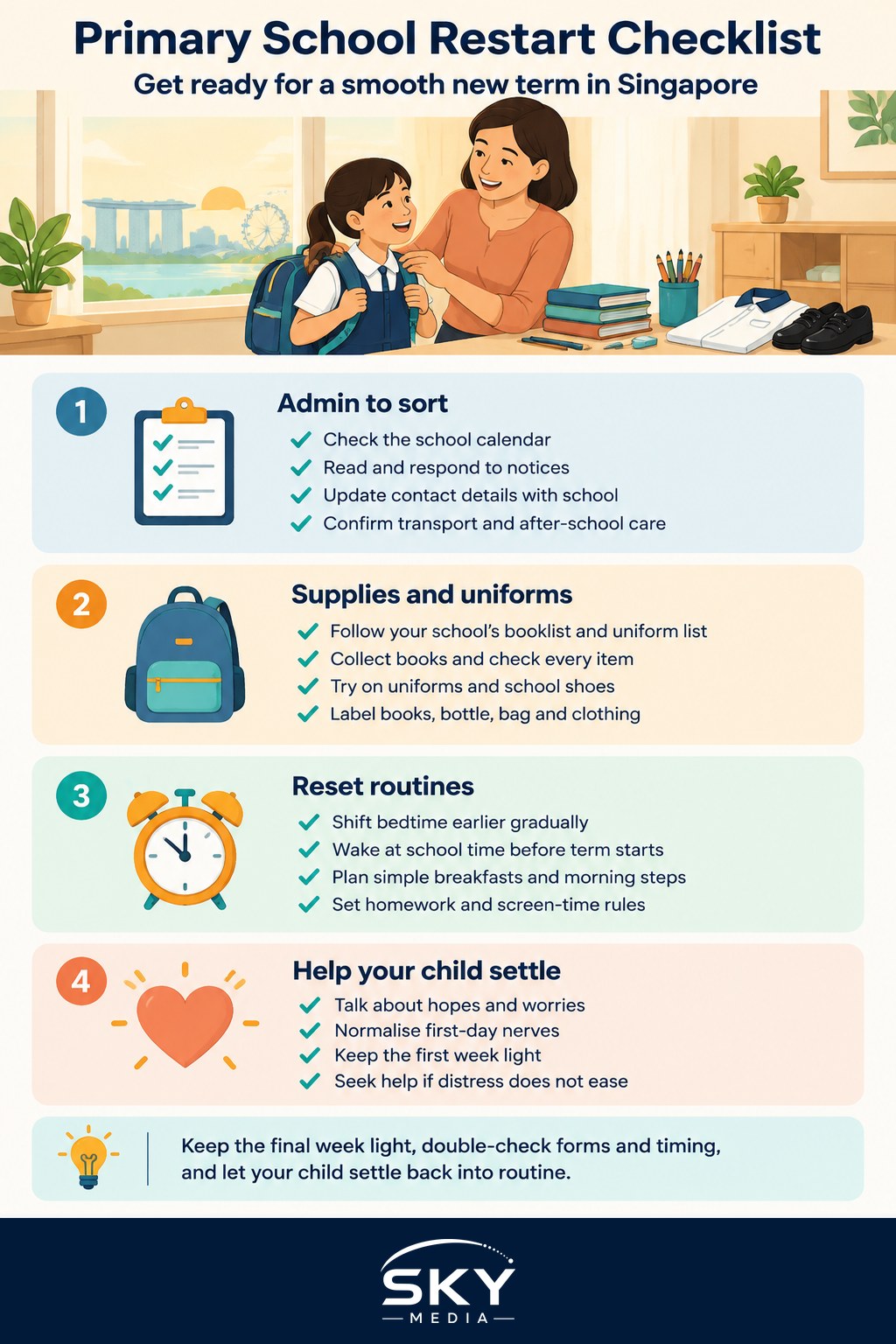
Admin to Sort Before Term Starts
School communications usually arrive through the parent messaging app the school uses (in most MOE schools, Parents Gateway) and printed letters. Set aside time in December to work through them.
- Check the school calendar for the first day of term, any orientation sessions and early dismissal days.
- Read and acknowledge notices on the school’s parent app. Consent forms for activities, excursions and photo use often need a response.
- Update contact details with the school if your phone number, address or emergency contact has changed.
- Confirm transport arrangements. If your child takes a school bus, check the pick-up time and route for the new term with the operator. If arrangements are changing, settle them early.
- Review after-school care. If your child attends a student care centre, confirm the new term schedule and any changes in fees or pick-up times. Our guide to finding a student care centre for after school covers what to ask if you are switching providers.
- Check financial assistance or subsidy schemes if relevant. Schools and MOE administer these, and eligibility and application windows can change, so confirm details directly with the school’s general office.
- Note any medical needs. If your child has allergies, asthma or another condition, update the school’s records and discuss any medication arrangements with the school. Your doctor can advise on what information to share.
School Supplies and Uniforms
Most schools release a booklist and uniform list towards the end of the year, often with an appointed bookshop and uniform vendor. Prices and items vary by school, so work from your school’s own list.
- Collect textbooks and workbooks from the booklist and check every item against it.
- Wrap or cover books if the school or teacher expects it, and label each one clearly.
- Try on uniforms, PE attire and school shoes; children grow quickly over the holidays.
- Buy at least two to three sets of uniforms so laundry does not become a daily crisis.
- Prepare a pencil case with pencils, erasers, a sharpener, ruler, coloured pencils, glue and scissors.
- Get a sturdy school bag with good back support and a water bottle that does not leak.
- Label everything: books, bottle, pencil case, shoes and uniform tags.
- Pack spare items such as a small towel, tissues and a spare mask.
The Restart Checklist at a Glance
The table below gives a timeline for the weeks before term. Adjust it to your family and the school’s calendar.
| When | Admin | Supplies | Routines | Emotional preparation |
|---|---|---|---|---|
| 3 to 4 weeks before | Read school notices, check calendar | Collect booklist and check uniform sizes | Note current bedtime and wake time | Chat about what your child enjoyed last year |
| 2 weeks before | Submit forms, confirm transport and student care | Buy or collect books, uniforms and shoes | Start shifting bedtime earlier | Talk about the new class, teacher and friends |
| 1 week before | Update contact and medical details | Label everything, pack the school bag | Practise a full school morning | Ask what they are looking forward to or worried about |
| Weekend before | Double-check first-day timing | Lay out uniform and bag | Early dinner and calm evening | Reassure and keep plans light |
Resetting Daily Routines
After weeks of holidays, the jump back to early mornings is often the hardest part.
- Shift sleep gradually. Move bedtime earlier by 15 to 30 minutes every few days before term starts.
- Wake at school time for several days before the first day so the body adjusts.
- Plan breakfast. Choose quick, simple options your child will actually eat early in the morning.
- Create a morning checklist with pictures for younger children or a written list for older ones: wash up, dress, breakfast, pack bottle, check bag.
- Set a homework rhythm. Decide when and where homework will be done each day so it becomes routine rather than a negotiation.
- Plan screen time. Agree on family rules for devices on school days before term begins, not during the first argument.
Preparing Your Child Emotionally
Even confident children can feel nervous about a new classroom, form teacher or classmates. Mixed classes and new subjects at higher levels add to the change.
- Talk openly. Ask what they are excited about and what worries them. Listen rather than rushing to fix.
- Normalise the nerves. Let them know that many children feel unsure on the first day, and that it usually eases within a week or two.
- Visit or revisit the school if possible, especially for younger children or after a school change.
- Rehearse practical worries. Practise buying food at the canteen, counting change or asking a teacher for help.
- Keep the first week light. Avoid packing extra activities or tuition into the first few days.
- Watch for signs of ongoing distress such as persistent stomach aches, trouble sleeping or refusal to go to school. If worries do not settle, speak to the form teacher or the school counsellor, who can offer support.
For children entering their first year of formal schooling, our article on the first year of primary school explains what to expect across the year, from recess to assessment.
A Note for Newcomer Families
If your family has recently moved to Singapore, some parts of the primary school system may feel unfamiliar. Schools usually communicate through a parent app and regular letters, and the form teacher is the main point of contact for questions about your child. Do not hesitate to contact the school’s general office for administrative matters, such as forms, fees or records. Many schools also have parent support groups, which can be a friendly way to learn how things work.
Final Day-Before Checklist
On the evening before the first day, run through this short list:
- Uniform, socks and shoes laid out
- School bag packed with books for the timetable, pencil case and bottle
- Forms signed and in the bag
- Transport confirmed and pick-up plan agreed
- Alarm set and a calm, early bedtime
With admin settled, supplies labelled and routines reset, your child can walk into the new term focused on learning and friendships rather than on what was forgotten at home.
Official sources: Ministry of Education (MOE)
Further reading: Choosing a School Backpack for Your Child · How to Pack a School Bag So Mornings Feel Easier