

Every working parent in Singapore knows the feeling. The helper wakes up with a fever, the grandparents fly home for a family wedding, or the childcare centre sends a message that your child cannot return until a rash clears. Suddenly the arrangement that holds your week together is gone, and you have a meeting at nine.
Planning backup childcare in Singapore before you need it turns a crisis into an inconvenience. This guide is not about choosing your main care option. It is about building a simple contingency plan so you know exactly who to call, what to pack and what to tell work when things fall through.
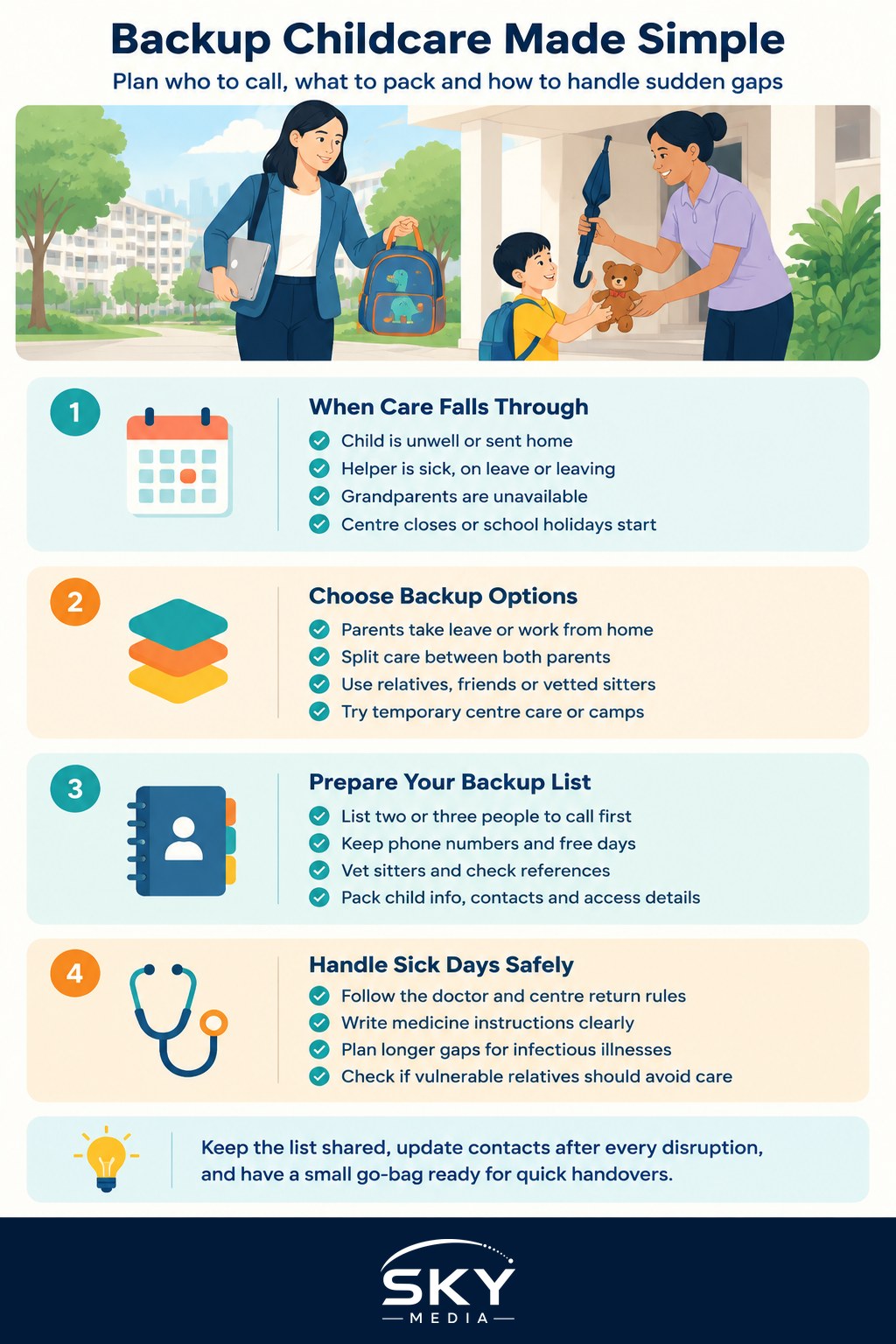
Know the Common Ways Care Breaks Down
Start by listing the realistic scenarios for your family. Each one calls for a slightly different response, and seeing them side by side shows where your plan has gaps.
- Your child is unwell. Childcare centres and preschools generally ask parents to keep children at home with fever or infectious conditions such as hand, foot and mouth disease, and may require a doctor’s note before return.
- Your helper is sick, on home leave or leaving. A migrant domestic worker (MDW) is entitled to rest and leave under MOM rules, and transfers or departures can leave a gap of days or weeks.
- Grandparents are unavailable. Elderly caregivers fall ill, travel or simply need a break.
- The centre or school closes. Planned closures for staff training, public holiday bridges or unexpected incidents can catch parents off guard.
- School holidays. Primary school holidays rarely line up with working parents’ leave.
Short gaps of a day or two need fast options. Longer gaps of a week or more need a different plan, so treat them separately.
Compare Your Backup Options
No single backup option covers every situation. Most families rely on two or three layers. The table below compares the common choices.
| Backup option | Best for | Things to check |
|---|---|---|
| Parent takes leave or works from home | Sick child, short closures | Your leave balance and employer policy; whether your role allows remote work |
| Splitting days between both parents | Gaps of several days | Each parent’s calendar; fair sharing of the load |
| Relatives or close friends | Short notice, familiar faces for the child | Their health, availability and willingness; house rules agreed beforehand |
| Ad-hoc babysitter or nanny | Planned closures, a helper on leave | References, background checks, first aid knowledge, clear rates and terms |
| Temporary or ad-hoc care at a centre | Longer gaps when your child is healthy | Whether places exist at short notice; orientation needs; fees |
| Holiday programmes and camps | School holidays for older children | Age suitability, supervision ratios, cancellation terms |
When your child is sick, centre-based options are usually off the table, so your plan for illness should lean on parents, relatives or a trusted individual sitter.
Build Your Backup List Before You Need It
The middle of a crisis is the worst time to search for help. Spend an hour now putting together a written list that both parents can access, such as a shared note on your phones.
Include:
- Two or three people you can call first, with their phone numbers and which days they are usually free.
- One or two vetted sitters. Meet them in advance, let your child spend time with them while you are at home, and agree on terms. Ask friends or parent groups for personal recommendations, and check references yourself.
- Your child’s information sheet: allergies, medication the doctor has prescribed, feeding and nap routine, comforters, emergency contacts and your family doctor or nearest polyclinic.
- Centre and school contacts, and where to find their closure notices.
- Practical access details: a spare key or door code arrangement, the condo guardhouse contact if relevant, and the location of the first aid kit.
Keep a small go-bag ready if your child might be dropped at a relative’s home: spare clothes, diapers or underwear, snacks, a water bottle, a favourite toy and a copy of the information sheet.
Handle Sick Days Calmly and Safely
Illness is the most common reason backup care is needed, and also the one where safety matters most.
- Follow your doctor’s advice and the centre’s return policy. Do not send a child back early to solve a care problem, as it can spread infection to other children and their families.
- If someone else is caring for a sick child, write down any medicine instructions exactly as the doctor or pharmacist gave them, and tell the carer when to call you or seek medical help.
- For conditions like hand, foot and mouth disease or chickenpox, which can keep a child home for several days, plan for a longer gap from the start. Our guide on caring for your child through hand-foot-mouth and chickenpox explains what those days typically look like.
- Consider whether elderly grandparents or a pregnant relative should look after a child with an infectious illness, and check with a doctor if unsure.
This is general information, not medical advice. Your family doctor, polyclinic and HealthHub are the right sources for health questions.
Use Leave and Flexible Work Wisely
Government-paid childcare leave and other family leave schemes exist in Singapore, but eligibility, the number of days and how they apply depend on your child’s age, citizenship and your employment. Check the current rules with MOM and your HR department rather than relying on what colleagues say. Our overview of childcare and parent-care leave is a helpful starting point.
Some tips for the workplace side:
- Talk to your manager before a crisis. Explain that you have a backup plan and ask how they prefer to handle short-notice absences.
- Know your company’s flexible work policy. Singapore has tripartite guidelines on how employers should consider flexible work arrangement requests. Your HR team can explain how they apply in your workplace.
- Split the load between parents. Agree in advance who covers the first day of an emergency, and alternate, so one parent’s career does not absorb every disruption.
- Keep work portable. If remote work is allowed on short notice, keep your laptop and essential files ready to go.
Plan Ahead for Predictable Gaps
Not every gap is a surprise. Some can go on the calendar months in advance.
- Centre closure days. Childcare centres usually publish their closure dates for the year. Add them to a shared family calendar as soon as you receive them.
- Helper home leave. Agree on leave dates early and line up cover. If you are changing helpers, expect a gap between one leaving and the next arriving.
- Grandparents’ travel. Ask about trips and medical appointments early, and do not assume they are always free.
- School holidays. Book holiday programmes early, since popular ones fill up.
If your child is very young and you are still deciding on main care, our comparison of infant care vs childcare in Singapore can help you pick an arrangement that is easier to back up.
Review the Plan After Each Disruption
After each time the plan is used, take five minutes to ask what worked and what did not. Was the sitter free? Did the go-bag have everything? Did work react well? Update your list and keep it current. A backup childcare plan that is tested and refreshed is what lets you stay calm the next time the phone buzzes at 6am.
Official sources: Early Childhood Development Agency (ECDA)