

Every flight that leaves Changi depends on someone who checked the tyres, inspected the engines and signed off the paperwork. If you like working with your hands, enjoy problem solving and want a skilled trade with a clear licensing path, becoming an aircraft technician in Singapore is a realistic route straight after ITE or polytechnic. This guide focuses on the maintenance side specifically: the courses, the CAAS licence categories and the kinds of employers that hire.
Course names, licence rules and entry requirements change over time, so treat this as a map and check the details with the schools, the Civil Aviation Authority of Singapore (CAAS) and employers directly.
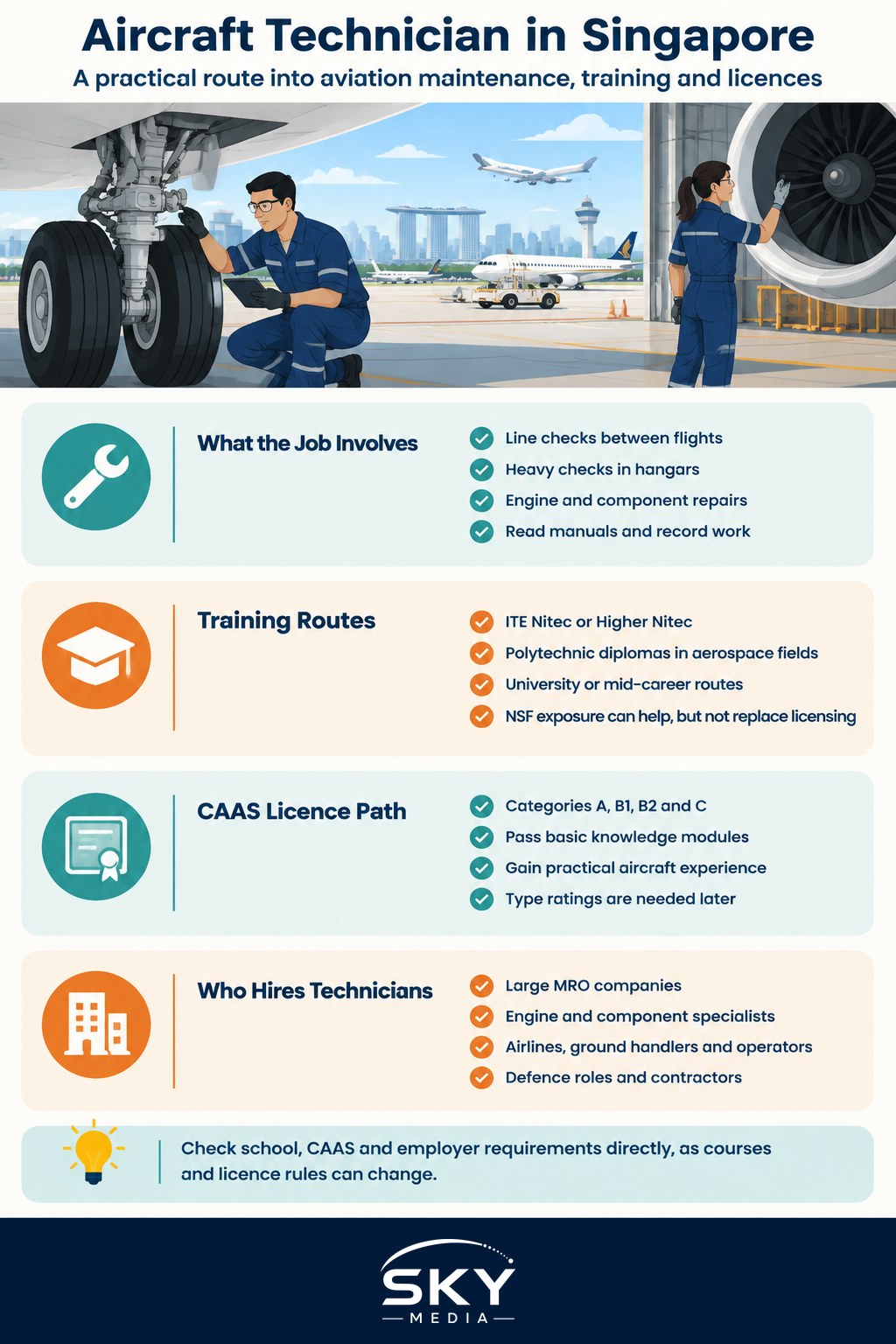
What Aircraft Maintenance Technicians Actually Do
Aircraft maintenance work splits broadly into two settings.
- Line maintenance happens at the airport between flights. Technicians do walkaround checks, fix faults reported by pilots, top up fluids and certify that the aircraft is fit to fly. The pace is quick because the plane has a departure time.
- Base or heavy maintenance happens in hangars. Aircraft come in for scheduled checks that can last days or weeks, with panels removed, structures inspected and parts overhauled.
There are also component and engine shops, where specialists repair landing gear, avionics units or engine modules away from the aircraft. The industry calls all of this MRO, short for maintenance, repair and overhaul.
The work involves reading technical manuals closely, following procedures exactly and recording everything. Precision and honesty matter more than speed, because a missed step has serious consequences.
Training Routes: ITE, Polytechnic and Beyond
There are three common entry points.
ITE. The Institute of Technical Education offers Nitec and Higher Nitec courses in aerospace technology and avionics. These are hands-on, include workshop practice on real aircraft systems, and can lead to entry-level technician roles or progression to a polytechnic diploma.
Polytechnic. Several polytechnics run diplomas in aeronautical engineering, aerospace engineering, aerospace electronics or aviation-related fields. Some courses are designed with modules that align with the basic knowledge needed for an aircraft maintenance licence, which can shorten your path later. Compare course outlines carefully, since some diplomas lean towards design and management rather than hands-on maintenance.
Degree and mid-career routes. University engineering degrees suit people aiming for engineering or planning roles rather than licensed technician work. For career switchers, Workforce Singapore, now part of the Skills and Workforce Development Agency (SWDA, formed in 2026 with SkillsFuture Singapore), has run career conversion programmes for the aerospace sector, and SkillsFuture credit may help with relevant short courses. Check the SWDA and SkillsFuture websites for what is currently offered.
National Service can also be relevant. Some full-time NSFs serve in air force engineering vocations, which gives early exposure to aircraft systems, although it does not replace civil licensing.
Understanding CAAS Licences: A, B1, B2 and C
In civil aviation, only licensed engineers can certify that maintenance work is complete and the aircraft is airworthy. In Singapore, CAAS issues the Aircraft Maintenance Licence under its Singapore Airworthiness Requirements, commonly referred to as SAR-66. Training for it is delivered through approved maintenance training organisations.
The main categories are as follows.
| Licence category | Main focus | Typical role |
|---|---|---|
| A | Simple, routine line tasks | Certifying minor scheduled maintenance and simple defect fixes |
| B1 | Mechanical: airframe, engines, structures and electrical systems | Certifying engineer for mechanical work on the aircraft |
| B2 | Avionics: electrical, instruments, navigation and communication systems | Certifying engineer for avionics and electrical work |
| C | Base maintenance oversight | Certifying release of an aircraft after a heavy check |
To earn a licence, you generally need to pass the required basic knowledge modules, build up a period of practical experience on aircraft, and later obtain type ratings for specific aircraft models. Experience requirements depend on your prior training. Check the current requirements on the CAAS website, since they are detailed and periodically updated.
Many new technicians start as unlicensed mechanics or trainees, working under supervision while they study for their modules. Employers often sponsor or support this, so ask about licence support at interviews.
Who Hires Aircraft Technicians in Singapore
Singapore is one of the region’s major MRO hubs, with activity centred around Changi Airport and the Seletar Aerospace Park. Employers fall into a few groups.
- Large MRO companies that service many airlines’ aircraft, such as SIA Engineering Company and the aerospace arm of ST Engineering.
- Engine and component specialists, including original equipment manufacturers and their joint ventures, which overhaul engines, landing gear and avionics.
- Airlines and ground handlers with their own line maintenance teams.
- Business and general aviation operators at Seletar, which service private jets and smaller aircraft.
- Defence roles with the Republic of Singapore Air Force or defence contractors.
Job portals, school career fairs and company career pages are the best places to look. Internships during ITE or poly are especially valuable, because they often turn into job offers.
Shift Work, Pay Expectations and Career Progression
Aircraft do not stop flying at night, so many technicians work rotating shifts, including weekends and public holidays. Hangar work can be hot and physically demanding, with climbing, lifting and working at height. Line maintenance means working outdoors on the apron in sun and rain.
Pay varies by employer, qualification and licence status. Rather than relying on numbers passed around online, check MOM’s occupational wage data and compare actual job offers. What is generally true is that gaining a licence and type ratings tends to move you into more responsible certifying roles.
A common progression looks like this:
- Trainee or mechanic working under supervision.
- Licensed technician or certifying engineer after passing modules and gaining experience.
- Senior engineer, team lead or specialist in a particular aircraft type or system.
- Moves into planning, quality assurance, technical services, training or management.
If you are comparing technical careers, our guides to becoming a rail technician or MRT train captain and a laboratory technician show how other licensed or certified trades work in Singapore.
Is This Career a Good Fit for You?
Ask yourself a few honest questions before committing to a course.
- Do you enjoy taking things apart and understanding how they work?
- Are you comfortable following detailed procedures exactly, even when it feels slow?
- Can you handle shift work and physically active days?
- Are you willing to keep studying for years to earn licences and ratings?
- Do you have normal colour vision and reasonable fitness? Some roles have medical requirements, so check with employers.
If most answers are yes, visit school open houses, talk to current students and, if possible, speak to a working technician. Seeing a hangar in person tells you more than any brochure.
Explore more: How to Become a Pharmacy Technician in Singapore