

Every time a patient collects medicine at a hospital, polyclinic or retail pharmacy, a team works behind the counter to make it happen. Pharmacists lead that team, but much of the day-to-day work of preparing, packing, checking stock and serving patients is done by pharmacy technicians. If you like healthcare, enjoy precise work and want a role you can enter without a full university degree, you may want to become a pharmacy technician in Singapore.
This guide explains what the job involves, the main education routes, the different workplaces, what to expect on pay, and how the role can lead to further career growth. Course names and entry requirements change over time, so always check the latest details with the polytechnics, ITE and employers.
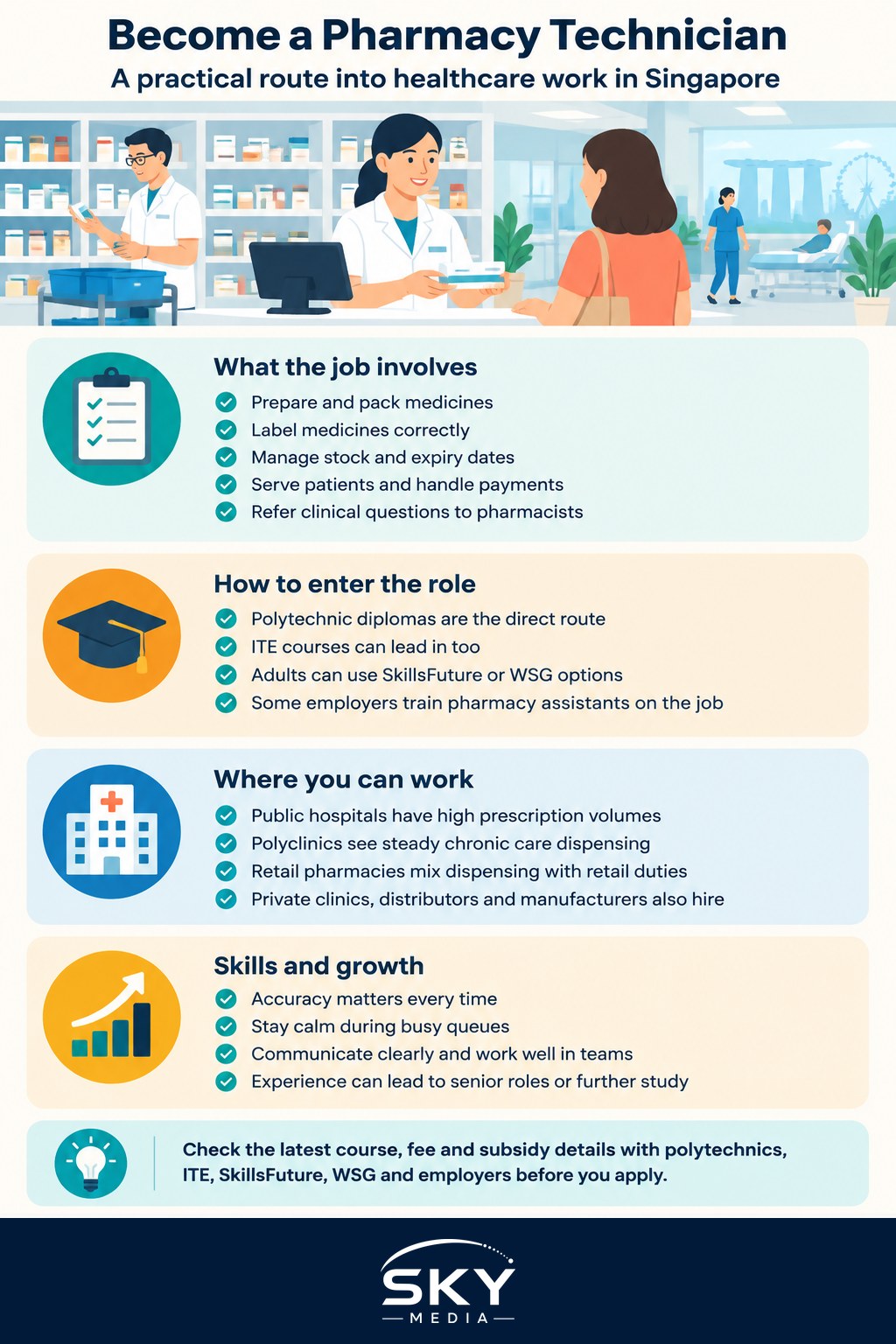
What a Pharmacy Technician Does
A pharmacy technician supports pharmacists in delivering medicines safely. The exact tasks depend on the workplace and the employer’s policies, but common duties include:
- Preparing and packing medicines according to prescriptions, under the supervision of a pharmacist.
- Labelling medicines with the correct instructions.
- Managing inventory, including ordering, receiving stock, checking expiry dates and storing items correctly, such as medicines that need refrigeration.
- Serving patients at the counter, handling payments and answering general queries, while referring clinical questions to the pharmacist.
- Supporting compounding or specialised preparation in some hospital settings, following strict procedures.
- Using pharmacy systems to record dispensing and stock movements accurately.
Pharmacy technicians do not replace pharmacists. In Singapore, pharmacists are registered with the Singapore Pharmacy Council and are responsible for clinical decisions and for checking dispensed medicines. Technicians work within the scope set by their employer and supervising pharmacist. If you want to understand the pharmacist route instead, see our guide to exploring a career in pharmacy.
Education Routes Into the Role
There is more than one way in. The most common route is a polytechnic diploma, but ITE graduates, career switchers and mature workers also find paths into pharmacy support work.
- Polytechnic diploma. Several polytechnics offer diplomas in pharmaceutical science or closely related fields. These courses typically cover pharmacology basics, pharmaceutics, dispensing practice, pharmacy law and ethics, and include an internship. They are the most direct preparation for hospital and community pharmacy technician roles.
- ITE pathway. ITE offers healthcare and applied science courses. Some graduates enter pharmacy support roles directly, while others progress to a polytechnic diploma through the usual progression routes. Check ITE’s current course list for programmes relevant to pharmacy.
- Continuing education and SkillsFuture. Adults switching careers can look at part-time courses, certificates and career conversion programmes listed on the SkillsFuture portal and by the Skills and Workforce Development Agency (SWDA, formed in 2026 from Workforce Singapore and SkillsFuture Singapore). Availability varies over time.
- On-the-job training. Some retail pharmacies and healthcare employers hire pharmacy assistants and provide structured in-house training, with opportunities to progress to technician roles.
| Route | Typical entry point | Time to job-ready | Best suited to |
|---|---|---|---|
| Polytechnic diploma in pharmaceutical science | After O-Levels, or via ITE progression | Usually a full-time diploma programme | School leavers aiming for hospital or polyclinic roles |
| ITE course then progression | After secondary school | Longer, but builds a strong foundation | Students who prefer hands-on learning first |
| Career conversion or part-time course | Adults with work experience | Varies by programme | Mid-career switchers |
| In-house training as pharmacy assistant | Direct hire by employer | Learn while earning | People who want to start working quickly |
Check entry requirements, course fees and subsidies directly with each institution, as these are set by the school and can change.
Where Pharmacy Technicians Work
The work environment shapes your daily routine as much as the job title does.
- Public hospitals. Inpatient and outpatient pharmacies handle a high volume of prescriptions and a wide range of medicines. Some roles involve ward supply, specialised preparation or medication delivery to wards. Shift work may be required.
- Polyclinics. Pharmacies here serve many patients with chronic conditions, so dispensing is steady and patient interaction is frequent.
- Retail and community pharmacies. Pharmacies inside supermarkets, malls and neighbourhoods combine dispensing with retail duties such as stock display and customer service. Opening hours can include evenings and weekends.
- Private clinics and specialist centres. Smaller teams, sometimes with broader responsibilities.
- Pharmaceutical distributors and manufacturers. Some technicians move into warehouse, quality or logistics roles that use their knowledge of medicines.
Patients from different backgrounds use these pharmacies, so language skills help. Our article on going to a pharmacy in Singapore gives a sense of the service from the patient’s side.
Pay and Working Conditions
Pay for pharmacy technicians depends on qualifications, experience, employer type and shift arrangements. Rather than relying on figures quoted online, use reliable sources:
- Polytechnic graduate employment surveys show the typical starting salaries of recent diploma graduates by course.
- MOM’s occupational wage data gives salary ranges by occupation.
- Job listings on MyCareersFuture and employer career pages often state salary ranges for specific roles.
Public healthcare employers usually have structured pay scales, allowances for shift work and defined career tracks. Retail roles may offer sales incentives but also involve longer opening hours. Ask about leave, shift patterns, training support and progression when comparing offers.
The work is detail-heavy. You will spend long periods on your feet, handle repetitive tasks that require full concentration, and follow strict procedures because errors can harm patients. In return, many technicians find real satisfaction in being part of patient care.
Skills That Help You Succeed
Qualifications get you in the door, but certain habits make you good at the job.
- Accuracy. Checking names, strengths and quantities carefully every time.
- Calm under pressure. Busy queues and urgent requests are common.
- Clear communication. Explaining collection procedures simply and knowing when to refer to a pharmacist.
- Teamwork. Pharmacies run on close coordination between technicians, assistants and pharmacists.
- Comfort with systems. Most pharmacies rely on electronic records and inventory tools.
- Ethics and confidentiality. Patient information must be handled with care.
If you enjoy precise technical work in other settings, you may also like our guide to becoming a laboratory technician.
Career Progression and Next Steps
Becoming a pharmacy technician can be a long-term career or a stepping stone.
- Senior or specialised technician roles. With experience, technicians can take on supervisory duties, training of new staff, or specialised areas such as inventory management or sterile preparation.
- Further study. Some technicians pursue a pharmacy degree to become pharmacists. Check university admission requirements, as these are set by each university.
- Related fields. Experience in pharmacy can lead to roles in pharmaceutical sales support, regulatory affairs support, quality assurance or healthcare administration.
To get started:
- Research polytechnic and ITE courses and attend their open houses.
- Look for part-time or holiday work in a retail pharmacy to see the job up close.
- Speak to current technicians or pharmacists about their daily work.
- Check job listings to understand what employers ask for.
- Consider SkillsFuture or SWDA programmes if you are switching careers.
If you want a stable healthcare career with a clear route in, steady demand and room to grow, the path to become a pharmacy technician in Singapore is practical and well within reach. Start by choosing the education route that fits your stage of life, and build hands-on experience early.
Further reading: How to Become an Aircraft Maintenance Technician in Singapore