

Ever watched a local drama and noticed the people walking past the hawker stall, sitting in the hospital waiting room or cheering at a concert scene? Those are extras, also called background actors, and many of them are ordinary young adults doing it for fun, a bit of side income and a peek behind the camera. If you are curious about becoming a film extra in Singapore, this guide explains how casting actually works, what the pay tends to look like, how to avoid the scams that target hopefuls, and what you will really be doing on a shoot day.
What Extras Actually Do on Set
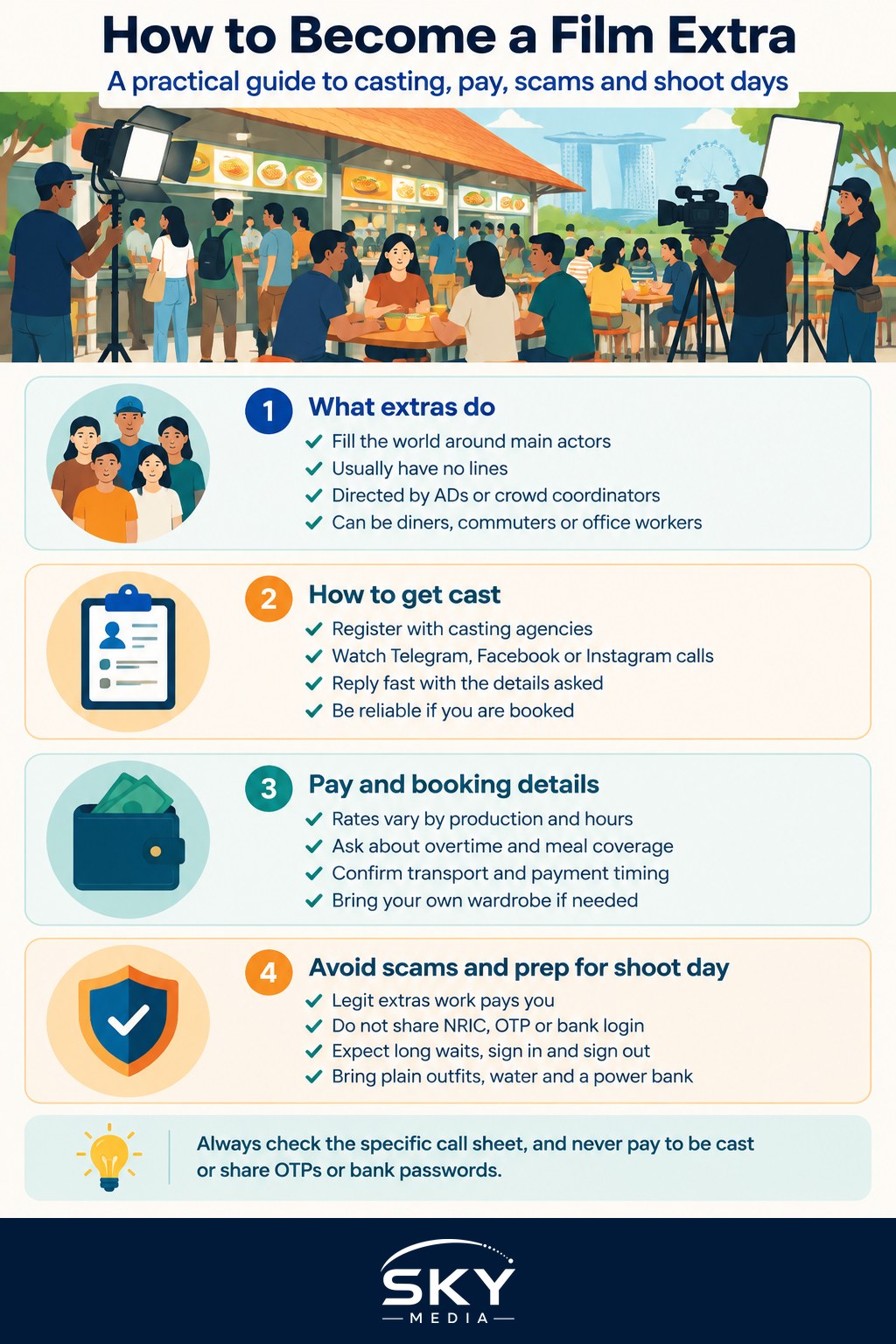
An extra fills the world around the main actors. You might be a diner, a commuter, a student in a classroom, an office worker or part of a crowd. You usually do not have lines, and you are directed as a group by an assistant director (AD) or a crowd coordinator rather than by the director personally.
There are a few loose tiers you will hear about:
- General extras or background: walk, sit, react silently, fill space.
- Featured extras: someone placed close to the camera or given a specific action, such as handing a drink to a main character.
- Stand-ins: people of similar height and colouring to a lead actor who stand in position while lighting and camera are set up.
- Bit parts or “one-liners”: a short spoken line. This moves you closer to actual acting and is usually booked differently.
Productions that use extras include local TV dramas, web series, commercials, music videos and the occasional international film shooting on location.
How Casting Agencies and Casting Calls Work
Most extras work flows through casting agencies or crowd coordinators. A production tells the agency what it needs, for example “20 people in their twenties, smart casual, available Tuesday 6am to 6pm in the west”, and the agency sends the call to people on its roster.
Typical ways to get on a roster:
- Register with established casting or talent agencies. Most have an online form asking for your age, height, languages, and a couple of recent, natural photos (one face, one full body, no heavy filters).
- Follow casting call channels. Many coordinators post calls in Telegram channels, Facebook groups or Instagram. Calls usually list the date, call time, location area, look required and pay.
- Respond quickly and clearly. Calls fill fast. Reply with exactly what is asked, usually name, age, height, photos and confirmation of availability.
- Be reliable once booked. Coordinators remember who turns up on time and who cancels last minute. Reliability is the single biggest factor in getting called again.
Useful things to mention on your profile: languages and dialects you speak, special skills (driving licence, sports, dance, instruments) and visible tattoos or dyed hair.
If you are not a Singapore citizen or PR, check that your pass allows this kind of paid work before accepting any booking. Work pass rules are set by the Ministry of Manpower (MOM), so confirm on its website rather than relying on what an agency says.
Pay, Hours and What Is Normally Covered
Extras pay in Singapore varies widely with the production, the hours and whether you are featured. Most calls state either a flat day rate or an hourly rate, and some add overtime after a set number of hours. Because rates change and differ between agencies, do not rely on figures you see in old forum posts. Read the specific call and ask if anything is unclear.
Things to confirm before you accept:
- Rate and basis: flat fee for the day, per hour, or per scene.
- Overtime: whether it applies and after how many hours.
- Meals: many shoots provide a meal or meal allowance on long days, but not all.
- Transport: early call times sometimes come before public transport starts, so ask whether there is a pickup point or transport claim.
- Payment timing: some agencies pay within weeks, others much longer. Know when and how (PayNow, bank transfer) you will be paid.
- Wardrobe: whether you need to bring your own clothes and how many changes.
Treat it as an occasional side gig. For steadier options, our guide to earning extra income on the side in Singapore covers other routes.
Spotting Casting Scams Before You Pay or Share Anything
Aspiring extras and models are a common scam target. The most reliable rule is simple: legitimate extras work pays you, you do not pay it.
| Red flag | What a genuine call usually looks like |
|---|---|
| Asks for a “registration fee”, “portfolio shoot” or “acting course” before any booking | Registration is free; you only provide your own simple photos |
| Requests your NRIC number, bank login or OTP early on | Personal details needed for payment are collected after booking, through a clear process |
| Pay that seems far too high for background work | Rates in line with other calls you have seen for similar hours |
| Vague production details, no company name, only a personal chat account | Named agency or production, a location area and a call sheet before the day |
| Pressure to decide immediately or “slots are almost gone, pay now” | Time to ask questions; no money changes hands |
| Asks for revealing photos or a private “audition” at a home or hotel room | Auditions, if any, are at offices or studios, and extras rarely audition at all |
If something feels wrong, stop replying. You can check the ScamShield app or the official ScamAlert resources from the Singapore Police Force and National Crime Prevention Council, and report suspected scams through official channels. Never send OTPs or bank passwords to anyone.
What a Real Shoot Day Is Like
Expect long days. A typical flow:
- The night before: you receive a call sheet or message with the call time, meeting point, wardrobe notes and a coordinator’s contact.
- Arrival: call times can be very early. You sign in, sometimes show ID, and wait in a holding area.
- Wardrobe check: the wardrobe team looks at your outfits and may pick one, or hand you a uniform.
- Waiting: this is most of the day. Lighting and camera setups take time, and you might wait hours between scenes.
- On set: the AD places you, gives you an action (“walk from the lift to the counter on action”), and you repeat it for multiple takes and angles.
- Wrap and sign out: sign out so your hours are recorded correctly. Keep your own note of times in case of a dispute.
What to bring:
- Two or three outfit options in plain colours. Avoid logos, bright white, fine stripes and busy prints, which can be a problem on camera.
- A charged phone and power bank, but keep it on silent and out of sight on set.
- Water, snacks, a light jacket for cold indoor sets, and an umbrella or sun protection for outdoor shoots.
On-set etiquette that gets you rebooked:
- Do not look at the camera unless asked.
- Do not take photos or post anything from set. Many productions have strict confidentiality rules.
- Stay in the holding area so the AD can find you.
- Repeat your action exactly the same way each take, which helps with continuity.
Is It Worth It, and Can It Lead Anywhere?
Extras work is a good fit if you have flexible days, enjoy people-watching and want to see how local TV and film get made. It is not usually a stepping stone to lead roles on its own. People who want to act seriously tend to also take acting classes, join community theatre and build a proper showreel.
Still, reliable extras sometimes get upgraded to featured extras or small speaking parts, and you will meet crew who can explain behind-the-scenes paths such as production assistant or wardrobe. If you enjoy local drama, see our guide to watching Chinese TV and streaming in Singapore to catch the shows you worked on.
Explore more: How to Earn Extra Income on the Side in Singapore · Understanding Prestige TV Series
Frequently Asked Questions
What kind of clothes should I wear on a film shoot as an extra? Bring two or three outfit options in plain colours. Avoid logos, bright white, fine stripes and busy prints, which can be a problem on camera. The wardrobe team may pick one outfit or hand you a uniform.
Can I post photos from set on social media? No. Many productions have strict confidentiality rules, so do not take photos or post anything from set. Following this, staying in the holding area and repeating your action the same way each take helps you get rebooked.
Can foreigners on a work pass or dependant’s pass work as film extras? Only if your pass allows this kind of paid work. Work pass rules are set by MOM, so confirm on its website before accepting any booking rather than relying on what an agency tells you.
What is the difference between an extra, a featured extra and a stand-in? General extras fill space with silent background action. Featured extras are placed near the camera or given a specific action, such as handing a drink over. Stand-ins match a lead actor’s height and colouring and stand in position while lighting is set up.
Why do I have to wait so long between scenes on a shoot day? Lighting and camera setups take time, so waiting is most of the day and you might wait hours between scenes. Bring water, snacks, a power bank kept on silent, and a light jacket for cold indoor sets.
Further reading: Singapore Film and TV Locations You Can Visit · How to Make a Short Film in Singapore: Crew, Permits and Budget · Classic Singapore TV Sitcoms Worth Watching · How to Become a Voice Actor in Singapore · Getting Your Child Into Modelling or Acting in Singapore: Agencies, Fees and Scams