
You have finished your short film, exported the final cut and shown it to friends. Now comes the part most first-time filmmakers underestimate: getting it in front of programmers. If you want to submit short film festival entries that actually have a chance, you need a plan, not just a credit card and a long list of deadlines. This guide walks young Singapore filmmakers through building a festival strategy, using submission platforms like FilmFreeway, managing fees and approaching local festivals such as the Singapore International Film Festival (SGIFF).
If you are looking for festivals to attend as an audience member, our guide to film festivals in Singapore covers that side. This article is about the other side of the screen.
Build a Festival Strategy Before You Pay a Single Fee
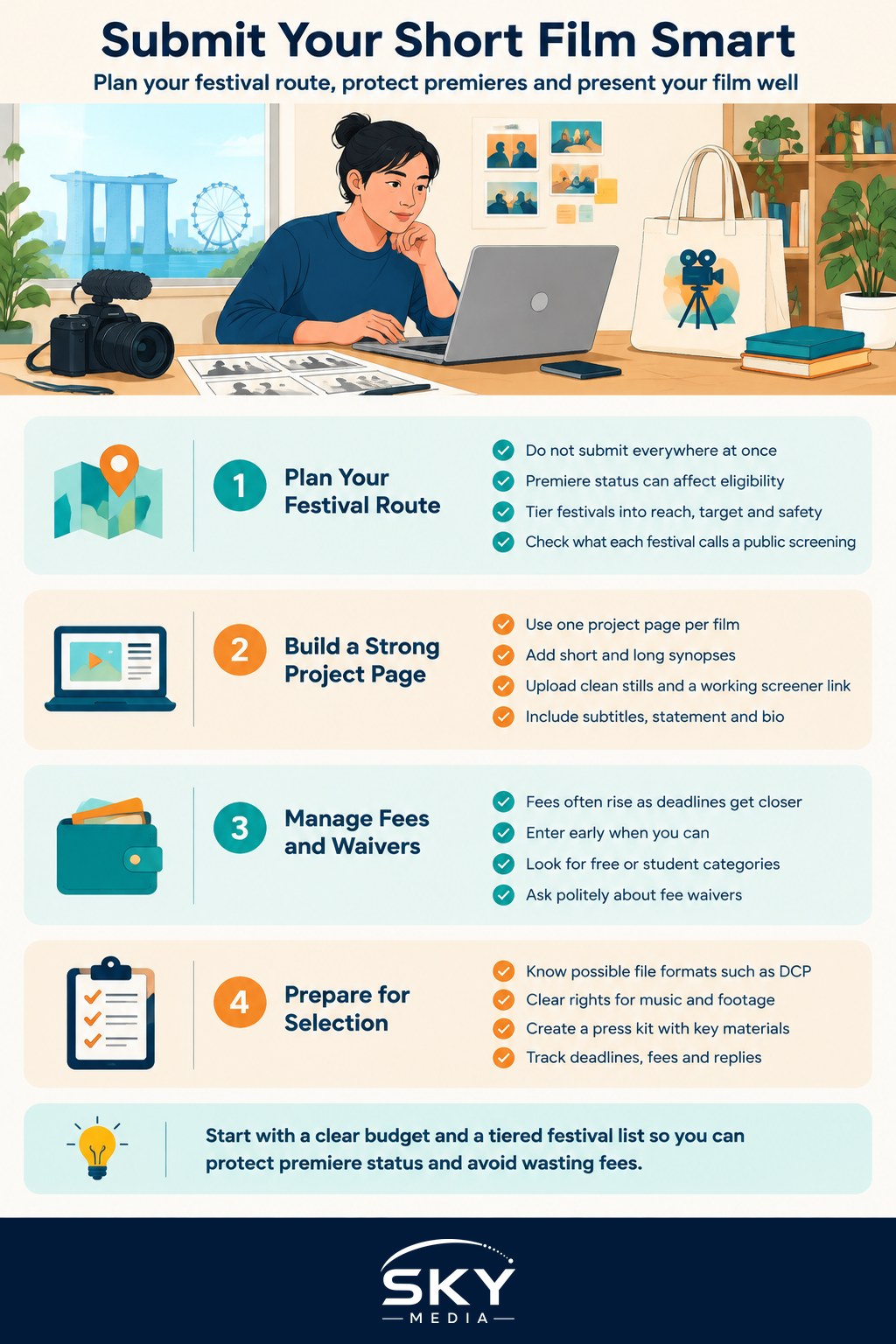
The biggest mistake new filmmakers make is submitting everywhere at once. Festival programming runs on premiere status, and once your film has screened publicly, some doors close.
Understand premiere status. Many top-tier festivals want a world, international or regional premiere. A world premiere means the film has never screened publicly anywhere. An Asian or Southeast Asian premiere means it has not screened in that region. If you send your film to a small online festival first and it screens, you may lose eligibility for a larger festival that requires a premiere. Read each festival’s rules carefully, because definitions of “public screening” differ, and some count online streaming.
Tier your list. A sensible approach is to sort festivals into three groups:
- Reach festivals: the large international events and major short film festivals that demand premieres and receive thousands of entries.
- Target festivals: respected regional and genre festivals where your film fits the programming, such as Southeast Asian, student, LGBTQ+, horror or documentary-focused events.
- Safety festivals: smaller, community or niche festivals that are more likely to accept, useful for building laurels and getting audience feedback.
Submit to your reach festivals first, wait for those results, then move down the list. This protects your premiere status for as long as it matters.
Know your film’s identity. Programmers look for films that fit their festival’s voice. Watching past selections, which many festivals list on their websites, is the best way to judge fit.
How FilmFreeway and Other Submission Platforms Work
FilmFreeway is the most widely used submission platform, and many festivals worldwide accept entries through it. Some festivals use their own forms or other platforms, so always check the official festival website first.
On FilmFreeway, you create one project page for your film with a synopsis, credits, stills, poster, runtime, country of production and a private screener link. You then submit that project to individual festivals, paying each festival’s fee where one applies.
Tips for a strong project page:
- Write a short and a long synopsis. Keep the short one to two or three sentences that hook the reader without spoiling the ending.
- Upload clean stills. Choose frames that show your best cinematography and performances, not blurry or dark shots.
- Use a private, password-protected screener. Make sure the link works and the password is correct. A broken link can mean your film is never watched.
- Add English subtitles if your film is in Mandarin, Malay, Tamil, Singlish-heavy dialogue or any other language. Most international festivals require them, and clear, well-timed subtitles matter.
- Fill in the director’s statement and bio. Programmers often read these to understand intent and context.
Submission Fees, Waivers and Budgeting
Fees vary widely by festival and often rise as deadlines approach. Most festivals have several deadlines, commonly called early, regular and late, with the earliest usually being the cheapest. Some festivals are free to enter, especially certain regional, student or government-supported events. Fees, deadlines and categories change each year, so always confirm them on the festival’s own page.
Ways to keep costs under control:
- Set a total budget first, then decide how many festivals it covers.
- Enter early. Planning around early deadlines can stretch your budget much further.
- Look for free or student categories. Many festivals offer them.
- Ask politely about fee waivers. Some festivals offer waivers for students, filmmakers from certain regions or films with a clear fit. Not all do, and they are not obliged to say yes.
- Avoid festivals that look like money-makers. Warning signs include no physical or clearly organised screening event, endless award categories, laurels for almost everyone and little information about past programmers or screenings.
| Festival type | What it usually asks for | Best for |
|---|---|---|
| Major international short film festivals | Premiere status, higher fees, strict technical specs | Polished films with strong festival potential |
| Regional and Southeast Asian festivals | Regional premiere or none, subtitles, moderate fees | Films with a Singapore or regional story |
| Student and youth festivals | Proof of student status, often low or no fees | First films and school or polytechnic projects |
| Genre and niche festivals | Fit with the theme, flexible premiere rules | Horror, animation, LGBTQ+, documentary and experimental work |
| Small online or community festivals | Few requirements, low fees | Feedback, laurels and screening experience, after premieres matter less |
Singapore Festivals to Know About
Starting locally makes sense: local programmers understand your context, and your cast and crew get to see the film on a big screen.
Singapore International Film Festival (SGIFF). SGIFF is the country’s best-known film festival and has long run a short film competition focused on Southeast Asian work. Eligibility rules, such as nationality, runtime, completion date and premiere requirements, are set each edition, so read the current call for entries on the official SGIFF website before submitting.
Student and school showcases. Polytechnics, arts institutions and universities often run their own showcases, and some festivals have youth or student sections. These can be good first steps that do not affect your eligibility elsewhere, but check whether a public showcase counts as a premiere.
Community and independent screenings. Independent cinemas, arts centres and film collectives in Singapore sometimes hold open calls or curated short film nights. Following local film communities on social media is the easiest way to hear about them.
Funding and support. Government and arts bodies, such as the Infocomm Media Development Authority (IMDA) and the National Arts Council, have offered support for local filmmakers in various forms over the years. Schemes change, so check their official websites for what is currently available.
Note that films screened publicly in Singapore generally need classification under IMDA’s rules. Festivals usually handle this process, but you may be asked for materials, so respond promptly if contacted.
Preparing Your Film and Following Up
Getting selected is only half the job. Be ready before the acceptance email arrives.
- Prepare screening formats. Festivals may ask for a DCP (Digital Cinema Package), a high-quality ProRes or H.264 file, or other formats. Know who can create a DCP for you in advance.
- Clear your music and footage. Festivals may ask you to confirm you hold the rights to all music, archive footage and artwork. Unlicensed tracks can get a selection withdrawn.
- Create a press kit. Include the poster, stills, synopsis, director’s bio, cast and crew list and contact details.
- Track everything in a spreadsheet. Log each festival, deadline, fee paid, premiere requirement and notification date.
- Handle rejection calmly. Rejections are normal, even for excellent films. Move to the next festival on your list.
- Use laurels properly. Once selected, add the official laurels to your poster and project page, and attend screenings and Q&A sessions where you can.
If you are still developing your skills, writing short fiction can sharpen your storytelling, and our guide on writing your first short story is a good starting point. Making short-form content for social platforms is another way to practise pacing and editing, covered in how to make reels and short videos.
Festival success takes patience, research and a clear plan. Protect your premiere, budget sensibly, write a strong project page and target festivals that fit your film, and your short will have its best chance of reaching an audience.
Explore more: Film Festivals in Singapore
Frequently Asked Questions
How many festivals should I submit my short film to? There is no fixed number, and more is not better. Set a budget first, then pick festivals where your film fits the programming. A focused list of reach, target and safety festivals beats a scattergun approach, which wastes fees and can burn your premiere status.
Can I put my short film on YouTube before submitting to festivals? It is best to wait. Many festivals count public online streaming as a screening, so posting a film publicly can cost you eligibility, especially for premiere-based festivals. If you want feedback, use a private link and read each festival’s rules first.
How long does a short film have to be to count as a short? Runtime limits differ by festival, so there is no single answer. Many festivals set their own maximum length for short film categories, and some programme very short films separately. Check the rules on each festival’s page before you pay the fee.
How long does it take to hear back after submitting? It depends on the festival, but expect weeks to a few months. Larger festivals tend to announce selections well after the final deadline. Check the notification date on the festival’s page and log it in your tracking spreadsheet instead of chasing programmers.
Do I need a distributor or sales agent to enter film festivals? No, most filmmakers submit directly through platforms like FilmFreeway or a festival’s own form. A distributor or agent is something to think about later, if a film gets traction. Focus first on a strong project page, clear subtitles and a smart festival list.
Further reading: How to Make a Short Film in Singapore: Crew, Permits and Budget · Best Places to Watch Student Films in Singapore · How to Become a Film and TV Extra in Singapore