

Many students who want to become a lawyer in Singapore know roughly that it involves a law degree and “the Bar”, but the actual route has several distinct stages, each with its own rules. Whether you study locally or overseas changes which exams you sit, and the training that follows is a formal requirement, not just a first job.
This guide walks through the pathway in order: choosing a law degree, the Part A and Part B components of the Singapore Bar Examinations, the practice training period and admission as an advocate and solicitor. It is general information for students and parents, not legal advice. Requirements are set under the Legal Profession Act and its rules, and administered by the Singapore Institute of Legal Education (SILE), so always check SILE’s website and the universities’ admissions pages for the current position.
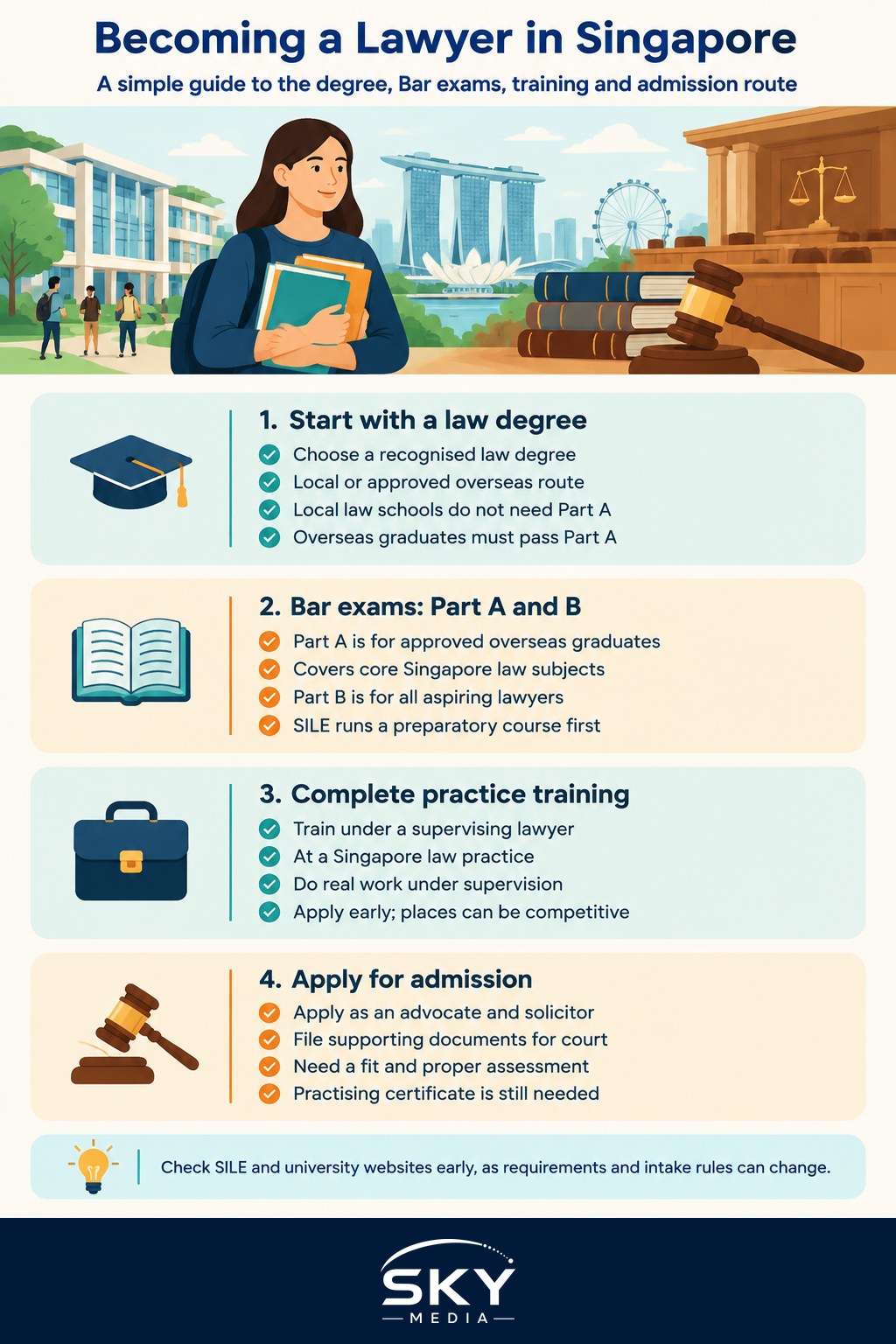
Step One: Choosing a Law Degree
To practise as a Singapore lawyer, you generally need to become a “qualified person” under the Legal Profession Act. That starts with a recognised law degree. Broadly, there are two routes.
Local law degrees. Singapore has three law schools: the National University of Singapore (NUS) Faculty of Law, the Singapore Management University (SMU) Yong Pung How School of Law, and the Singapore University of Social Sciences (SUSS) School of Law, which focuses on areas such as criminal and family law and has its own admissions profile. Graduates of recognised local law degrees do not need to sit Part A of the Bar exams.
Overseas law degrees. Graduates from certain approved overseas universities, for example in the United Kingdom and Australia, can also qualify. The list of approved universities, together with minimum requirements such as degree classification, is set out in the rules and published by SILE. If you study overseas, you will need to pass Part A of the Singapore Bar Examinations before moving on.
Before committing to an overseas course, check three things on SILE’s website: that your university is on the approved list, that the degree meets the requirements, and whether any rules have changed for your intake year. The list has been revised before, and assumptions based on an older cousin’s experience can be out of date.
Local places are competitive. Admissions typically consider A-Level, diploma or IB results, along with written tests and interviews, depending on the school. Polytechnic graduates and mature applicants can also apply, so check each university’s criteria. Our guide on Choosing Between a Diploma and a Degree may help if you are deciding between routes after secondary school.
Local vs Overseas: How the Paths Compare
The table below shows how the two degree routes differ in the steps that follow.
| Stage | Local law graduate | Approved overseas law graduate |
|---|---|---|
| Degree | NUS, SMU or SUSS law degree | Law degree from an approved overseas university meeting SILE’s requirements |
| Part A of Bar exams | Not required | Required, covering core Singapore law subjects |
| Part B of Bar exams | Required | Required, after passing Part A |
| Practice training period | Required with a Singapore law practice | Required with a Singapore law practice |
| Admission to the Bar | Petition to the Supreme Court | Petition to the Supreme Court |
Overseas study can suit students who want a particular university experience or did not secure a local place, but it adds an exam stage, usually costs more and may involve adjusting to Singapore law later. Talk to SILE, the universities and practising lawyers before deciding.
The Singapore Bar Examinations: Part A and Part B
Part A is for graduates of approved overseas universities. It tests areas of Singapore law that overseas degrees do not cover in local detail, such as Singapore’s constitutional and criminal law, evidence and other core subjects. SILE sets the subjects, format and dates and publishes them on its website. Passing Part A brings an overseas graduate to the same starting line as a local graduate.
Part B is taken by all aspiring lawyers, local and overseas. It is preceded by a preparatory course run by SILE and focuses on practical skills and the law relevant to practice, such as civil and criminal procedure, professional ethics and practice-oriented subjects. The structure of Part B has been reviewed in recent years, so read SILE’s current description rather than relying on older forum posts.
A few practical tips:
- Plan your finances, since course and exam fees apply. SILE publishes current fees.
- Note registration deadlines early. Missing one can push your timeline back.
- Treat ethics and professional responsibility seriously. They are central to being an advocate and solicitor, not a side topic.
Practice Training: Your First Real Legal Work
Alongside or after the Bar exams, you must complete a practice training period under a supervising lawyer at a Singapore law practice. Many students call this the “training contract”, a term inherited from the UK system. During this period you work on real matters, attend hearings, draft documents and learn how a firm runs, under supervision.
The required length and conditions of the practice training period are set by SILE’s rules and have been changed in the past, so check the current requirement for your cohort. Training places are offered by law firms, and some legal departments and other organisations that meet the criteria. Competition for places can be strong, so many students apply during their degree, often after internships.
To improve your chances:
- Do internships early. Law firms, the courts, the Legal Aid Bureau and community legal clinics all offer exposure.
- Build writing and research skills. Moots, law reviews and pro bono projects show you can apply the law.
- Be clear on what interests you. Litigation, corporate, family, criminal, intellectual property and in-house work are very different day to day.
Admission as an Advocate and Solicitor
Once you have your degree, passed the required Bar exams and completed practice training, you can apply to be admitted as an advocate and solicitor of the Supreme Court of Singapore. You file an admission application with supporting documents, and it is heard in court. Admission ceremonies, often called the “Mass Call”, mark this milestone.
Admission is not automatic. You must also meet requirements such as being a fit and proper person, and the qualified person route is generally linked to citizenship or permanent residence; foreign lawyers have separate regimes. After admission, you need a practising certificate, renewed regularly, to actually practise, along with continuing professional development requirements. The Law Society of Singapore and the Supreme Court publish the details.
Is a Law Career Right for You?
Law rewards careful reading, clear writing, patience with detail and the ability to stay calm under pressure. Hours can be long, especially early on, and the work is often less dramatic than television suggests. Many law graduates go on to careers outside private practice, such as the Legal Service, compliance, policy, in-house roles or academia, so the degree has value beyond the Bar.
If you are still exploring, it helps to understand how laws are made in the first place; How a Bill Becomes Law in Singapore is a good primer. Adults thinking of switching careers can look at Adult Education and Part-Time Degrees in Singapore for flexible study options, though law degrees have their own specific entry routes.
The path to become a lawyer in Singapore is long, but it is clearly structured. Start by checking SILE’s website for the latest rules on degrees, Bar exams and practice training, then speak to university admissions teams and practising lawyers to plan your own route.
Frequently Asked Questions
How many years does it take to become a lawyer from the start of a law degree? It takes several stages in a row, namely the degree, the Bar exams where required, practice training and then admission. The exact length depends on your degree route and the training requirement set by SILE for your cohort. Check SILE for current timelines.
Can I become a lawyer in Singapore if my first degree is not in law? You would generally still need a recognised law degree first, since that is the starting point for being a qualified person. Check SILE and the law schools’ admissions pages for graduate entry options. Some routes may differ by university and intake year.
Can foreigners or PRs qualify as lawyers in Singapore? The qualified person route is generally linked to citizenship or permanent residence, and foreign lawyers have separate regimes. Rules can change, so check the Legal Profession Act framework and SILE’s pages. Overseas students planning to study should confirm eligibility before committing.
Is it better to study law locally or overseas? Local degrees skip Part A of the Bar exams and offer easier access to Singapore’s legal training, but places are competitive. Overseas degrees suit those who prefer that experience or missed a local place, at the cost of an extra exam stage. Speak to SILE and practising lawyers.
Can I work as a paralegal while waiting for a training place? Many graduates do take legal support roles while applying, and the experience can help show commitment. Check with SILE whether any such work counts towards formal training, as the rules for qualifying practice are set out separately. Treat it as useful experience, not a substitute.
Official sources: Ministry of Law
Further reading: Practising Law in Singapore With an Overseas Law Degree