

One of the bigger decisions a young person in Singapore faces is which qualification to aim for after secondary school or as an adult returning to study. The diploma vs degree question in Singapore comes up again and again, at kitchen tables, in career conversations, and during course applications. There is no single right answer, because the best choice depends on your goals, your circumstances, and the path that genuinely suits you.
It helps to set aside the idea that one qualification is simply better than the other. A diploma and a degree are different tools for different purposes, and both can lead to rewarding careers and further study. What matters is understanding how each generally works, then matching it honestly to what you want. This guide lays out the main considerations so you can decide with clarity rather than pressure.
How Diplomas and Degrees Generally Differ
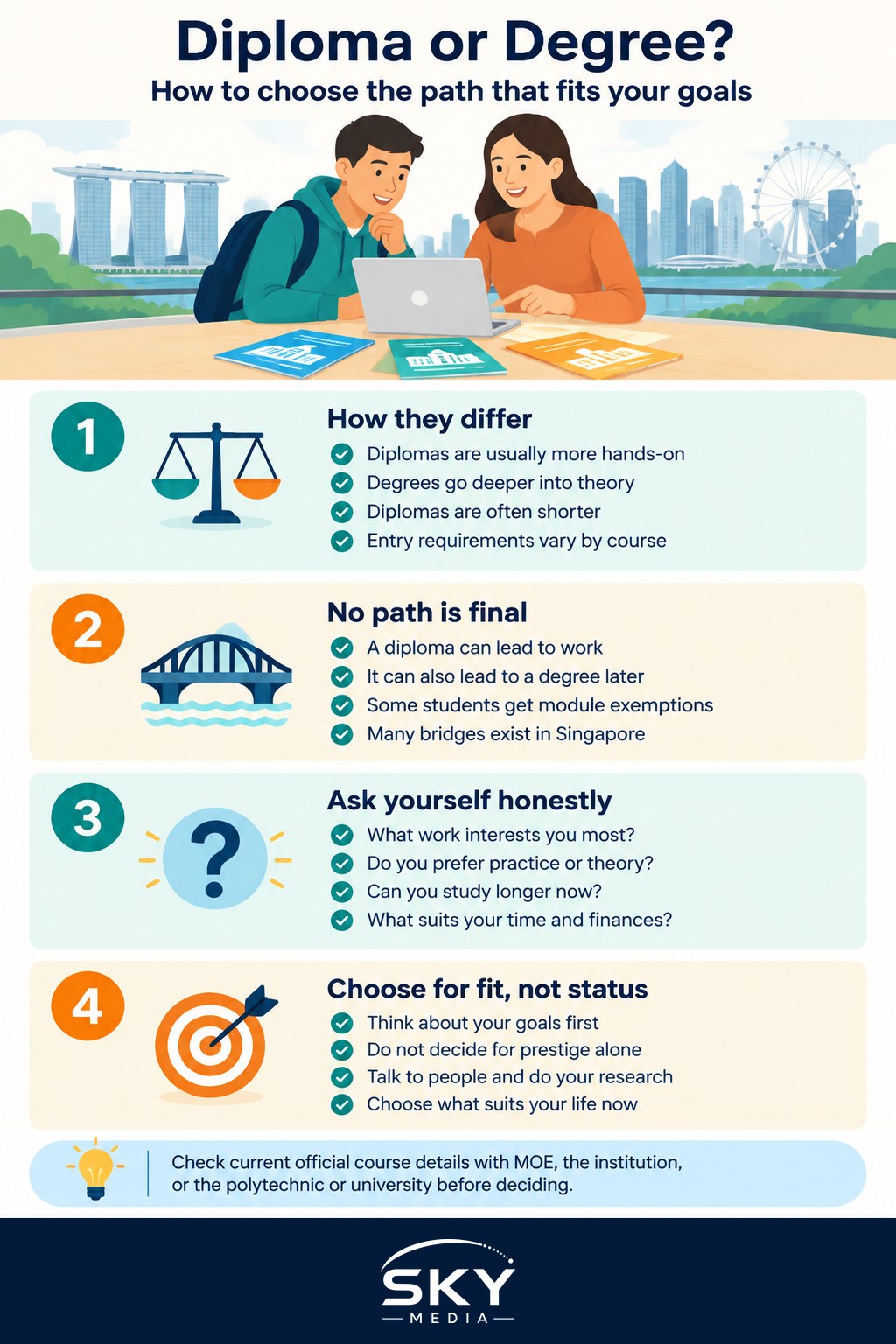
In broad terms, a diploma is often a more applied, hands-on qualification that can prepare you for a specific field of work, while a degree is usually a longer, more academic qualification that goes deeper into theory and independent study. In Singapore, diplomas are commonly associated with the polytechnics, while degrees are offered by universities, though the landscape includes many providers and pathways.
Some general differences people weigh up include:
- Duration, with diplomas typically shorter than degrees, though this varies by course and provider.
- Focus, with diplomas leaning towards practical, industry-relevant skills and degrees towards deeper theory and research.
- Progression, since a diploma can lead directly to work or serve as a stepping stone towards a degree later.
- Entry requirements, which differ between courses and institutions.
- Cost and time commitment, which naturally differ with the length and type of programme.
These are general patterns rather than fixed rules, and there is a lot of overlap and flexibility in today’s system. Because course structures, entry requirements, fees, and pathways change over time, always check current official information with MOE, the polytechnics, the universities, or the specific institution you are considering. Avoid relying on outdated figures or hearsay about which course leads where.
If you are still weighing up the institutions themselves, it is worth reading around the options, such as a guide to polytechnics in Singapore and the wider view in understanding university admission in Singapore, so you can see how each path is generally structured.
Neither path closes doors
A common worry is that choosing one route shuts off the other for good. In practice, Singapore’s education system is known for its many bridges. A diploma holder can often go on to pursue a degree, sometimes with module exemptions, and people move between applied and academic learning throughout their lives. So while the choice is important, it is rarely final. Thinking of your first qualification as a step rather than a life sentence takes some of the fear out of the decision.
Questions to Help You Decide
Rather than asking which qualification is “higher”, ask which fits you and your goals right now. Honest reflection tends to lead to better decisions than following what everyone else seems to be doing. Sit with a few questions, ideally with input from people who know you well.
- What kind of work genuinely interests you, and what qualification do those fields usually value?
- Do you learn best through hands-on, applied projects, or through deeper theory and independent study?
- Are you keen to start working sooner, or happy to study longer before entering the workforce?
- What are your circumstances around time, finances, and family, and what is realistic for you now?
- Where might this lead in five or ten years, remembering that you can build further later?
Notice that some of these are about the field you want to enter, and some are about how you like to learn and live. Both matter. A person who thrives on practical problem-solving may flourish on an applied path, while someone who loves deep theory may prefer a more academic one. There is dignity and opportunity in both.
Do your own research too. Speak to people working in the fields you are drawn to, attend open houses, and read course details carefully. If you find yourself weighing specific institutions, comparing structured paths such as in jc vs polytechnic in Singapore can help you understand how earlier choices connect to later ones. And remember that whichever route you take, ongoing learning matters, which is why building a habit of lifelong learning will serve you long after any single qualification.
Choose for your goals, not for status
It is easy to feel pressure from relatives or society to chase a particular qualification for the prestige it seems to carry. Try to resist deciding based on status alone. A qualification that leads to work you find meaningful, in a way that suits how you learn and live, will serve you far better than a more prestigious one that leaves you unhappy or in the wrong field. Your worth is not measured by a certificate, and success takes many forms.
Take your time, gather real and current information, and talk it through with people you trust. Whether you choose a diploma, a degree, or a path that combines both over the years, what matters most is that the decision fits your genuine goals and circumstances. With honest reflection and up-to-date facts, you can choose with confidence, knowing that in Singapore’s flexible system, there is almost always a way forward from wherever you begin.
Further reading: Postgraduate Diplomas in Singapore Explained Clearly · Choosing Between SIM, Kaplan, PSB and Other Private Degrees · University of the Arts Singapore: LASALLE and NAFA Degrees Explained