

If you are searching for how to become prison officer singapore, know that you would be signing up for something quite different from a guard job. The Singapore Prison Service (SPS) describes its officers as people who keep custody secure while also helping inmates change their lives, and the work reflects that mix. Officers spend their days supervising housing units, running routines, defusing tension, and having the kind of conversations that can nudge someone towards a better path after release.
This guide focuses on the SPS uniformed schemes themselves: the Personal Supervisor and Rehabilitation Officer tracks, what training looks like, and how careers progress. It is general information for young adults weighing the option. Scheme names, entry criteria and salaries can change, so always confirm the current details on the official SPS careers page before applying.
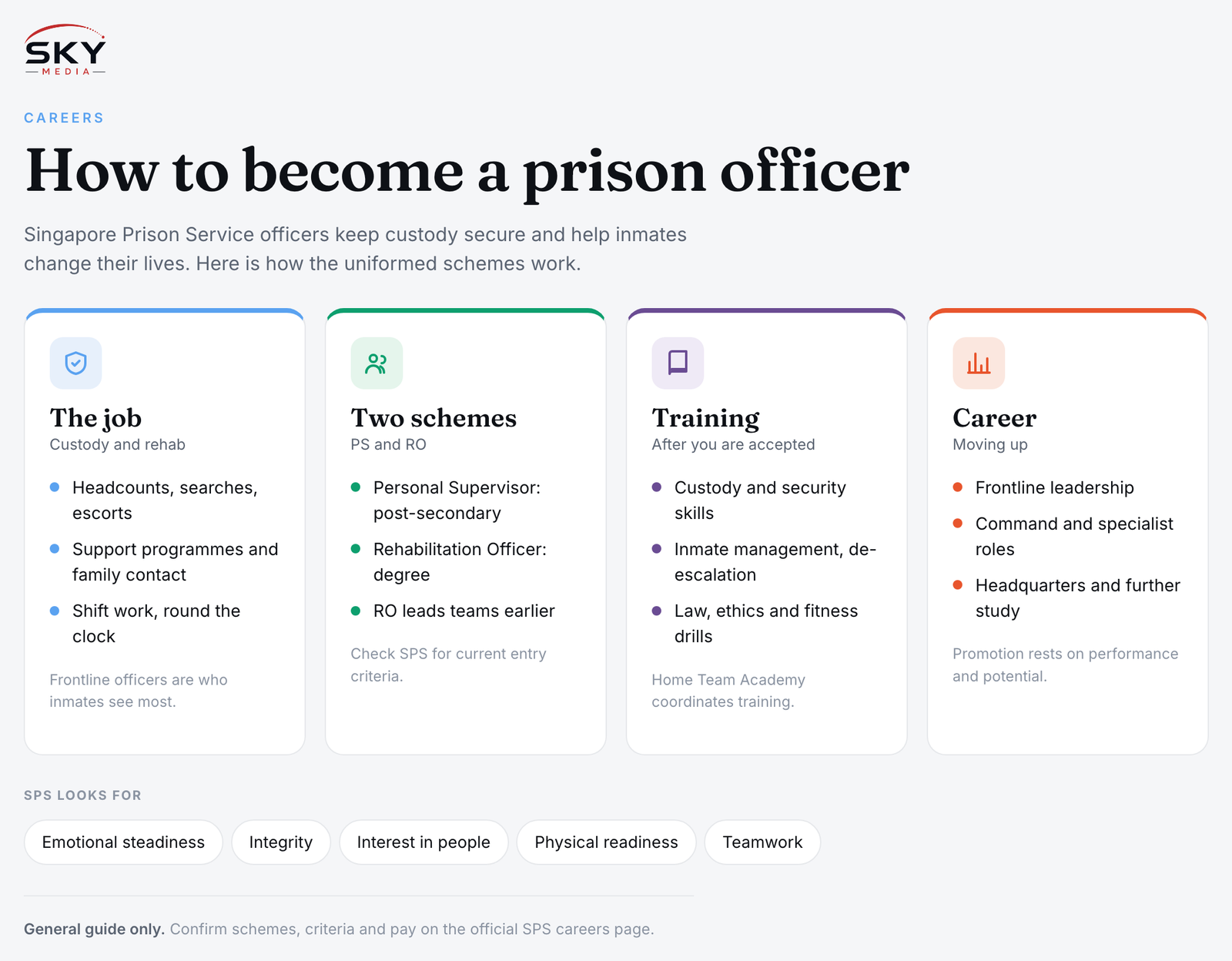
What a Prison Officer in Singapore Actually Does
SPS is a department under the Ministry of Home Affairs (MHA) and part of the wider Home Team, alongside agencies such as the police, civil defence and immigration. Its job has two halves that sit side by side.
- Secure custody. Officers keep institutions safe and orderly: headcounts, searches, escorting inmates, managing incidents, and making sure rules are followed fairly.
- Rehabilitation. Officers support inmates through programmes, education, work and family contact, so that they are better prepared to return to the community and less likely to reoffend.
In practice, frontline officers are often the people inmates see most. A good officer notices when someone is withdrawn, spots friction between inmates before it boils over, and keeps a firm but respectful tone. Shift work is normal, since institutions run around the clock, and the environment can be emotionally demanding.
The Two Main Uniformed Schemes: Personal Supervisor and Rehabilitation Officer
SPS has historically recruited frontline uniformed staff through two broad schemes. The exact titles, qualification requirements and pay bands are set by SPS and may be updated, so treat the summary below as a starting point.
Personal Supervisor
Personal Supervisors are the frontline officers who work most closely with inmates day to day. They typically look after a group of inmates in a housing unit, handle routines and security, and act as a first point of contact for problems. The “personal” part of the title is deliberate: each officer is meant to know their inmates well enough to guide and supervise them individually.
This scheme has generally been open to applicants with post-secondary qualifications, such as a diploma, Higher Nitec or A-Level certificate, but check the current SPS listing for the exact requirements.
Rehabilitation Officer
Rehabilitation Officers usually join with a university degree. They take on supervisory and leadership responsibilities earlier, overseeing teams of Personal Supervisors, coordinating rehabilitation work for groups of inmates, and handling more complex cases and operational planning.
Graduates in any discipline can find a fit here; a social science, psychology or social work background helps with the rehabilitation side, but it is not usually required.
| Aspect | Personal Supervisor | Rehabilitation Officer |
|---|---|---|
| Typical entry qualification | Post-secondary (check SPS for current list) | University degree (check SPS for current list) |
| Main focus | Direct supervision of inmates in a housing unit | Leading teams and coordinating rehabilitation work |
| Early responsibility | Daily routines, security, inmate guidance | Supervising officers, case and operational planning |
| Typical path upward | Senior frontline and specialist roles | Command, staff and headquarters appointments |
SPS also hires non-uniformed professionals, such as psychologists, counsellors and programme specialists, under separate schemes. If your heart is set on clinical work, look at those listings instead.
Who Can Apply and What SPS Looks For
Uniformed Home Team roles are generally open to Singapore Citizens, and SPS sets its own requirements on age, qualifications, medical fitness and background screening. Confirm every criterion on the official listing rather than relying on forums.
Beyond paper qualifications, SPS tends to look for:
- Emotional steadiness. You will meet people at their lowest and sometimes angriest. Staying calm matters more than being tough.
- Integrity. Officers handle sensitive information and must resist manipulation or favours.
- Interest in people. The rehabilitation side needs patience, curiosity and a belief that people can change. If you want to work on that quality, our piece on how to become more patient is a useful read.
- Physical readiness. There is a fitness element, and medical standards apply.
The process usually involves an online application, assessments, interviews and medical checks. Timelines vary by intake, so apply early if you are aiming to start after NS, polytechnic or university.
Training: What Happens After You Are Accepted
New uniformed officers go through basic training before being posted to an institution. Home Team training is coordinated through the Home Team Academy, and SPS runs its own specialised training for correctional work. The specific course names and durations are set by SPS and can change, so ask during recruitment.
Training typically covers:
- Custody and security skills. Search procedures, escort duties, incident response, use of restraint and self-defence within strict rules.
- Inmate management. How to communicate with inmates, de-escalate conflict, and build working relationships while keeping professional boundaries.
- Rehabilitation basics. How rehabilitation programmes work, how to support inmates through them, and how SPS works with community partners and aftercare agencies.
- Law, procedure and ethics. The legal framework officers work within, reporting duties and the standards of conduct expected of Home Team officers.
- Physical training and drills. Uniformed discipline, fitness and teamwork.
Once posted, new officers learn on the job under more experienced colleagues.
Career Progression and Specialisations
A prison career is not a single job for life. SPS offers routes upward and sideways, and officers with good performance can move through ranks and appointments. Promotion is generally based on performance, potential and the needs of the service.
Common directions include:
- Frontline leadership. Senior Personal Supervisors take on more responsibility within housing units and mentor newer officers.
- Command roles. Rehabilitation Officers and promoted officers can lead units, institutions or operational teams.
- Specialist work. Areas such as intelligence, operations planning, training, escort and emergency response teams, and programme management.
- Headquarters roles. Policy, planning, research, corporate communications and HR.
- Further study. SPS and the wider Home Team have supported officers in upgrading their qualifications through sponsorship schemes. Details and bond conditions vary, so check current terms.
If you join without a degree and later complete one, ask about scheme conversion. Policies on this can change, so speak to HR rather than assuming.
Is This Career a Good Fit for You?
Consider the realities honestly before you apply.
It suits you if:
- You want stable, structured work in public service with clear progression.
- You are interested in second chances and helping people rebuild.
- You can handle shift work and an environment that is sometimes tense.
- You value teamwork and a uniformed culture.
Think twice if:
- You find conflict very draining, or struggle to switch off after work.
- You prefer creative autonomy over procedure and rules.
- You want a job with no weekend or night shifts.
Talking to serving officers, attending SPS career talks or fairs, and reading SPS publications can give a truer picture than any job ad. If you are comparing uniformed careers, our guide on how to become an ICA officer covers another Home Team route, while becoming a licensed security officer is a private-sector alternative with a very different focus. For those drawn more to the legal side of the justice system, see how to become a paralegal.
Practical Next Steps
- Visit the official SPS careers page and read the current scheme descriptions and requirements.
- Check you meet citizenship, age, qualification and medical criteria.
- Prepare a clear, honest application that shows why rehabilitation work matters to you.
- Build basic fitness ahead of assessments.
- Ask about training, bond obligations, if any, and pay structure during recruitment.
Becoming a prison officer is demanding, but for the right person it offers a stable career, real responsibility early on, and the rare chance to influence someone’s future directly.
Frequently Asked Questions
Can women apply to become prison officers in Singapore? Yes, women serve as officers in the Singapore Prison Service, including in frontline roles. The eligibility details, such as citizenship, qualifications and medical standards, are set by SPS and can change. Check the current requirements on the official SPS careers page before you apply.
Do I have to complete NS before applying? Check the current SPS listing, because the timing rules depend on the scheme and your own situation. Many applicants apply as they near the end of NS, polytechnic or university, as the guide notes. Contact SPS recruitment if you are unsure.
How should I prepare for a prison officer interview? Think about why rehabilitation work matters to you and prepare honest examples of staying calm under pressure and working in a team. Read the SPS website, understand its two-part role of custody and rehabilitation, and be ready to talk about shift work.
How do officers cope with the stress of the job? It is an emotionally demanding job, so support from colleagues and supervisors, training and counselling resources matter. Ask SPS during recruitment what support is provided. Good habits outside work, such as exercise, sleep and time with family, also help officers switch off.
Do eyesight, tattoos or past medical issues affect my application? They can, since medical standards and background screening apply, but the details are set by SPS and can change. Do not rely on forums. Ask SPS recruitment or check the official application page, and be truthful about your health history.
Further reading: How to Become an Auxiliary Police Officer in Singapore · How to Join Singapore Customs as an Officer