

If you want a uniformed job that involves real responsibility, structured training and the chance to carry a firearm on duty, a career as an auxiliary police officer in Singapore is worth a look. Auxiliary police officers, often called APOs, guard key installations, screen people and vehicles at checkpoints and sensitive sites, and support security at major events.
This guide explains what APOs do, who employs them, how they differ from regular police and private security officers, and what the path in usually looks like. Details such as pay, entry requirements and training length change over time and differ between employers, so always check the latest information on the official careers pages of each auxiliary police force and the Singapore Police Force (SPF).
What Auxiliary Police Officers Do
Auxiliary police forces are licensed and regulated under Singapore law and operate under the oversight of the SPF. Their officers are given certain police powers while on duty, which is what sets them apart from private security guards.
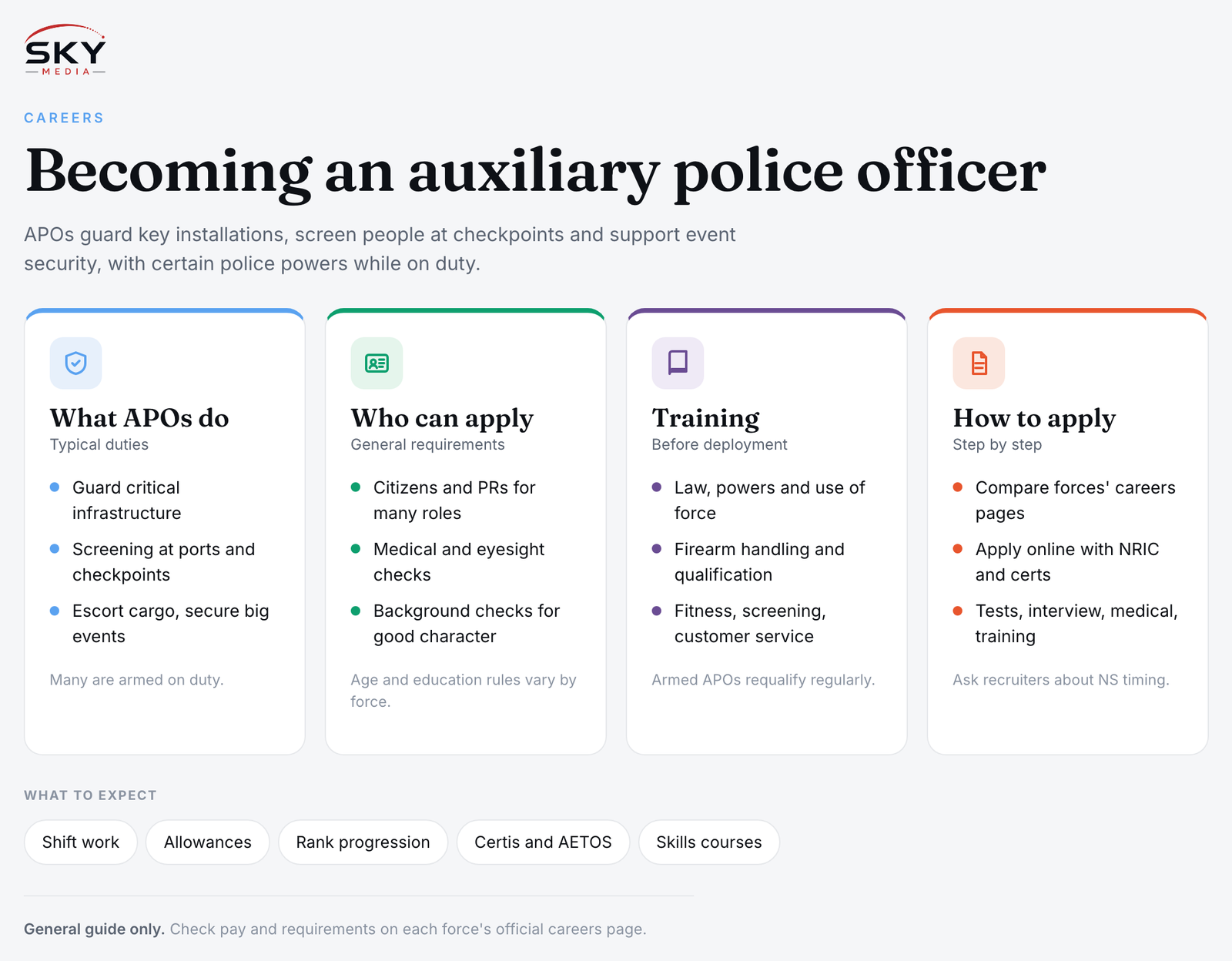
Typical APO duties include:
- Guarding critical infrastructure and government buildings
- Access control and screening at ports, checkpoints and protected places
- Escorting high-value cargo or cash
- Security at large public events
- Patrols at designated premises
- Supporting enforcement roles at certain agencies, where contracted
Many APOs are armed during duty, which is why firearm training and licensing form a significant part of the job.
Who Employs APOs
Singapore has a small number of licensed auxiliary police forces. The best-known include Certis and AETOS, with a few others operating at specific sites. Each force recruits and trains its own officers, and job types, deployments and benefits vary between them.
For example, one force may focus heavily on aviation and port security, while another may be deployed at government buildings, industrial sites or events. It is worth reading each force’s careers page and, where possible, attending a recruitment talk or career fair to compare.
APO vs Police Officer vs Security Officer
People often confuse these three roles. The table below gives a general comparison.
| Aspect | Auxiliary police officer | SPF police officer | Licensed security officer |
|---|---|---|---|
| Employer | A licensed auxiliary police force | Singapore Police Force (Home Team) | Private security agency |
| Powers | Certain police powers while on duty at assigned locations | Full police powers | Limited, similar to a member of the public |
| Firearms | Often armed after training and licensing | Armed as part of duties | Generally unarmed |
| Typical work | Guarding key sites, screening, escorts, event security | Patrols, investigations, response, community policing | Building security, access control, patrols |
If you are weighing the alternatives, see How to Become a Licensed Security Officer in Singapore and Exploring a Career in the Home Team and Police.
General Requirements to Apply
Each force sets its own criteria, and requirements may change, so treat the points below as a general guide rather than a checklist.
- Citizenship or residency. Many APO roles are open to Singapore citizens and permanent residents. Some forces also recruit from overseas under specific schemes. Check each employer’s current policy.
- Age. There is usually a minimum age, and some roles may have an upper limit. Confirm on the force’s careers page.
- Education. Requirements vary by role and rank. Some entry roles accept lower academic qualifications, while supervisory or officer roles may ask for higher ones.
- Medical fitness. Expect a medical check, including eyesight and general fitness, as the role is physically demanding.
- Good character. Background checks are standard. A criminal record may affect eligibility.
- National Service. For male Singaporeans, NS status may affect when you can start. Ask the recruiter how this applies to you.
Training and Firearm Licensing
New APOs go through structured basic training before deployment. While each force runs its own programme, training usually covers:
- Law and powers. Understanding the legal powers and limits of an APO, arrest procedures and use of force.
- Firearm handling. Safe handling, marksmanship and maintenance, followed by qualification tests.
- Physical training. Fitness, self-defence and restraint techniques.
- Security operations. Screening, access control, patrolling and incident response.
- Customer service and communication. Many APO roles involve dealing with the public calmly and professionally.
APOs who carry firearms must meet the standards set by the SPF and their force, and they are typically required to requalify regularly. Firearm licensing and authorisation are handled through official channels, not by the officer applying privately, so ask your recruiter how this works for your role.
Pay, Shifts and Career Progression
Pay for APOs depends on the force, rank, deployment and allowances, such as shift or firearm allowances. Rather than relying on figures quoted online, check the latest salary ranges on each force’s official job listings or ask during recruitment.
What you can generally expect:
- Shift work. Many APO roles run around the clock, with day and night shifts, weekends and public holidays.
- Allowances and benefits. These may include medical coverage, annual leave and performance bonuses, depending on the employer.
- Progression. Many forces have clear rank structures, from entry-level officers to sergeants, inspectors and supervisory roles.
- Skills development. Forces often support further training, such as supervisory courses or specialised security skills.
How to Apply
The process differs by force, but most follow a similar pattern.
- Research the forces. Visit each auxiliary police force’s official careers page to compare roles and requirements.
- Submit an application online. Prepare your NRIC, educational certificates and any relevant work history.
- Attend interviews and assessments. These may include a fitness test, aptitude tests and a face-to-face interview.
- Undergo medical and background checks. Be honest and complete in your declarations.
- Complete basic training. Once accepted, you will attend the force’s training programme before deployment.
Some employers hire throughout the year, while others run recruitment drives. Keep an eye on their websites and official social media pages.
Is an APO Career Right for You?
A career as an auxiliary police officer in Singapore suits people who like structure, teamwork and public service, and who are comfortable with shift work and carrying responsibility. It can also be a stepping stone into wider security, law enforcement or Home Team careers.
If you are exploring other uniformed paths, compare it with How to Become an ICA Officer in Singapore and How to Become a Prison Officer With the Singapore Prison Service. Whatever you choose, always verify current requirements, pay and conditions directly with the employer before you apply.
Frequently Asked Questions
Can women become auxiliary police officers? Many auxiliary police forces recruit women as well as men, although the roles open to you and the deployment can vary by force. Check each force’s careers page for current openings, and ask the recruiter about fitness standards and shift arrangements before you apply.
Do I need to have served National Service to join as an auxiliary police officer? Not necessarily, but National Service status can affect when a male Singaporean is able to start. Some forces also hire people who have completed NS, while others may have different arrangements. Ask the recruiter how your own NS status applies to the role you want.
What is the difference between Certis and AETOS officers? Both are licensed auxiliary police forces, but they run their own recruitment, training and deployments, so the work and benefits can differ. One may emphasise certain sites or sectors more than the other. Compare their official careers pages and recruitment talks to see which suits you.
Can an auxiliary police officer move on to become a regular police officer? An APO career can build useful experience in security, procedures and public service, but it is not an automatic route into the Singapore Police Force. Regular police roles have their own recruitment process, so check the SPF careers page for the current requirements.
What should I prepare for an auxiliary police officer interview? Bring your NRIC, certificates and work history, and be ready for questions on why you want a uniformed, shift-based role. Expect a fitness or aptitude component for some roles. Read the force’s careers page beforehand and answer background and medical declarations honestly.
Official sources: Singapore Police Force
Further reading: How to Join Singapore Customs as an Officer · How to Become a Private Investigator in Singapore