

Private investigation looks glamorous on screen, but the real job is quieter and more methodical: long hours of observation, careful note taking, database checks and well-written reports that a lawyer or company can rely on. If you are a young adult who enjoys problem solving, has patience, and wants a career that sits between security, law and research, becoming a private investigator Singapore style may suit you.
In Singapore, private investigation is a regulated activity. You cannot simply print business cards and start taking cases. This guide explains how licensing works, what training to expect, the kind of work agencies offer, and how to decide whether the career fits you. It is general information; licensing rules are set by the authorities and can change, so check the official requirements before you commit.
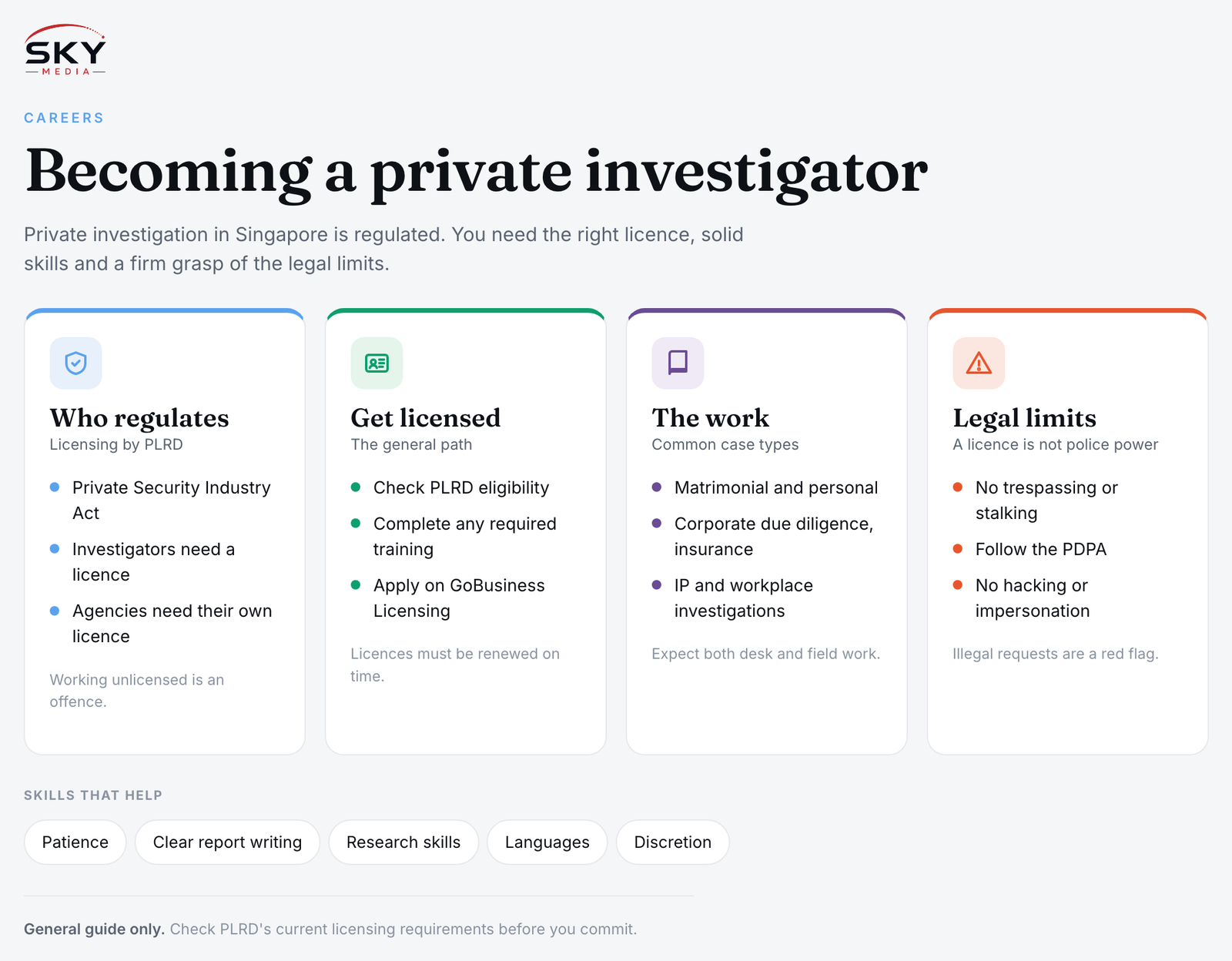
Who Regulates Private Investigators
Private investigators and private investigation agencies in Singapore are regulated under the Private Security Industry Act. Licensing is handled by the Police Licensing and Regulatory Department (PLRD), part of the Singapore Police Force.
In practical terms, this means:
- Individuals who carry out private investigation work generally need a private investigator licence.
- Agencies that offer investigation services to the public need their own agency licence.
- Working as an investigator without the required licence, or running an unlicensed agency, is an offence.
PLRD sets the eligibility criteria, which typically cover age, residency status, fitness and propriety (for example, criminal record checks), and any required training. These criteria are published on the PLRD and GoBusiness Licensing websites, and they are the only reliable source. Do not rely on secondhand advice or old forum posts.
Steps to Getting Licensed
While details can change, the general path looks like this:
- Check your eligibility. Read PLRD’s current requirements for the private investigator licence, including any minimum age and residency conditions. If you have any past criminal record, read the fitness criteria carefully, as it may affect your application.
- Complete any required training. PLRD may require applicants to complete specified training courses. Look for courses listed or recognised by PLRD, and check a provider’s standing before paying. Our guide on verifying private school accreditation explains the general checks to make on training providers.
- Secure a job offer or sponsoring agency, if required. Some licence types are tied to employment with a licensed agency. Check whether this applies.
- Apply online. Applications are typically made through the GoBusiness Licensing portal using Singpass. Prepare identity documents, training certificates and any employment details.
- Pay the fee and wait for the outcome. PLRD sets the fees and processing timelines. Check the current figures on the official site.
- Renew on time. Licences have a validity period and must be renewed. Keep your training and personal details up to date.
What the Work Actually Involves
Most private investigation work in Singapore falls into a handful of areas. Here is how they compare.
| Type of work | Typical clients | What you would do |
|---|---|---|
| Matrimonial and personal | Individuals, family lawyers | Surveillance, documenting activities lawfully, preparing reports for legal proceedings |
| Corporate and due diligence | Companies, investors, law firms | Background checks, verifying credentials, researching business partners |
| Insurance claims | Insurers, loss adjusters | Checking whether claims are genuine, interviewing witnesses, site visits |
| Intellectual property | Brand owners, law firms | Identifying counterfeit goods, test purchases, gathering evidence for enforcement |
| Employee and workplace | Employers, HR teams | Investigating misconduct, fraud or leaks, interviewing staff |
Day to day, expect a mix of desk work and field work. Desk work includes public records searches, reviewing documents and writing reports. Field work includes surveillance, which can mean sitting in a car or a coffee shop for hours, and occasionally interviewing people.
Staying Within the Law
A licence does not give you police powers. Investigators must operate within the same laws as everyone else, and clients expect evidence that will hold up. Key boundaries include:
- No trespassing. You cannot enter private property without permission.
- No harassment or stalking. The Protection from Harassment Act makes certain conduct, including unlawful stalking, an offence. Surveillance must be lawful and proportionate.
- Personal data protection. The Personal Data Protection Act (PDPA) governs how organisations collect, use and disclose personal data. Agencies need proper practices around data handling.
- No impersonation or deception that breaks the law. Pretending to be a police officer or public servant is a serious offence.
- No illegal access to computers or accounts. Hacking or accessing someone else’s accounts is a crime under the Computer Misuse Act.
Good agencies train new hires on these limits. If an employer asks you to cross a legal line, that is a red flag for the whole organisation.
Skills and Background That Help
There is no single required degree, but certain backgrounds and skills make you more attractive to agencies:
- Observation and patience. Surveillance is mostly waiting, then noticing the one moment that matters.
- Clear writing. Your report is the product. It must be factual, well organised and free of speculation.
- Research skills. Comfort with public registries, open-source research and spreadsheets is increasingly important.
- Communication. Interviewing witnesses calmly and professionally takes practice.
- Languages. Mandarin, Malay, Tamil or dialects are useful in a multilingual city, especially for interviews.
- Related experience. Former security officers, police or Home Team staff, insurance claims handlers, auditors and paralegals often move into investigation work. Studies in criminology, law, psychology or business can help, and our guide to private universities in Singapore covers part-time degree options if you want to study while working.
- A clean record and discretion. Trustworthiness is the foundation of the job.
Finding Your First Role
Most new investigators start as employees of a licensed agency rather than freelancing. Ways in include:
- Searching job portals for roles such as investigator, surveillance operative or investigation assistant.
- Applying to corporate risk and due diligence firms, which may hire research analysts who move into investigations.
- Building experience in related roles, such as security, insurance claims or compliance, then switching.
When assessing an employer, check that the agency is licensed by PLRD, ask how they train new staff, and ask how they handle legal and ethical questions. Be cautious of anyone offering investigation work that sounds like it involves secret recording in private places, accessing accounts or harassing people.
Is This Career Right for You
Private investigation can be rewarding if you like variety, independent work and solving real puzzles. It also has drawbacks: irregular hours, long periods of waiting, and cases that involve people at difficult points in their lives. Some investigators eventually move into specialist corporate investigations, compliance, or start their own licensed agency, which requires a separate agency licence and business setup.
Before applying, read PLRD’s current requirements in full, talk to someone already working in the field if you can, and be honest with yourself about whether the daily reality matches what you are looking for.
Frequently Asked Questions
Can I work as a private investigator without a degree? There is no single required degree. Agencies value observation, clear report writing, research skills and discretion, and backgrounds such as security, claims handling, auditing or paralegal work help. What matters legally is meeting PLRD’s licensing criteria, so read them first.
Can I freelance as a private investigator in Singapore? Not without the proper licence. Investigators generally need a private investigator licence, and agencies offering services to the public need their own agency licence. Most newcomers start as employees of a licensed agency, and some licence types are tied to that employment.
What is a private investigator not allowed to do? A licence gives no police powers. Investigators cannot trespass, harass or stalk, break data protection rules, pretend to be police, or hack into someone’s accounts. A reputable agency trains staff on these limits, and being told to cross them is a red flag.
What is the daily work of a private investigator really like? It is a mix of desk and field work. Desk work covers records searches, document review and report writing, while field work can mean hours of surveillance in a car or cafe, and occasional interviews. Expect irregular hours and long periods of waiting.
Which languages help in a Singapore investigation career? Mandarin, Malay, Tamil and dialects are all useful in a multilingual city, particularly for interviewing witnesses. Strong written English matters too, since the report is the product clients rely on.