

Most people never expect to need a private investigator. Then something happens: a suspicion about a spouse, a worrying new business partner, a staff member who might be stealing, or a debtor who has vanished. If you are searching for a private detective in Singapore, you are probably already stressed, which is exactly when people make poor choices. This guide explains how the industry is regulated, what a legitimate investigator can and cannot do, how fees usually work and the warning signs that should make you walk away.
How Private Investigators Are Licensed in Singapore
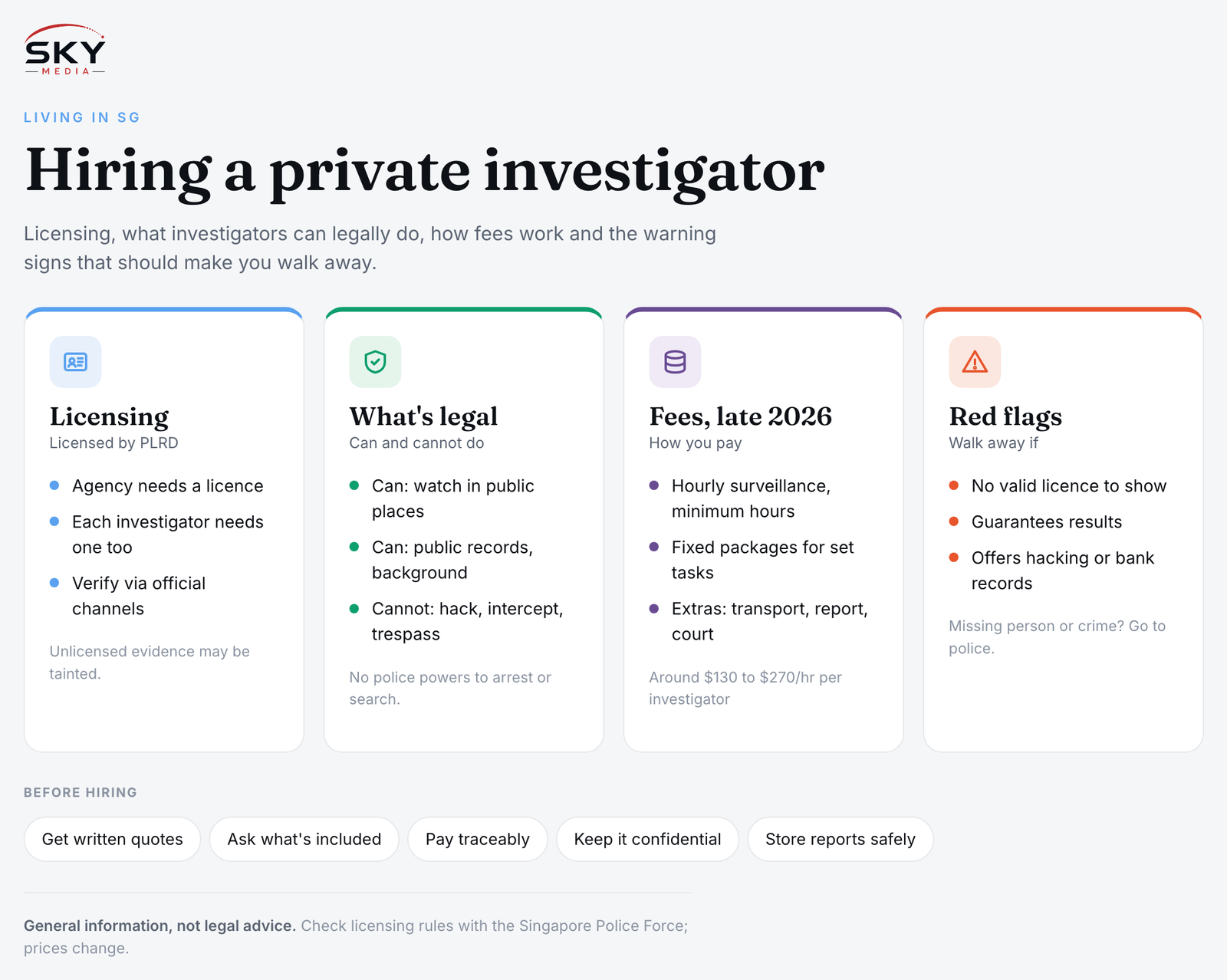
Private investigation in Singapore is a regulated activity. Under the Private Security Industry Act, both private investigation agencies and individual private investigators must be licensed. Licensing is handled by the Police Licensing and Regulatory Department (PLRD) of the Singapore Police Force.
In practice, this means:
- The agency needs a licence to offer private investigation services.
- Each investigator working on your case needs their own licence too. An agency licence does not cover unlicensed staff.
- You can check. The Singapore Police Force provides ways to verify whether an agency or investigator is licensed. Ask for the licence details and check them yourself on the official channel before you sign anything.
Working with an unlicensed operator is risky. They are not accountable to the regulator, and evidence they gather may be tainted by the methods they used.
What a Private Detective Can and Cannot Do
Television gives a misleading picture. A licensed investigator in Singapore works within the same laws as everyone else and has no special powers. They are not police officers and cannot arrest anyone, search property or demand information.
Things investigators commonly do legally:
- Observe and record a person’s movements in public places.
- Make enquiries with people who are willing to talk.
- Search public records and open sources.
- Conduct background and due diligence checks.
- Prepare written reports, photos and videos, and in some cases give evidence in court.
Things that are illegal or likely to land you both in trouble:
- Hacking into phones, email or social media accounts.
- Intercepting calls or messages.
- Trespassing on private property or installing hidden cameras in places where people expect privacy.
- Impersonating police or government officers.
- Obtaining personal data in breach of the Personal Data Protection Act (PDPA), such as buying bank or telco records.
- Following or contacting someone in a way that amounts to harassment under the Protection from Harassment Act.
- Secretly attaching tracking devices to vehicles or belongings that are not yours, which may break the law.
If you ask for, or knowingly benefit from, illegal methods, you may face legal consequences yourself, and the evidence is unlikely to help your case. This is general information, not legal advice; speak to a lawyer if you are unsure.
Common Reasons People Hire an Investigator
- Matrimonial matters. Suspected infidelity is one of the most common reasons. If you are considering divorce, speak to a family lawyer first. They can tell you whether investigation evidence is actually relevant under current divorce law and what kind of evidence would help.
- Background checks. Before entering a business partnership, a large investment or a serious relationship, people sometimes want to verify someone’s identity, history and claims.
- Workplace issues. Employers may investigate suspected theft, fraud, moonlighting or abuse of medical leave, usually with legal or HR advice.
- Insurance and fraud. Insurers and businesses investigate suspicious claims.
- Locating people. Tracing debtors, witnesses or lost contacts, within the law.
- Due diligence. Checking a company or individual before a deal.
If someone is missing and you fear for their safety, or a crime has been committed, go to the police first. A private investigator is not a substitute for a police report.
| Situation | Better first step | Where a PI may help |
|---|---|---|
| Suspected affair, considering divorce | See a family lawyer | Gathering lawful evidence the lawyer says is relevant |
| Missing family member | Make a police report immediately | Supporting enquiries alongside the police, if appropriate |
| Possible fraud by a business partner | Speak to a lawyer, consider a police report | Background and asset checks, due diligence |
| Staff misconduct | Consult HR and an employment lawyer | Lawful surveillance and fact-finding |
| Online scam or harassment | Report to the police | Usually limited; police have the legal powers |
How Fees Are Usually Charged
There is no standard price, and fees vary widely between agencies and cases. Common pricing structures include:
- Hourly rates for surveillance, often with a minimum number of hours per session.
- Fixed packages for defined tasks such as a background check or a set number of surveillance days.
- Additional costs such as transport, vehicle use, extra investigators, equipment, and report or court attendance fees.
As a rough guide, as of late 2026, surveillance is typically billed at around $130 to $270 per investigator per hour, and fixed surveillance packages often start from around $1,500 to $3,000. Night work, two-person teams, vehicle tailing and long cases push costs higher; quotes vary.
To compare quotes fairly, ask each agency:
- What exactly will you do, and for how many hours or days?
- How many investigators will be assigned?
- What extra charges could apply?
- What will the final report contain, and in what format?
- What happens if the subject does not appear, or the case ends early?
Get everything in a written agreement before any work begins, and pay in a traceable way.
Red Flags When Choosing an Agency
Walk away, or at least think twice, if an agency:
- Cannot or will not show a valid licence, or the licence details do not check out.
- Guarantees results, such as promising proof of an affair. No honest investigator can know what they will find.
- Offers to hack phones, read messages or pull bank records. These are illegal methods and a clear sign of an unreliable operator.
- Pressures you to decide on the spot, or pushes a bigger package than you need.
- Asks for large cash payments with no receipt or written contract.
- Has no clear office address or company registration that you can verify.
- Is vague about how they will gather evidence or what the report will include.
Spotting pressure tactics and too-good-to-be-true promises is a skill that helps in other areas too, as our guide to spotting bad financial advice and red flags shows.
Protecting Yourself During the Investigation
- Keep it confidential. Do not tell the person being investigated or mutual friends.
- Do not interfere. Avoid doing your own surveillance alongside the investigator, which can blow their cover or create legal risk.
- Look after your wellbeing. Investigations into personal matters can be emotionally draining. Talking to a counsellor or trusted friend can help.
- Store reports safely. They may contain sensitive personal information.
If you are curious about the profession itself, see how to become a private investigator in Singapore.
Frequently Asked Questions
Are private detectives legal in Singapore?
Yes, provided the agency and each investigator are licensed by the Police Licensing and Regulatory Department and act within the law.
Can a private investigator get someone’s phone records?
No. Obtaining phone, bank or similar records without proper legal authority is illegal.
How much does a private detective in Singapore cost?
It depends on the work involved. Hourly surveillance rates of roughly $130 to $270 per investigator are common, but packages and extras vary, so get several written quotes.
How long does a typical private investigation take to produce results? There is no fixed timeline, because it depends on the task. A defined background check can be quick, while surveillance may need several sessions before the subject does anything relevant. Agree the number of hours or days in writing, and ask what happens if nothing useful turns up within that period.
Can evidence from a private investigator be used in a Singapore court? It can be, if it was gathered lawfully. Some investigators prepare reports, photos and videos and may give evidence in court. Evidence obtained by hacking, trespass or buying personal records is unlikely to help and may expose you to legal trouble, so ask your lawyer what is admissible and relevant before the work starts.
Should I see a lawyer before hiring a PI for suspected infidelity? That is usually the better order. A family lawyer can tell you whether evidence of an affair actually matters to your case under current divorce law, and what kind of evidence would help. That way you avoid paying for surveillance that adds little to your position.
Can a private detective find someone who owes me money? Tracing debtors is a common job, as long as it is done within the law. Investigators can search public records, make enquiries and observe in public places, but they cannot pull bank or telco records. Recovering the money itself usually needs legal action, so speak to a lawyer about the next step.
Is it legal to put a GPS tracker on my spouse’s car? Secretly attaching a tracking device to a vehicle or belongings that are not yours may break the law, even if you are married. A licensed investigator should refuse such a request. If you have concerns about a partner, get legal advice on lawful options rather than tracking them yourself.
Licensing rules are set and updated by the Singapore Police Force, so check its official website for the current requirements before you hire.