

Many experienced professionals reach a point where they want to teach what they know. If you want to become a WSQ trainer in Singapore, the main route runs through a single qualification: the Advanced Certificate in Learning and Performance, usually shortened to ACLP. It is the foundational certificate for adult educators delivering Workforce Skills Qualifications (WSQ) courses, the national continuing education and training system overseen by the Skills and Workforce Development Agency (SWDA, formed in 2026 from Workforce Singapore and SkillsFuture Singapore).
This guide focuses on the ACLP route: what the certificate covers, who offers it, how to fund it, and what happens after you qualify. For background on the WSQ system itself, see our explainer on WSQ courses.
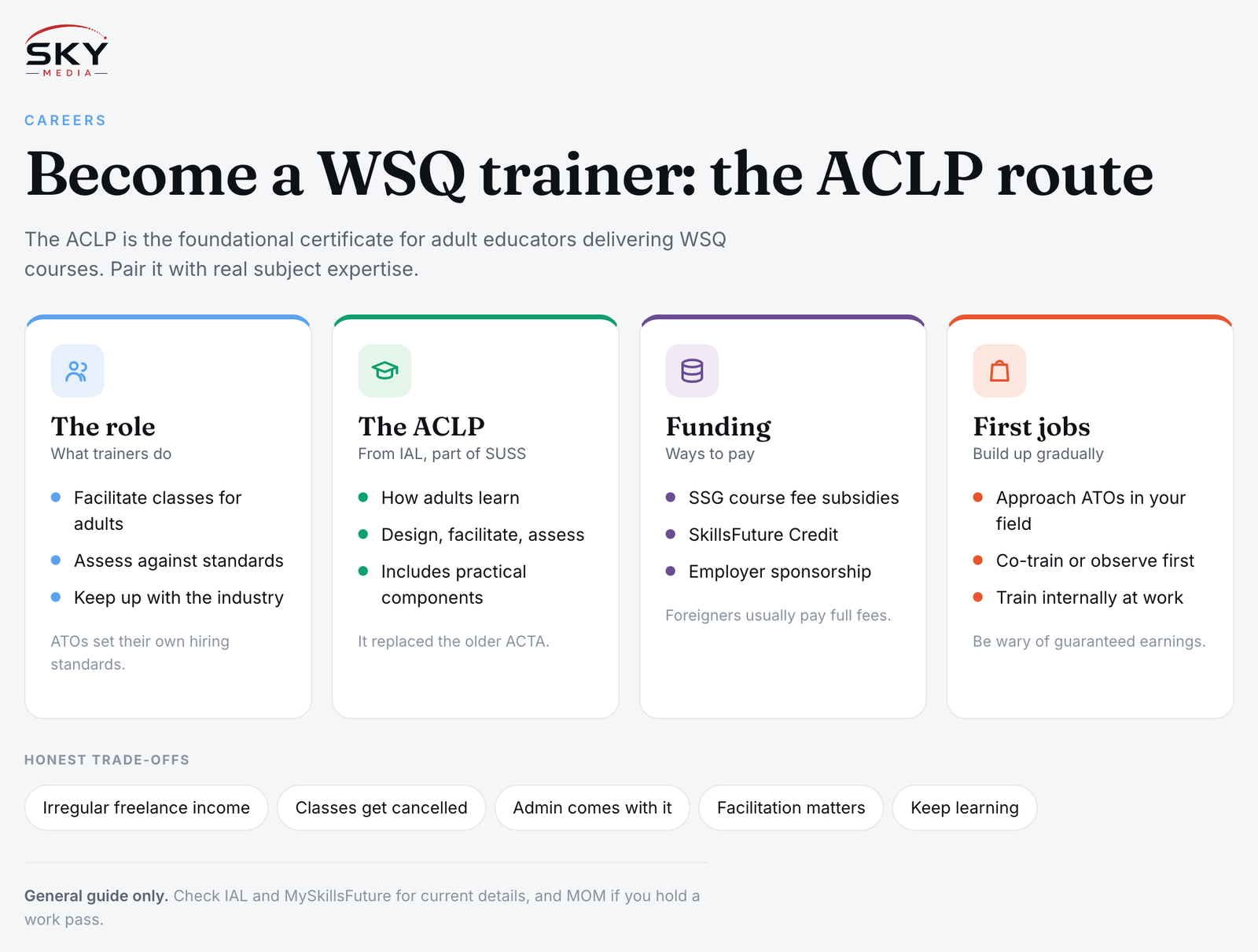
What a WSQ Trainer Actually Does
A WSQ trainer, often called an adult educator, delivers courses mapped to national skills standards. Courses are run by Approved Training Organisations (ATOs), which are training providers approved by SWDA to offer WSQ programmes. Trainers might teach anything from food hygiene and workplace safety to digital marketing, logistics or leadership.
The role usually combines:
- Facilitating classes for working adults, in person or online.
- Assessing learners against the competency standards of the course.
- Adapting materials so they suit adult learners with varied experience.
- Keeping up with the industry so the content stays relevant.
Two things are needed to train on most WSQ courses: subject expertise in the area you will teach, usually shown through work experience and relevant qualifications, and a recognised adult education qualification such as the ACLP. ATOs set their own hiring standards on top of SWDA’s requirements, so expectations vary between providers and courses.
The ACLP in Plain Terms
The ACLP is developed by the Institute for Adult Learning (IAL), which is part of the Singapore University of Social Sciences (SUSS). It replaced the older Advanced Certificate in Training and Assessment (ACTA), so you may still meet experienced trainers who hold ACTA.
The certificate is built around the practical skills of adult education, such as:
- Understanding how adults learn differently from children.
- Designing learning experiences and lesson plans for working adults.
- Facilitating sessions in class and online.
- Assessing competency fairly and consistently.
- Reflecting on and improving your own practice.
The programme is modular and includes practical components where you facilitate and assess, so it is not purely theory. Course structure, duration, delivery mode and entry requirements are set by IAL and the approved providers, and can be updated, so check the current details on IAL’s website before enrolling. Some providers may also ask about your language proficiency, since much of the coursework and assessment is in English.
Pathways Compared
The ACLP is the most common starting point, but it sits within a wider set of adult education qualifications. The table below gives a general overview.
| Qualification or step | Typical purpose | Who it suits |
|---|---|---|
| ACLP (Advanced Certificate in Learning and Performance) | Foundational qualification for delivering and assessing WSQ courses | Professionals starting out as adult trainers |
| Diploma-level adult education programmes | Deeper skills in learning design, curriculum and evaluation | Trainers moving into course design or training management |
| Higher-level adult learning qualifications | Specialisation, research and leadership in adult learning | Senior practitioners and training leaders |
| Professional recognition for adult educators | Formal recognition of experience and ongoing development | Practising trainers building long-term careers |
IAL publishes the current suite of adult education programmes and any professional recognition schemes for adult educators. Names and requirements can change, so treat the table as a map rather than a rulebook.
Funding the ACLP
The ACLP is generally eligible for national training subsidies, but the exact amount depends on who you are and when you enrol. Funding options commonly include:
- SWDA course fee subsidies for eligible Singapore citizens and permanent residents, with enhanced support for some groups, such as mid-career learners.
- SkillsFuture Credit, which eligible Singaporeans can use to offset remaining fees for approved courses.
- Employer sponsorship, if your company wants you to become an in-house trainer.
Subsidy rates and eligibility are reviewed from time to time, so check the current fee and funding details on the IAL and MySkillsFuture websites. Foreigners can usually enrol but are generally not eligible for the same subsidies, so confirm the full fee with the provider. Our guide to SkillsFuture and the WSQ framework explains how these funding schemes fit together.
If you hold a work pass, remember that teaching or freelancing on the side is governed by MOM rules for your specific pass. Check with MOM and your employer before taking on any paid training outside your main job.
Getting Your First Training Work
Finishing the ACLP does not automatically come with a job. Most new trainers build up gradually.
- Start with what you know best. Your strongest selling point is real industry experience. An ATO running courses in your field will value that.
- Approach ATOs directly. Many providers maintain a pool of freelance or associate trainers. Send a short profile highlighting your domain expertise, your ACLP and the courses you could teach.
- Offer to co-train or observe. Some providers let new trainers shadow an experienced colleague before leading a class.
- Train internally first. If your employer runs staff training, volunteering to deliver it gives you practice and references.
- Look out for learner feedback. WSQ courses usually collect learner feedback on training quality, and providers pay attention to it when choosing trainers.
- Keep your industry skills current. Many providers expect trainers to stay active in their field, not just in the classroom.
Many WSQ trainers work as freelancers paid per session or per course, while others are employed full-time by training organisations or in-house learning teams. Income varies widely by subject, demand and experience, so be cautious about any provider promising guaranteed earnings.
Is Adult Training the Right Move for You?
Becoming a trainer suits people who enjoy explaining things, are patient with mixed-ability groups and like seeing others grow. It can work as a full career, a bridge into semi-retirement, or a side role alongside your main job, depending on your pass type and employer rules.
Some honest considerations:
- Freelance income can be irregular. Classes can be cancelled when enrolments are low.
- Teaching adults is different from presenting. Adult learners bring opinions, experience and limited time. Facilitation skills matter as much as expertise.
- Admin is part of the job. Attendance records, assessment documentation and quality requirements come with WSQ delivery.
- It rewards continuous learning. Your own development in both your subject and in adult education keeps you in demand.
If you are weighing this up against other education careers, compare it with becoming an allied educator in MOE schools, which focuses on supporting school students rather than working adults.
Your Next Steps
- Read the current ACLP programme details and entry requirements on IAL’s website.
- Check your subsidy and SkillsFuture Credit eligibility on MySkillsFuture.
- List the subjects you could credibly teach based on your work history.
- Shortlist ATOs that run courses in those areas.
- If you hold a work pass, confirm with MOM what is allowed before taking paid training work.
Explore more: WSQ or Academic Diploma: Which Helps Your Career More?
Official sources: SkillsFuture (SWDA)