

If you run a renovation firm, a cleaning company, a logistics outfit or almost any business that sends staff to work on someone else’s premises, sooner or later a client will ask: “Are you bizSAFE?” This guide explains bizSAFE certification in Singapore for SMEs, how the levels work, what each step involves, what you will pay for along the way and why main contractors and tender documents keep asking for it.
It is general information, not legal advice. The programme is run by the Workplace Safety and Health Council (WSH Council), and its structure, course providers and funding can change, so confirm current details on the WSH Council’s bizSAFE pages before you start.
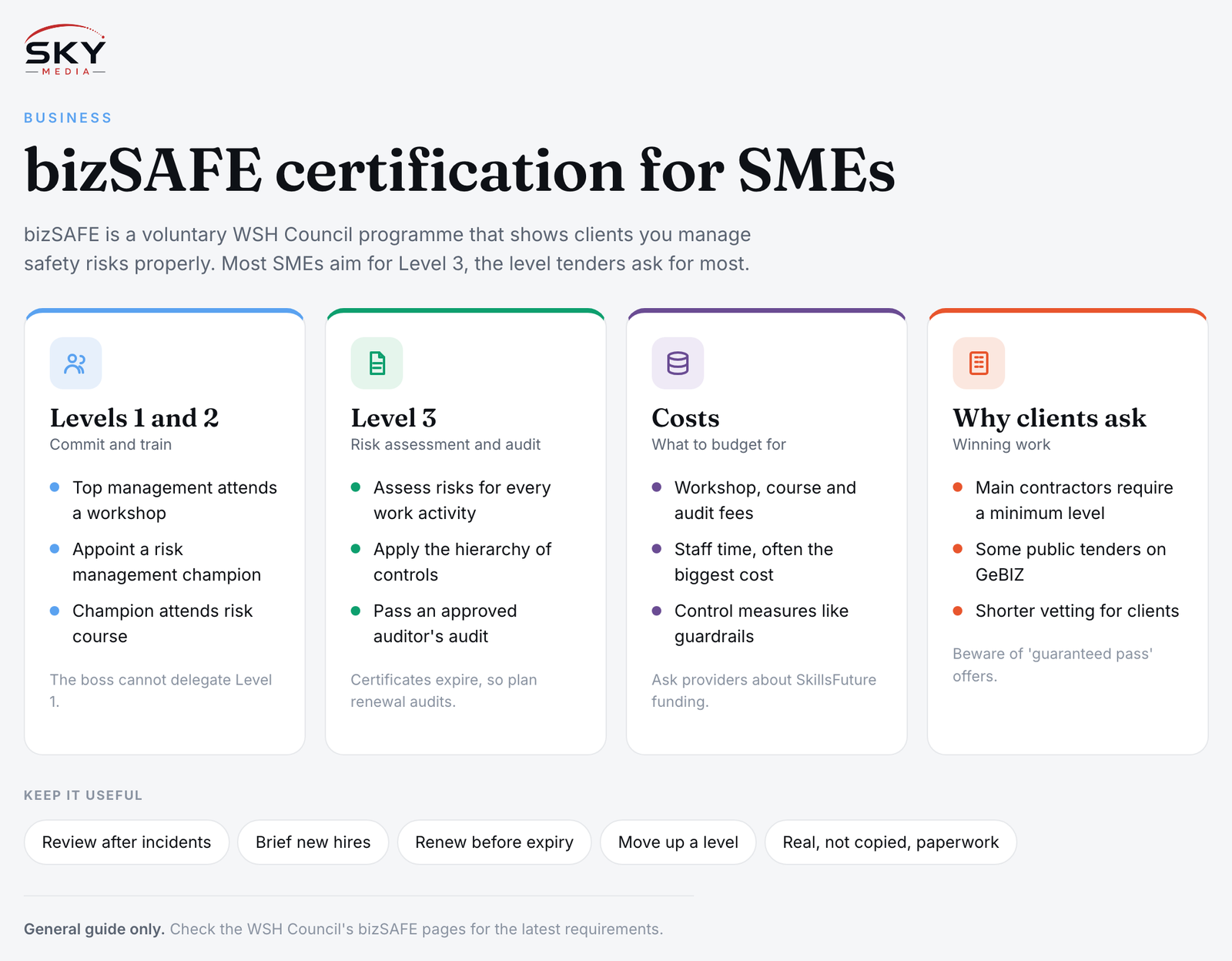
What bizSAFE Is and How It Differs From Your Basic WSH Duties
Every employer in Singapore already has legal duties under the Workplace Safety and Health Act, enforced by the Ministry of Manpower (MOM). Those duties apply whether or not you join any programme. This guide focuses on bizSAFE rather than those general duties.
bizSAFE is something different. It is a structured, step-by-step programme that helps companies, especially SMEs, build the ability to manage safety risks properly, starting with risk management. Each level you complete shows clients that you have gone beyond the legal minimum in a verifiable way. Think of WSH law as the rule book and bizSAFE as a recognised scorecard of how seriously your company applies it.
The programme is voluntary. In practice, though, many clients make it a condition of doing business.
The bizSAFE Levels at a Glance
bizSAFE runs from Level 1 up to Level 5 and then bizSAFE Star at the top. Most SMEs aim for Level 3, because that is the level most commonly requested in tenders and by main contractors.
| Level | Who does what | What you get at the end |
|---|---|---|
| Level 1 | Top management (owner, director or CEO) attends a short bizSAFE workshop and commits to building WSH capability | Recognition that leadership has committed to the programme |
| Level 2 | The company appoints a risk management champion who attends a risk management course | A trained in-house person who can lead risk assessments |
| Level 3 | The company carries out risk assessments for its work activities and implements controls, then passes an audit by an approved risk management auditor | bizSAFE Level 3 certificate, the level many clients ask for |
| Level 4 | The company develops a broader WSH management system and has it reviewed | Recognition of a structured management system beyond risk assessment |
| Level 5 | The WSH management system is certified to a recognised standard by an accredited certification body | Formal management system certification |
| bizSAFE Star | The company sustains its system and demonstrates strong WSH performance | The top tier of the programme |
The names and exact requirements of the higher tiers have been refined over the years, so check the current descriptions with the WSH Council if you are aiming beyond Level 3.
Step by Step: Getting to bizSAFE Level 3
Here is how a typical SME moves through the first three levels.
1. Register and send the boss to the Level 1 workshop.
The person attending must be someone with real authority over the business, usually the owner or a director. The workshop explains your legal responsibilities, the basics of risk management and what the programme expects. It is short, but you cannot delegate it to a junior staff member.
2. Pick and train a risk management champion (Level 2).
Choose someone who knows the daily operations well, such as a supervisor or operations manager, not just whoever is free. They attend a risk management course run by an approved training provider. After the course they should be able to lead your team through identifying hazards, assessing risks and choosing controls.
3. Do the actual risk assessments.
This is the heart of Level 3 and where most of the effort goes. Your champion and the team list every work activity, from loading a lorry to working at height, using chemicals or operating machinery. For each one, you identify what could go wrong, rate the risk and decide on controls following the hierarchy of controls (eliminate, substitute, engineer, administrate, then protective equipment). Document everything in the required format, communicate it to workers and keep the records up to date.
4. Engage an approved auditor.
Once your risk management is in place, you appoint an auditor from the WSH Council’s list of approved risk management auditors. They review your documents, visit your workplace or worksite, and may speak to workers to check that what is on paper actually happens.
5. Fix any gaps and receive your certificate.
If the auditor finds issues, you correct them and resubmit. On passing, you receive bizSAFE Level 3 recognition. Certification is valid for a fixed period, after which you need to be re-audited to renew, so diarise the expiry date.
What It Costs and How to Budget
The WSH Council does not set a single all-in price, because your costs depend on your choices and the size and complexity of your operations. Rather than rely on figures you see quoted online, get current quotes. The main cost items are:
- Workshop fees for Level 1, charged by the training provider
- Course fees for the Level 2 risk management course, again set by the provider
- Staff time spent attending courses and doing the risk assessments, often the largest hidden cost
- Control measures you decide to put in place, such as guardrails, signage, equipment or protective gear
- Audit fees charged by your chosen approved auditor, which vary by auditor and company size
- Optional consultant fees if you hire someone to help prepare documents
Funding support for training, including course fee subsidies, has been available through SkillsFuture and related schemes at various times. Ask the training provider what applies to your company at the point of registration, as eligibility and amounts change.
A word of caution: be wary of anyone promising a “guaranteed pass” or ready-made risk assessments that you simply sign. Auditors check that assessments reflect your real work, and copied paperwork tends to fall apart under questioning.
Why Tenders and Main Contractors Ask for bizSAFE
There are a few practical reasons bizSAFE has become a common gatekeeper:
- Main contractors carry responsibility for their sites. Many large construction and facilities companies require subcontractors to hold a minimum bizSAFE level before they can work on site.
- Public sector tenders. Some government procurement, especially for construction, maintenance and cleaning services, includes bizSAFE requirements or gives credit for it. Read each tender document on GeBIZ (the government’s procurement portal) carefully, as requirements differ.
- Shorter vetting. A recognised certificate saves the client from assessing your safety practices from scratch.
- Insurance and reputation. Clients and insurers increasingly look for evidence of structured safety management.
Beyond winning work, the process often uncovers real hazards that nobody had thought about, which protects your workers and reduces costly stoppages.
Keeping Your bizSAFE Status Useful
Getting certified is the start, not the finish. To keep your status meaningful:
- Review risk assessments whenever you take on a new type of job, buy new equipment or after any incident or near miss
- Brief new hires and foreign workers on the controls in a language they understand
- Keep the certificate current and plan the renewal audit ahead of expiry
- Consider moving up a level once Level 3 is stable, particularly if larger clients expect it
If you are also building your own team’s credentials, see Professional Certifications in Singapore and Professional Certifications and SkillsFuture Credit in Singapore for how training and funding generally work. For another certification that unlocks customers, read Halal Certification in Singapore Explained.
Further reading: Is ISO 9001 Certification Worth It for a Singapore SME? · The Cyber Essentials Mark: Getting CSA Certified as an SME