

Sooner or later, many small businesses meet a tender form or a supplier questionnaire with a box that asks: “Are you ISO 9001 certified?” If you are weighing up ISO 9001 certification in Singapore, the real questions are practical ones. What does it actually involve, who does the auditing, what will it cost your team in time and money, and will it win you work that you are currently missing out on?
This guide walks through those questions from an SME owner’s point of view. It is general information, not consultancy advice, so check the details with an accredited certification body before you commit.
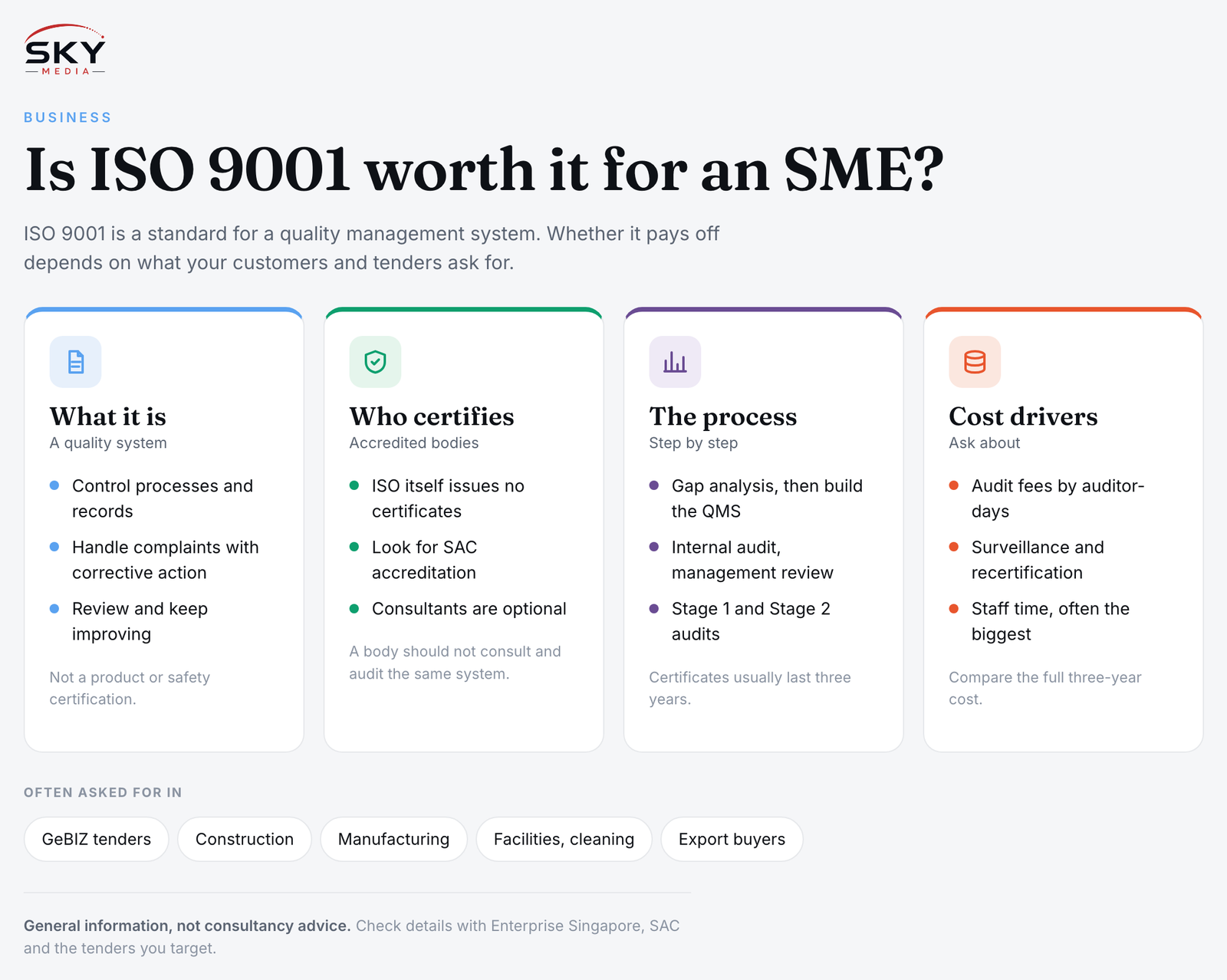
What ISO 9001 Actually Is (and Is Not)
ISO 9001 is an international standard for a quality management system (QMS). A QMS is simply the documented way your company makes sure it delivers what customers expect, consistently, and gets better over time. The standard does not tell you how to bake a cake, fabricate a steel bracket or run a cleaning crew. Instead, it asks you to show that you:
- Understand your customers’ requirements and your own business risks
- Define who is responsible for what
- Control key processes, documents and records
- Handle complaints, defects and mistakes in a structured way (often called corrective action)
- Measure performance and review it at management level
- Keep improving
It is not a product certification, so ISO 9001 does not mean your product is “approved”. It also does not cover workplace safety, which is what bizSAFE certification and standards such as ISO 45001 deal with, or environmental management, which is ISO 14001. Many SMEs combine several of these later, but ISO 9001 is usually the first.
The current edition for many years has been ISO 9001:2015, and a revision has been in progress internationally. Ask your certification body which edition you will be audited against and what any transition period looks like.
Who Certifies You: Certification Bodies and Accreditation
ISO itself does not issue certificates. Independent certification bodies audit your QMS and issue the certificate. In Singapore, look for a certification body accredited by the Singapore Accreditation Council (SAC), which operates under Enterprise Singapore, or by another accreditation body that is part of the international mutual recognition arrangements. Accreditation means the auditors themselves have been checked for competence and impartiality.
Why this matters: some buyers, especially government agencies and large corporates, may only accept certificates from accredited bodies. A cheap certificate from an unaccredited outfit can turn out to be worthless when it counts. You can search SAC’s directory of accredited certification bodies on its website.
There are also consultants who help you build the QMS and prepare documentation. A consultant is optional. Note that a certification body should not consult for you and then audit the same system, because that is a conflict of interest.
The Certification Process Step by Step
The exact sequence varies by certification body, but most SMEs go through something like this:
- Gap analysis. Compare how you work today against the standard’s requirements.
- Build the QMS. Write a quality policy and objectives, map your main processes, set up document control, complaint handling and corrective action.
- Run it for a while. Auditors want evidence that the system is used, not just written. Keep records.
- Internal audit and management review. You audit yourself and hold a formal review meeting.
- Stage 1 audit. The certification body checks your documentation and readiness.
- Stage 2 audit. Auditors visit (or audit remotely where allowed), interview staff and sample records.
- Close any nonconformities. You fix findings and submit evidence.
- Certificate issued. Typically valid for three years, with surveillance audits at regular intervals (commonly yearly) and a recertification audit before expiry.
On timelines, a small, well-organised firm can move faster than a larger one with many sites, but the elapsed time from start to certificate is usually measured in months rather than weeks. The biggest variable is how much your team already documents and how much time the owner can give it.
What Drives the Cost
Fees vary widely, so we will not quote numbers. Instead, here are the cost components to ask about when you collect quotes:
- Audit fees, usually based on the number of auditor-days, which depends on your headcount, number of sites and complexity of operations
- Surveillance and recertification audits over the three-year cycle, not just the first year
- Consultant fees, if you use one, whether fixed-price or per day
- Internal staff time, often the largest hidden cost, for writing procedures, training and internal audits
- Software or templates for document control, if you choose to use them
- Travel or remote-audit arrangements, depending on your setup
Get at least two or three quotes from accredited bodies and compare the full three-year cost. Enterprise Singapore has run support schemes for SMEs investing in capability upgrades, and the scope of these changes over time, so check the current options on the Enterprise Singapore and GoBusiness websites before assuming anything is claimable.
When Tenders and Clients Require It
ISO 9001 is rarely a legal requirement. It becomes a commercial requirement when your customers ask for it. Common situations include:
- Some public-sector tenders on GeBIZ, the government procurement portal, which may list quality certification as a requirement or as a scoring criterion. Read each tender’s documents; requirements differ by agency and contract.
- Construction and building-related work, where main contractors and certain registration schemes may expect a QMS
- Manufacturing and engineering supply chains, where multinationals often require suppliers to hold ISO 9001 or a sector variant
- Facilities management, cleaning and security contracts, where buyers want evidence of consistent service delivery
- Exporters, where overseas buyers use ISO 9001 as a quick trust signal
Before you start, pull out the last ten tenders or supplier forms you received and count how many asked for it. That simple exercise often answers the “is it worth it” question.
| Your situation | Is ISO 9001 likely worth it? | What to do next |
|---|---|---|
| You bid regularly for government or MNC contracts that list it | Usually yes | Get quotes from SAC-accredited bodies and plan the timeline around tender dates |
| Customers ask occasionally, but most work comes from referrals | Maybe | Build basic QMS habits first, certify when demand is clearer |
| You are a one or two person consultancy or retailer | Often not yet | Focus on simple written processes and customer feedback |
| You are scaling fast and quality slips as you hire | Often yes, for the discipline alone | Use the standard as a framework even before certifying |
| A specific client or contract makes it mandatory | Yes, if the contract value justifies it | Confirm the exact standard and accreditation the client accepts |
Benefits SMEs Report Beyond the Certificate
The certificate opens doors, but owners often say the internal changes matter more:
- Fewer repeated mistakes, because problems get a root-cause fix instead of a quick patch
- Easier onboarding, since new staff can follow written processes
- Less dependence on the owner, which helps if you ever want to step back or sell
- Clearer data on complaints, delivery times and rework
The downside is real too. A badly designed QMS becomes a paper exercise that staff resent. Keep documents short, write procedures in the language your team actually uses, and only document what adds value.
Tips to Keep It Lean
- Start with what customers notice most: quoting, delivery, complaints
- Use tools you already have, such as shared drives
- Train one or two staff as internal auditors
- Treat surveillance audits as a free health check
If you are also thinking about personal credentials for yourself or your team, see our guide to choosing a professional certification in Singapore. Food businesses with a halal market in mind may find halal certification in Singapore explained useful alongside a QMS.
Bottom line: ISO 9001 is worth it when your customers ask for it or when growth is stretching your ability to deliver consistently. Check current requirements with Enterprise Singapore, SAC and the specific tenders you target, then decide with the full three-year cost in front of you.
Official sources: Enterprise Singapore
Further reading: The Cyber Essentials Mark: Getting CSA Certified as an SME