

There comes a point when your child has outgrown their harnessed car seat but is still too small for an adult seatbelt to fit safely on its own. That gap is exactly what booster seats are made for. A booster lifts the child so the car’s seatbelt crosses their body in the right places, over the strong bones of the shoulder and hips rather than the soft stomach and neck. Getting this stage right matters just as much as the baby years, because an ill-fitting belt can cause serious injury in a crash. This guide explains when a child is ready, how the law frames it in Singapore, and how to set a booster up correctly.
As with all child restraint topics, treat this as general information rather than legal advice. Rules can change, so for the current requirements always defer to the Traffic Police and LTA, and follow the fitting instructions that came with your specific booster.
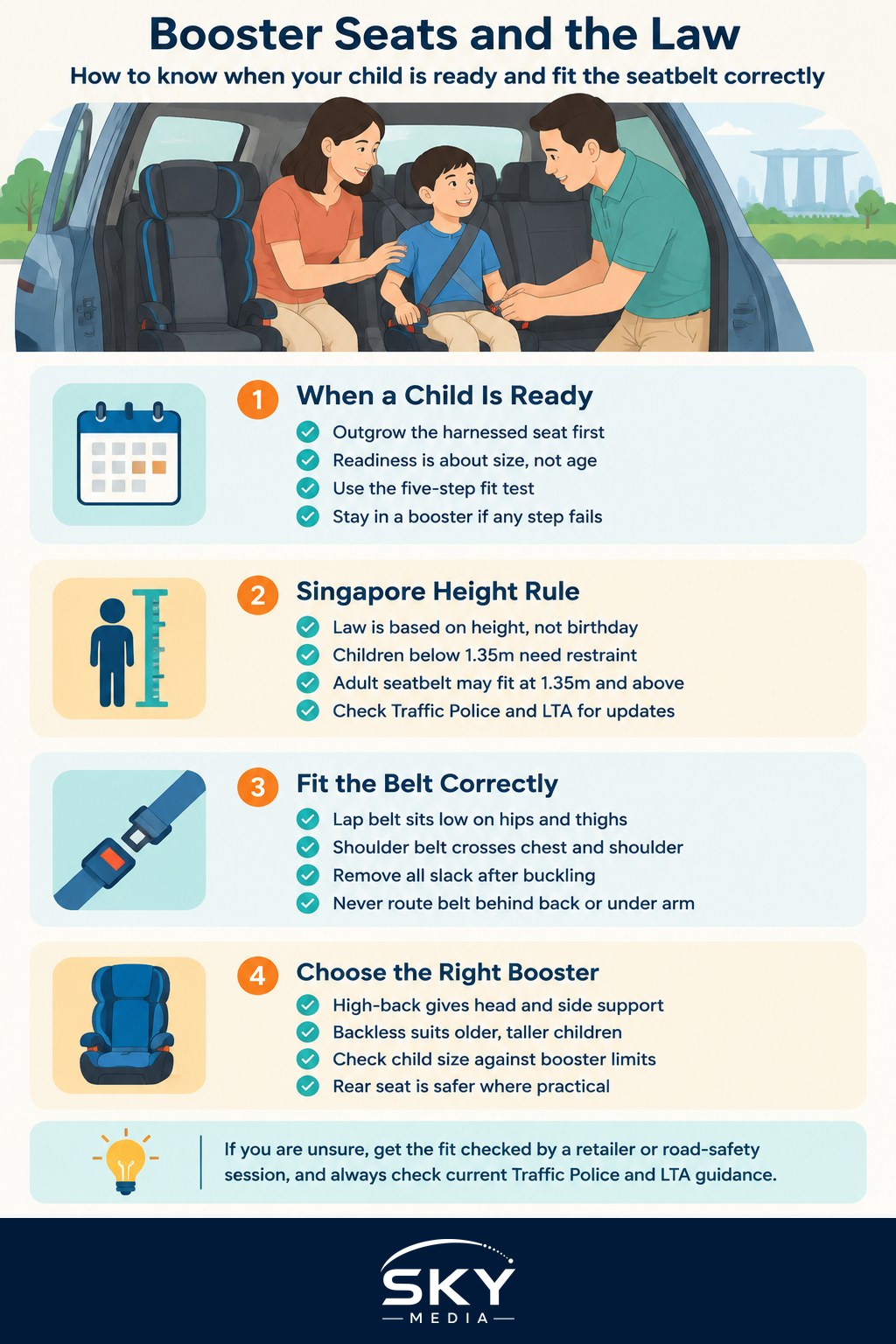
When a Child Is Ready for a Booster
Moving up should be about size and maturity, not age or impatience. A child is ready to leave a harnessed seat only once they have genuinely outgrown it by the maximum weight or height printed on that seat, so check those limits before switching.
Even then, a booster is only doing its job if the adult belt sits correctly. A simple readiness check, sometimes called the five-step test, helps:
- The child sits right back against the vehicle seat, with their bottom and back flat against it.
- Their knees bend comfortably over the edge of the seat.
- The lap belt sits low across the tops of the thighs, not the soft belly.
- The shoulder belt crosses the middle of the shoulder and chest, not the neck or the arm.
- The child can stay seated like this, without slouching or sliding, for the whole journey.
If the child cannot pass all five points, they still need a booster. Rushing a child into just a seatbelt, or worse none at all, leaves the belt riding across the abdomen and neck, where it can do real harm in a sudden stop.
The 1.35m Rule and Singapore Law
In Singapore, the law is framed around height. Broadly, children below 1.35m in height must be secured in an appropriate child restraint, an adjustable seatbelt, or a booster seat suited to their size, while a child at or above that height may use the adult seatbelt. Front and rear seats are both covered, and the driver carries responsibility for ensuring young passengers are properly restrained.
Because these rules and their exact wording can be updated, do not treat the 1.35m figure here as the final word for your situation. Check the official Traffic Police and LTA sources, or the OneMotoring portal, for the current requirement, any exemptions, and how they apply to private cars, taxis and private-hire vehicles, which can differ.
The practical takeaway is straightforward. Height, not birthday, is the trigger, and a booster is the tool that bridges the years between a harnessed seat and a proper adult-belt fit. Keeping a child in a booster until the seatbelt genuinely fits, even if they have technically passed the legal height, is the safer choice.
Getting the Seatbelt Routing Right
A booster does not restrain the child by itself; it positions the car’s own three-point belt so that the belt does the work. That makes correct routing the whole point.
Follow these principles every trip:
- Thread the lap belt through the low guides. Most boosters have clear hooks or horns on each side. The lap portion must sit low and flat across the hips and upper thighs, never up over the stomach.
- Run the shoulder belt through the correct guide. On a high-back booster this is usually a slot or clip near the headrest; on a backless one it may be a small guide clipped to the shoulder. The belt should cross the centre of the shoulder and chest.
- Remove all slack. Pull the belt snug after buckling so there is no loose loop at the lap or shoulder.
- Never tuck the shoulder belt behind the back or under the arm. Children often do this because the belt rubs their neck, but it leaves the upper body unrestrained and is dangerous. If the belt hits the neck, the booster or its position may need adjusting.
Check the routing yourself each time rather than assuming the child has clipped in correctly, especially with younger booster users.
High-Back or Backless: Which Booster
Boosters come in two broad styles, and each has its place. A high-back booster has a full back and sides with a headrest and a built-in shoulder-belt guide. A backless booster, sometimes called a booster cushion, is just the base that raises the child.
| Consideration | High-back booster | Backless booster |
|---|---|---|
| Head and side support | Provides side wings and head support | None; relies on the vehicle seat |
| Best suited to | Younger or smaller booster-age children | Older, taller children near adult-belt fit |
| Shoulder-belt guide | Built into the seat near the headrest | A clip-on guide, if provided |
| Portability | Bulkier to move between cars | Light and easy to carry or share |
For most children moving out of a harnessed seat, a high-back booster is the more protective starting point, particularly if your car’s rear seat has low or no head restraints, because it supports the head and offers some protection in a side impact. A backless cushion suits an older, taller child who is close to fitting the adult belt but still needs a little lift. Whichever you choose, confirm it matches your child’s height and weight against the booster’s own limits.
Booster Safety Habits and When to Ask for Help
A few habits keep a booster doing its job. Always seat children in the rear where practical, as the back seat is safer for them. Insist that the belt is worn correctly for the entire trip, even short hops to the nearby mall, since most collisions happen close to home. In our climate, a car parked in the sun heats up fast, so check that buckles are not too hot, and never leave a child alone in a parked vehicle.
Because a booster is safety-critical, it pays to get the setup checked rather than guess. Retailers that sell child seats can often demonstrate a correct fit, and community or parenting road-safety sessions sometimes offer checks. Ask them to watch you buckle your child in so you can repeat it confidently.
Boosters are the quiet workhorse of child car safety, covering the long stretch between the toddler seat and a proper adult-belt fit. Judge readiness by size and the five-step test rather than age, keep the belt routed correctly every single trip, and lean towards keeping your child in a booster a little longer rather than moving on too soon. For the legal requirements, including how the 1.35m rule applies to your vehicle, always check the current Traffic Police and LTA guidance.
Frequently Asked Questions
Can a child sit in the front seat once they are in a booster? The back seat is generally safer for children, so keep them there where practical. Whether a child may sit in front, and under what conditions, is covered by the Traffic Police and LTA rules, so check the latest guidance. Airbags are designed for adults, which is another reason to prefer the rear.
What if my child falls asleep and slumps out of the belt? Sleeping children often slide sideways, which pulls the shoulder belt off the shoulder. A high-back booster with side wings helps keep them in position. Stop safely and reposition them rather than adjusting while driving. Never let them tuck the belt behind their back to be comfortable.
Is a belt-positioning clip or cushion an alternative to a proper booster? Be wary of add-ons that only pull the belt down. A booster raises the child and guides the lap and shoulder belt together. Products that are not certified may not protect properly in a crash. Choose a certified booster that suits your child’s height and weight.
Can my child use a booster with grandparents or in carpools? Yes, as long as every car that carries the child has the proper restraint. A lightweight backless booster is easy to pass along, while a high-back suits a regular car. Show anyone driving how to route the belt correctly, because the driver is responsible for the child being restrained.
Does my child still need a booster if they reach 1.35m at age eight? Possibly not by law, but keep checking the fit. The five-step test shows whether the belt sits low on the thighs and across the middle of the shoulder. If the child cannot sit properly the whole trip, a booster remains safer even after reaching the legal height.
Official sources: OneMotoring
Further reading: Seat Belt Rules for Every Passenger in Singapore