
Most drivers know to replace brake pads when they wear thin, but brake fluid is easy to forget because it does not visibly run out. It quietly degrades over time, and in a humid climate like Singapore’s it can happen faster than you might expect. Knowing when to change brake fluid, and why it matters, helps you keep your brakes responsive and avoid expensive repairs to other parts of the braking system.
This is general information. Your car’s owner’s manual and a qualified mechanic are the authorities for your specific vehicle.
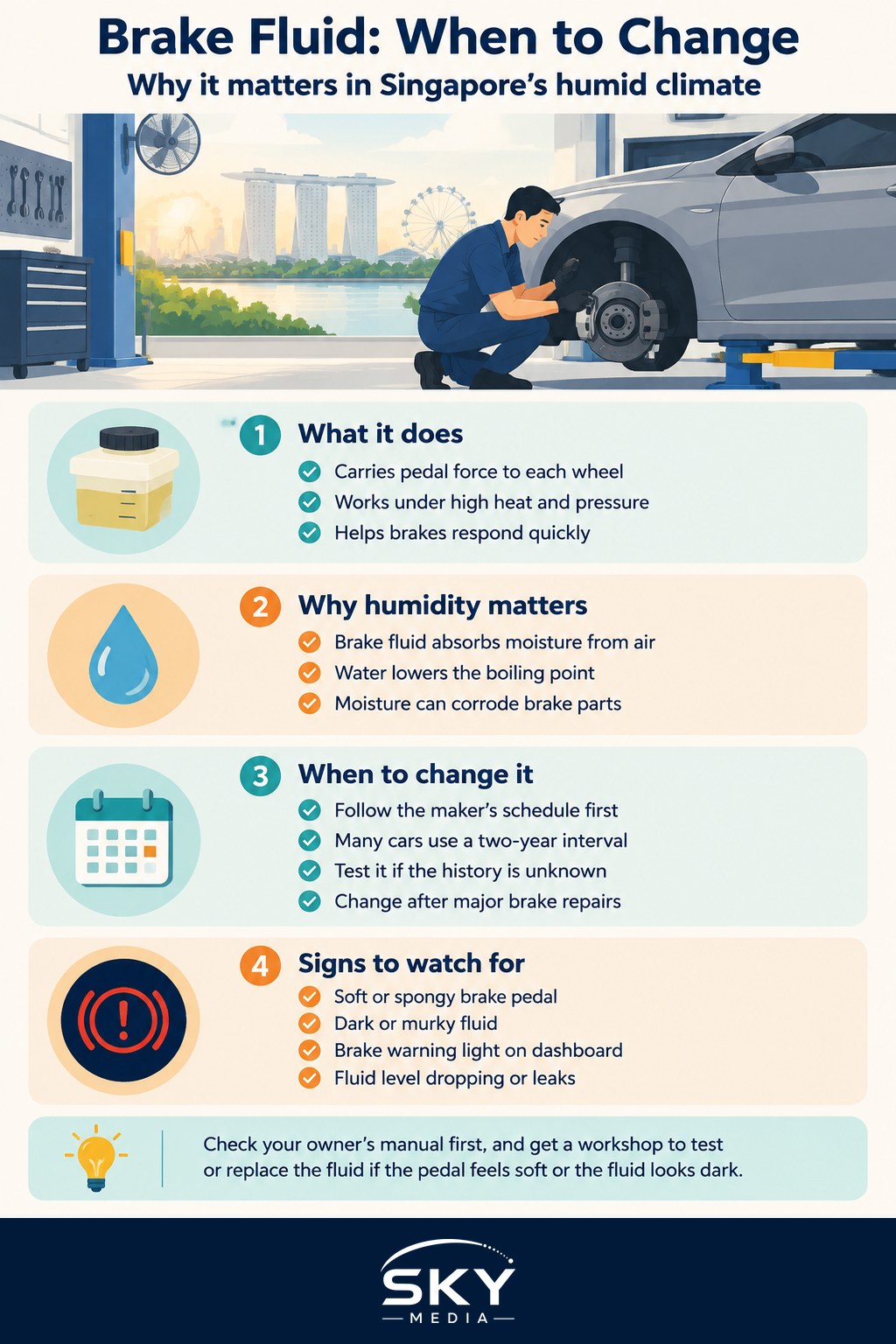
What Brake Fluid Does
When you press the brake pedal, you push a piston in the master cylinder. Brake fluid carries that pressure through the brake lines to the callipers or wheel cylinders at each wheel, which squeeze the pads against the discs or drums. Because liquid does not compress easily, the force you apply at the pedal arrives at the wheels almost instantly.
Brake fluid also works under heat. Hard or repeated braking turns a car’s movement into heat, and some of that heat reaches the fluid in the callipers. The fluid must stay liquid at high temperatures to work.
Why Singapore’s Humidity Shortens Brake Fluid’s Life
Most cars use glycol-based brake fluids, labelled DOT 3, DOT 4 or DOT 5.1. These fluids are hygroscopic, which means they absorb water from the air. Moisture enters slowly through the reservoir cap, rubber hoses and seals, every time the system breathes as it heats and cools.
Water in the fluid causes two problems:
- A lower boiling point. As water content rises, the fluid boils at a lower temperature. Under heavy braking, such as a long downhill drive or repeated hard stops, it can form vapour bubbles. Vapour compresses, so the pedal may feel soft or sink further than normal. This is called brake fade.
- Internal corrosion. Moisture can corrode metal parts inside the system, including brake lines, callipers and the ABS (anti-lock braking system) unit. These parts cost far more to replace than a fluid change.
Singapore’s high year-round humidity gives the fluid more moisture to absorb, and stop-start traffic on expressways and in town means frequent braking. Neither makes brake failure likely on a well-maintained car, but both are good reasons not to stretch the interval.
How Often to Change Brake Fluid
There is no single rule for every car, but common guidance looks like this:
- Follow the manufacturer’s schedule first. Many manufacturers recommend changing brake fluid every two years, often regardless of mileage, because moisture absorption is time-based rather than distance-based.
- Consider a shorter interval for heavy use. Cars used for ride-hailing, deliveries or frequent long trips with lots of braking may benefit from more frequent checks.
- Test rather than guess. Many workshops can check the moisture content or boiling point of the fluid with a tester. Simple test strips also exist. A test helps you decide whether a change is due.
- Change it after major brake work. If callipers, lines or the master cylinder are replaced, the system is usually bled and refilled anyway.
If you buy a used car without service records, ask a workshop to check the brake fluid early, since you do not know when it was last changed.
Warning Signs Your Brake Fluid Needs Attention
- A soft or spongy pedal, or a pedal that sinks further than it used to.
- Fluid that looks dark or murky. New glycol fluid is usually clear to light amber and darkens as it ages and collects contaminants. Colour alone is not a reliable test, but very dark fluid deserves a check.
- A brake warning light on the dashboard, which can indicate low fluid or another fault.
- A falling fluid level. The level drops slightly as pads wear, but a noticeable drop may mean a leak. Do not just top it up; have it inspected.
- Fluid under the car near a wheel, or wet patches on the inside of a tyre.
Any of these, especially a soft pedal or a warning light, means you should get the car checked promptly. Do not drive if the brakes feel unsafe. Our guide to checking your car’s fluids yourself explains how to find the reservoir and read the level markings.
Top-Up, Flush or Bleed: What the Workshop Does
| Service | What happens | When it is used |
|---|---|---|
| Top-up | Fluid is added to bring the reservoir to the correct level | Small drop from pad wear only, after checking for leaks |
| Bleed | Fluid is pushed through to remove air from the lines | After repairs or if air has entered the system |
| Flush | Old fluid is fully replaced with new fluid at every wheel | Routine change at the recommended interval |
| Moisture test | Fluid is tested for water content or boiling point | Before deciding whether a change is due |
A full flush is the standard way to change brake fluid. The mechanic opens the bleed valve at each wheel in sequence while new fluid goes in at the reservoir, until clean fluid comes through. Some workshops use a pressure or vacuum machine; others do it manually with two people. Cars with certain ABS systems may need a scan tool to cycle the ABS unit so old fluid there is also replaced.
Points to check with your workshop:
- Use the correct fluid type. Check the reservoir cap or manual. DOT 3, DOT 4 and DOT 5.1 are glycol-based and some can be mixed, but DOT 5 is silicone-based and must never be mixed with glycol fluids.
- Ask for a sealed, fresh bottle. Opened brake fluid absorbs moisture in storage.
- Ask whether the clutch is included. In many manual cars, the clutch hydraulic system shares the brake fluid reservoir and should be refreshed at the same time.
Cost and Doing It Yourself
The cost of a brake fluid change in Singapore depends on the car, the fluid specified, the workshop and whether an ABS procedure or clutch bleed is needed. Ask for a written quote, and compare it with the service package your authorised dealer offers. Many owners have it done as part of a scheduled service, which can be cheaper than a separate visit.
Bleeding brakes yourself is possible with the right tools and experience, but mistakes such as letting the reservoir run dry can introduce air into the system and compromise braking. Brake fluid also damages paintwork and needs proper disposal. For most drivers, a qualified workshop is the safer choice.
Brake fluid and brake pads usually wear on different timelines, so track them separately. For the pad side of the system, see when to replace your brake pads.
Frequently Asked Questions
What happens if you never change your brake fluid? Over the years the fluid keeps absorbing moisture, so its boiling point drops and the pedal can feel soft under heavy braking. Moisture can also corrode lines, callipers and the ABS unit. Brake failure on a well-kept car is unlikely, but neglect makes repairs costlier.
Do hybrids and electric cars need brake fluid changed too? Yes, they still have hydraulic brakes, and the fluid still absorbs moisture over time. Regenerative braking reduces pad wear, but it does not stop the fluid ageing. Follow the interval in the owner’s manual or ask the authorised dealer.
Is it safe to drive when the brake fluid level is low? Not without a check first. A slightly lower level can come from pad wear, but a noticeable drop may mean a leak, and a brake warning light adds to the concern. Avoid long drives, have the car inspected promptly and do not simply top it up.
Can I top up my brake fluid with whatever bottle is at home? No, use only the type printed on the reservoir cap or in the manual. DOT 3, DOT 4 and DOT 5.1 are glycol-based, but DOT 5 is silicone-based and must never be mixed with them. An opened bottle also absorbs moisture, so a fresh sealed one is better.
Is brake fluid change part of a normal car service in Singapore? Not always. Some service packages include it at set intervals, while others treat it as a separate item. Ask your workshop or authorised dealer what your package covers, and request a written quote so you can compare it against a standalone visit.
Further reading: Spark Plugs and When to Change Them