

Most of us in Singapore reach for our phone before we are fully awake and put it down only after we are half asleep. It pays our bills, checks the weather before a run, holds our train card, and keeps us in touch with family here and overseas. The phone is not the enemy. But when scrolling starts to eat our sleep, focus, and mood, it is worth pausing. Digital wellbeing in Singapore is not about quitting technology; it is about using it on purpose, so it serves your life instead of quietly running it.
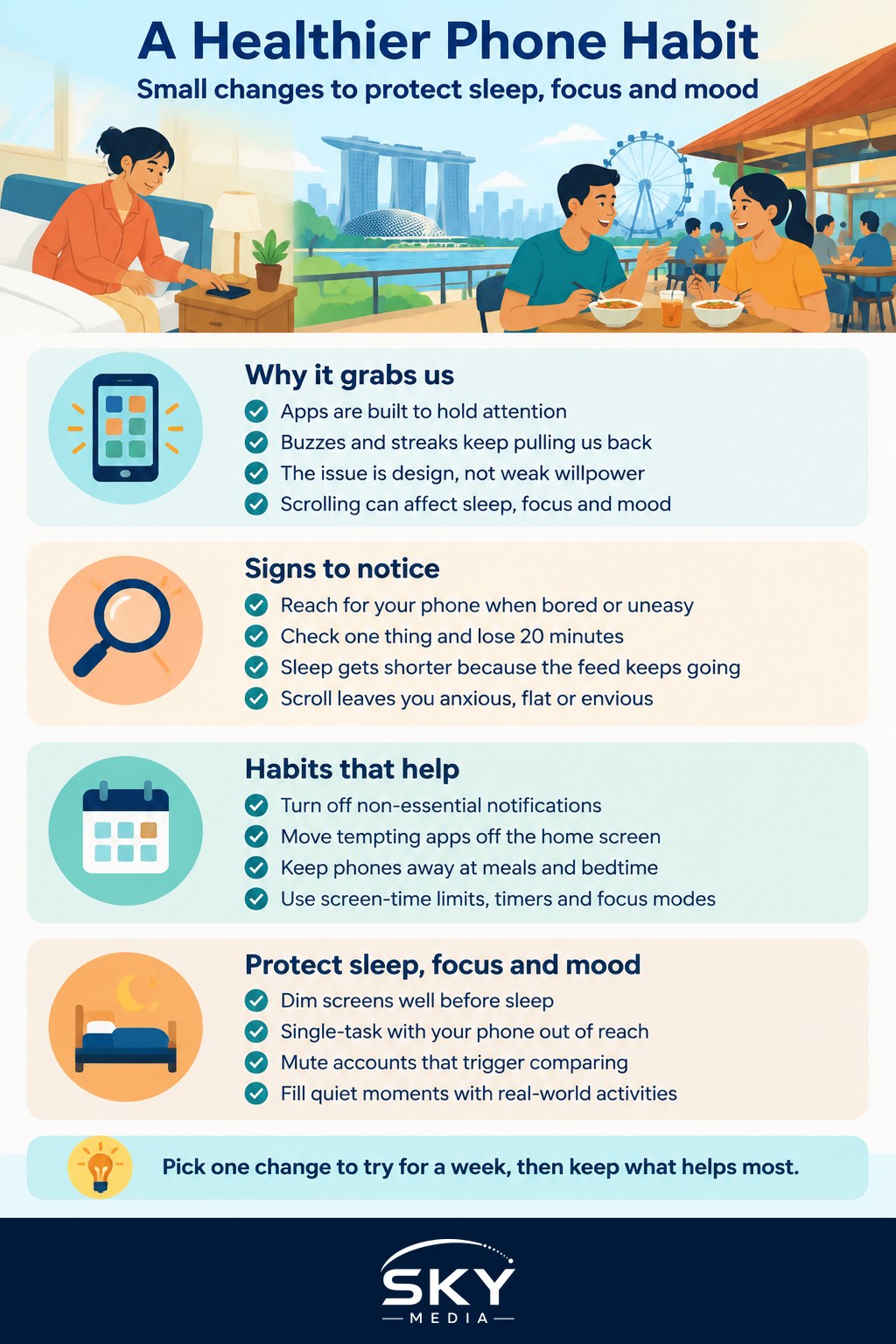
How Your Phone Hooks You
It helps to understand why putting the phone down feels so hard. Apps are designed to hold your attention. Endless feeds, autoplay videos, likes, streaks, and notifications all tap the same reward system in your brain that responds to slot machines. Each little buzz offers a small hit of novelty, and your brain learns to crave the next one.
This is not a personal failing. Some of the smartest engineers in the world are paid to keep you scrolling. Once you see the design, you can stop blaming yourself and start setting up your environment so the easy choice becomes the healthier one.
The cost shows up in familiar ways: nights that vanish into the feed, a jittery inability to sit through a meal or an MRT ride without checking something, work that takes longer because focus keeps shattering, and a low, comparing mood after an hour of other people’s highlight reels.
Signs Your Balance Is Off
You do not need a diagnosis to know something is off. A few honest questions help.
- Do you reach for your phone the moment you feel bored, awkward, or uncomfortable?
- Do you pick it up to check one thing and surface twenty minutes later?
- Is your sleep shorter because the feed keeps pulling you back?
- Do you feel anxious, flat, or envious after scrolling, yet keep scrolling?
- Would a whole day without your phone feel genuinely stressful?
If several of these ring true, your relationship with your phone could use some care. The aim is not shame; it is noticing, so you can adjust.
Practical Habits That Actually Help
Willpower alone rarely wins against a well-designed app. Changing your surroundings works far better. Try a few of these and keep what sticks.
- Turn off non-essential notifications. Let calls, messages from real people, and maybe your calendar through. Silence the rest. Fewer buzzes mean fewer hooks.
- Move tempting apps off your home screen. Tuck social and video apps into a folder on a later page, or log out so opening them takes effort. Friction is your friend.
- Grey out your screen. Switching your display to greyscale at night makes the feed far less enticing.
- Create phone-free zones and times. No phones at the dinner table, during your hawker lunch, or for the first and last half hour of the day. Protect meals and conversations.
- Charge it outside the bedroom. A simple alarm clock replaces the phone, so you are not scrolling in bed or checking it at 3am. This one change often improves sleep the most.
- Use the built-in tools. Screen-time dashboards, app timers, focus modes, and bedtime settings are already on your phone. Set limits on your heaviest apps and let the phone nudge you.
- Replace, do not just remove. Boredom drives scrolling, so line up easy alternatives: a book, a walk in the park connector, a real chat, a stretch. The gap needs filling with something.
The table below shows how small swaps change the whole texture of a day.
| Moment | Autopilot habit | Healthier swap |
|---|---|---|
| Waking up | Scroll in bed for 20 minutes | Get up first, phone stays on the desk |
| Queuing for kopi | Check the feed reflexively | Look up, breathe, or just wait |
| Dinner with family | Phone face-up on the table | Phone away in a bag or another room |
| Winding down at night | Watch autoplay videos in bed | Screens off early, read or stretch |
| Feeling bored at work | Open social media for a break | Stand, stretch, get water, then return |
Protecting Sleep, Focus, And Mood
Three things suffer most when the phone takes over, and all three respond quickly once you make space.
Sleep improves when screens dim well before bed. The late-night feed keeps your mind alert and steals rest you cannot get back. A wind-down routine without screens, and a charger in another room, does more for your energy than any supplement.
Focus returns when you stop feeding the habit of constant checking. Try single-tasking: one tab, one job, phone out of reach and face down. Work in short focused blocks, then take a real break. Your attention is a muscle that recovers with practice.
Mood lifts when you curate what you consume. Mute or unfollow accounts that leave you anxious or comparing, and keep the ones that inform, connect, or make you laugh. Remember that feeds show polished highlights, not real life. Time with actual people, family, friends, a CCA, a community group, feeds you in a way the screen never will.
Keeping It Realistic
You do not have to go cold turkey or throw your phone in the reservoir. Digital wellbeing is a balance you adjust, not a test you pass or fail. Pick one or two changes, live with them for a week, and notice what feels better. Some seasons of life, exams, a new baby, caring for elderly parents, will pull you back toward the screen, and that is fine. You can reset any time.
If your phone use feels genuinely compulsive, if it is harming your sleep, work, relationships, or mood and you cannot rein it in despite trying, that is worth taking seriously. Please speak to a doctor or a mental-health professional, who can look at the fuller picture, including any anxiety or low mood underneath the scrolling. This article is general information, not a diagnosis. You can also look up a current support service in Singapore, such as mindline.sg or IMH, for guidance. If you ever feel persistently distressed or have thoughts of harming yourself, please seek professional help immediately and contact a current crisis line or call 995.
Your phone is a brilliant tool. With a few deliberate habits, you can keep everything it gives you while quietly taking back your sleep, your focus, and your attention.
Explore more
A calmer relationship with your phone supports your whole mind. Pair this with our guide to understanding and managing everyday stress in Singapore and, since scrolling often replaces real connection, our piece on the health effects of loneliness. To fill quiet moments more kindly, try mindfulness and meditation for beginners.
Frequently Asked Questions
How much phone time is okay for children and teenagers? There is no single number that suits every child, so focus on what screens replace, such as sleep, homework, play and family time. Set clear rules together, keep phones out of bedrooms at night and model good habits yourself. Check Ministry of Education and HealthHub guidance for the latest advice.
How do I stop doomscrolling bad news? Set a fixed time to check the news rather than refreshing all day, and turn off news alerts. Mute accounts that leave you anxious, and end the session with something calming. If news is affecting your sleep or mood, take a longer break.
Do I really have to reply to work messages after office hours? Not always, and it depends on your role and your employer’s expectations. Talk with your manager about what counts as urgent and agree on a way to reach you for emergencies. Muting work chats in the evening protects rest and focus.
How do I set phone rules for the whole family? Agree on a few simple rules together, such as no phones at meals and phones charging outside bedrooms overnight. Adults following them too makes a big difference. Review the rules after a few weeks and adjust to suit everyone.
Is a weekend digital detox worth trying? A short break can help you notice how often you reach for the phone, and many people feel calmer afterwards. You do not need to go fully offline, as even a few phone-free hours with a walk or meal can help. Keep emergency calls available.