

For many Singapore children, “writing” means the dreaded composition: a blank page, a picture prompt, and a word count to hit. No wonder so many freeze. But building writing skills in children is not really about churning out model compositions. It is about helping a child feel they have something worth saying, and the tools to say it clearly. Get that right, and the exam writing looks after itself far more easily.
The good news is that writing grows at home, in small everyday moments, long before and well beyond any assessment. You do not need to be an English teacher or buy an expensive programme. You need patience, a bit of structure, and a willingness to let early writing be messy.
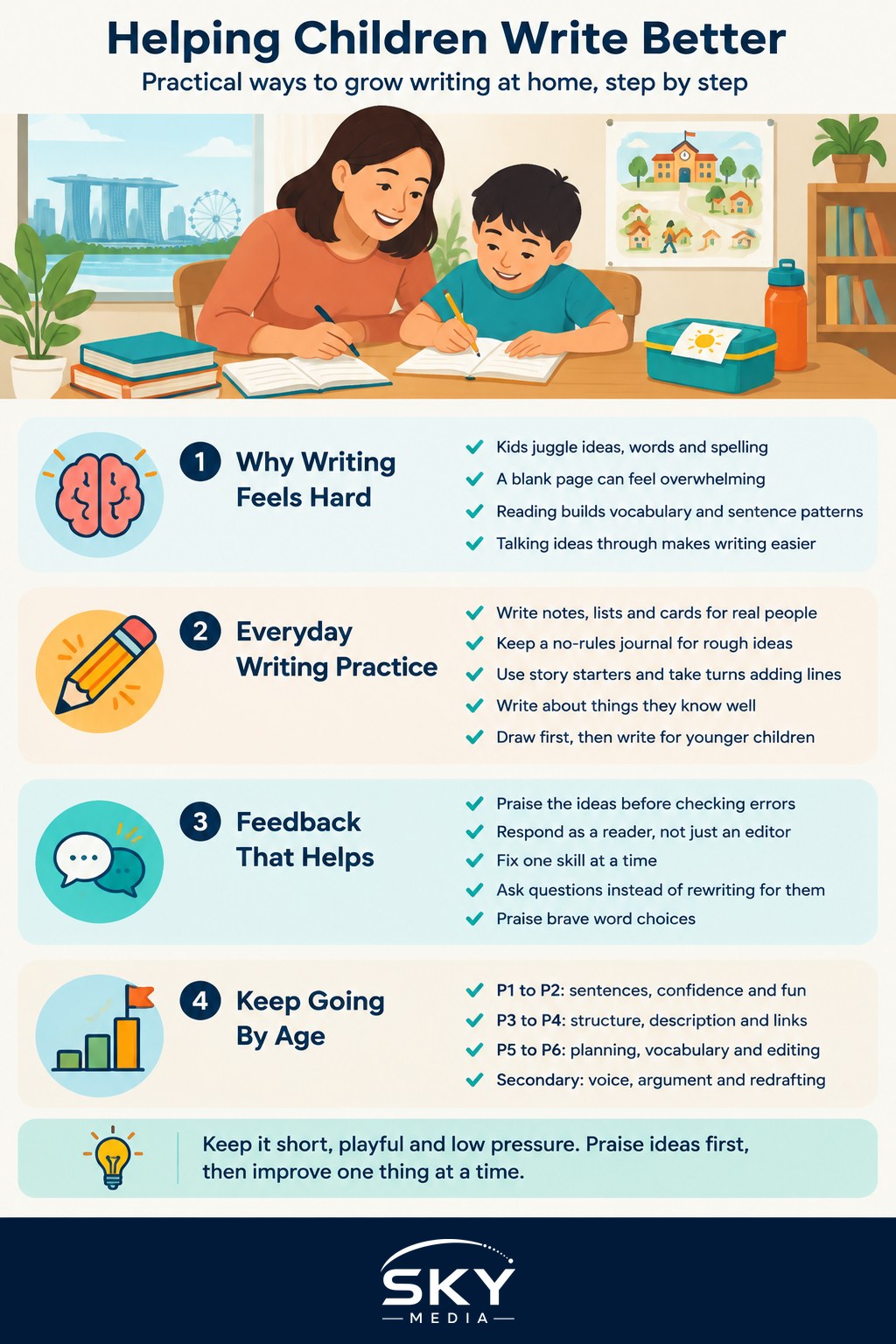
Why Writing Feels So Hard For Kids
Writing asks a child to do several difficult things at once: think of an idea, choose words, spell them, form letters or type, punctuate, and keep it all making sense. For a young learner, that is a heavy cognitive load. When a child says “I don’t know what to write,” they are often overwhelmed, not lazy.
Two things ease this load enormously.
- Reading widely. Children who read absorb sentence patterns, vocabulary and story shapes without effort. Reading is the quiet engine of writing. A strong reader has a fuller toolbox to write from, which is why building strong reading comprehension and writing grow together.
- Talking first. A child who can tell you a story out loud can usually write it. Talk is the rehearsal; writing is the recording. Skipping the talk makes the page far scarier.
In a multilingual Singapore home, this matters even more. A child may think in one language and write in another. Letting them talk through an idea in whatever language flows, then helping them shape it in English, is a bridge, not a shortcut.
Everyday Ways To Spark Writing At Home
The aim is to make writing feel useful and low stakes, not like a test. Look for real reasons to put words down.
- Messages and lists. A note in a lunchbox, a birthday card for Ah Ma, a shopping list, a message to a cousin. Real audiences make writing matter.
- A no-rules journal. A cheap notebook where spelling and neatness do not count. The goal is fluency and the habit of getting thoughts down.
- Story starters. Give a fun opening line (“The lift doors opened and inside was…”) and take turns adding sentences.
- Write about their world. Their favourite game, a hawker dish they love, the school field trip, the MRT ride. Children write best about what they know.
- Draw then write. For younger children, a drawing gives them something concrete to describe, which lowers the fear of the blank page.
Keep sessions short and cheerful. Ten focused minutes that end on a good note beat an hour of tension. If you can make it playful, you build a positive association that lasts; our guide on making learning fun for kids has more ideas in that spirit.
Feedback That Builds, Not Bruises
How you respond to your child’s writing shapes whether they want to write again. A page bleeding with red corrections teaches a child that writing is a trap. Praise the ideas first, always.
A gentle rule of thumb is to respond as a reader before you respond as an editor. React to the content (“I did not expect the dog to be the hero, that surprised me!”) before touching spelling. Then pick just one or two things to improve, not everything at once.
- Focus on one skill at a time. This week, fuller sentences. Next week, a stronger opening. Piling on ten fixes overwhelms.
- Ask, do not rewrite. “What happened next?” or “How did she feel?” invites the child to add, rather than you taking over the page. Doing the work for them helps as little in writing as it does with any homework you help without doing.
- Celebrate the brave word. When a child reaches for an ambitious word, praise the reach even if the spelling wobbles.
Mistakes are part of the process. A child who fears errors writes short, safe, dull sentences. A child who feels safe experimenting grows.
Matching The Help To The Age
What works for a Primary 1 child is not what a Primary 5 or secondary student needs. This table offers a rough guide; every child develops at their own pace.
| Stage | What to focus on | A simple activity |
|---|---|---|
| Early primary (P1 to P2) | Confidence, forming sentences, having fun | Draw a picture, then write one or two sentences about it |
| Middle primary (P3 to P4) | Structure, describing, linking ideas | Tell a short story out loud, then write it in three parts |
| Upper primary (P5 to P6) | Planning, vocabulary, editing their own work | Plan a composition with a quick mind map before writing |
| Lower secondary and up | Voice, argument, redrafting | Write an opinion on a real issue, then improve one draft |
The thread running through every stage is the same: talk, draft, respond kindly, improve one thing. The demands rise, but the friendly process stays constant.
Keeping It Going Without The Pressure
Singapore’s exam culture can tempt families to turn writing into drill. Endless practice papers may lift a mark in the short term, but they can quietly kill the desire to write. A child who enjoys writing will practise far more, and far more willingly, over the years that actually count.
To keep the momentum healthy:
- Protect the joy. Keep some writing completely free of marking and correction. Not every piece needs to be improved.
- Read together often. Continue reading aloud even after your child can read alone. It keeps feeding their language.
- Model it yourself. Let them see you write a message, a list, a card. Children copy what they see valued.
- Be patient with plateaus. Writing grows in fits and starts. A quiet spell is not a failure.
- Mind the wellbeing. If exam writing is causing real distress, ease off and talk to the teacher. A trusted adult or the school counsellor can help, and mindline (call 1771) is a real free service for general support.
This is general learning support for parents, not professional advice. For the current English syllabus, composition formats and assessment expectations, MOE and your child’s school are the right sources, and these change over time, so check the latest official guidance rather than assuming.
The Bigger Picture
Building writing skills in children is a long, gentle project measured in years, not weekends. The child scribbling a shaky sentence about their favourite noodles today is on the same path as the confident secondary student arguing a point next decade. Your job is not to rush that journey but to keep the road pleasant.
Give them real reasons to write, respond as a curious reader, fix one thing at a time, and above all protect their belief that their words are worth writing down. That belief, more than any technique, is what turns a reluctant writer into a willing one.
Related across Sky Media: How to Build a Writing Habit