
In many Singapore offices, the first thing that changes hands at a meeting is not a handshake but a small rectangle of card. Locals usually call it a “name card”, and while digital contact sharing is now common, the physical exchange still matters in many industries, particularly finance, government-linked companies, trading, logistics and anywhere you deal with clients from across Asia. This guide to business card etiquette Singapore newcomers can use explains how to give and receive cards, what to print on yours, and how customs shift slightly between the communities you will meet at work.
The good news is that Singapore is relaxed and forgiving. Nobody expects a newcomer to know every nuance. A little care simply signals respect, and that goes a long way.
Why Name Cards Still Matter in Singapore
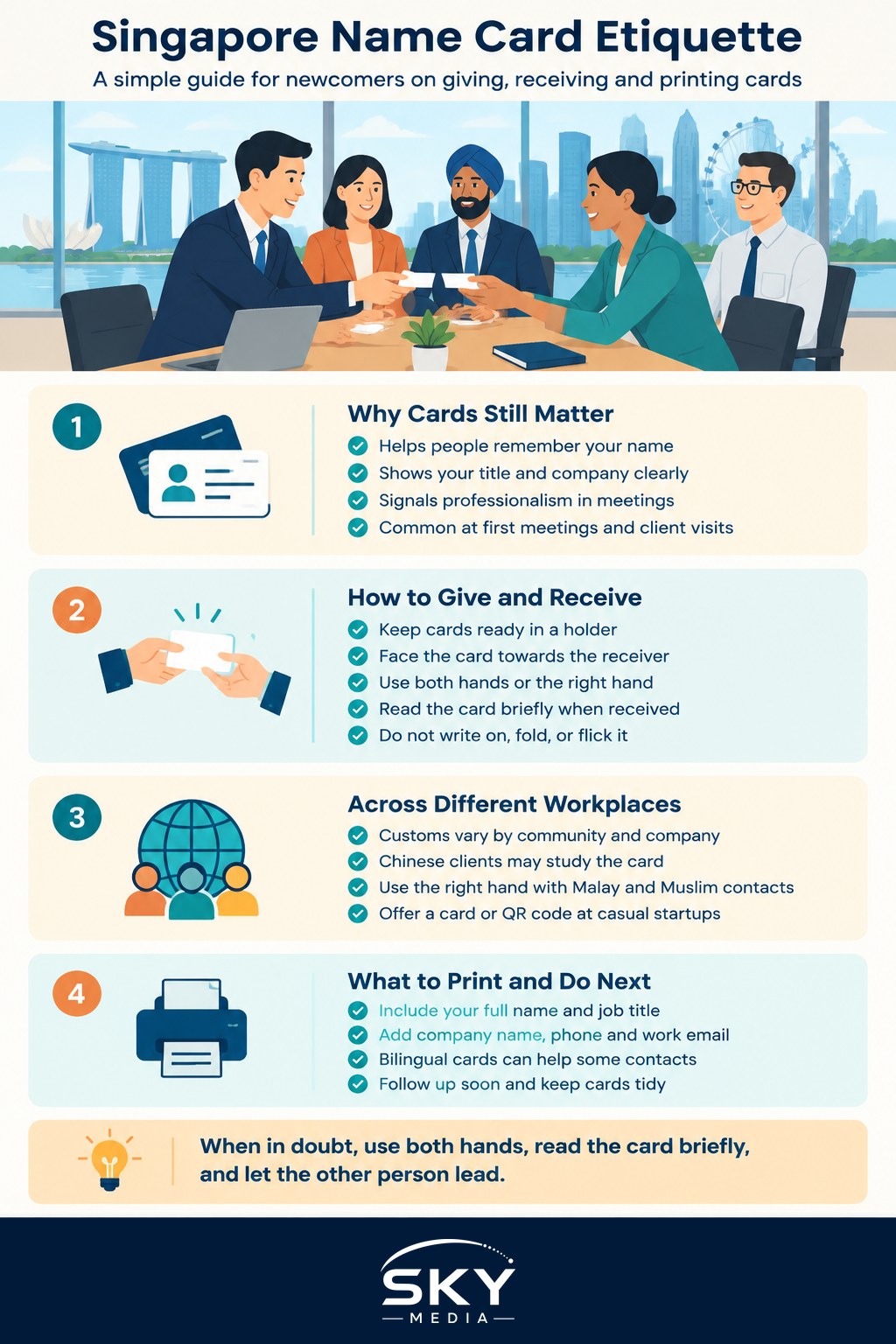
Even in tech-forward workplaces, a name card does several jobs:
- It helps people remember your name. In a multicultural city, names come from Chinese, Malay, Indian, Western and many other traditions. Seeing the spelling helps colleagues pronounce and recall it.
- It shows your title and company clearly, which helps people understand who makes decisions in a meeting.
- It signals professionalism, especially with older clients, regional partners and more traditional sectors.
Expect to exchange cards at first meetings, networking events, trade fairs and client visits. Internal meetings with colleagues you already know rarely involve cards.
How to Give Your Card
The widely observed approach, influenced by East Asian business custom, is simple:
- Have cards ready in a card holder, not loose in a wallet or pocket. Fumbling is the most common small mistake.
- Face the card towards the receiver, so they can read it immediately.
- Offer it with both hands, holding the top corners, or with the right hand. A slight nod or bow of the head is common with Chinese and Japanese counterparts, but not required.
- Say your name as you hand it over, so they hear the pronunciation.
- Give cards in order of seniority when meeting a group, starting with the most senior person, if you can tell.
When cards are exchanged at the same time, people often give with the right hand and receive with the left, then free both hands quickly. Do not worry if this feels awkward. Many locals do it differently.
How to Receive a Card
Receiving well matters just as much, and is where newcomers make most slips.
- Accept with both hands or the right hand, and say thank you.
- Look at the card for a moment. Read the name and title, perhaps comment on the role or office location. This shows you value the person.
- Do not write on the card in front of them, fold it, or flick it.
- During a meeting, place it on the table in front of you. If there are several people, arrange the cards to match the seating. This is also a handy memory aid.
- At the end, put cards away in your card holder or folder, not in your back trouser pocket.
How Customs Vary Across Communities
Singapore’s workplaces mix many cultures, and small differences are worth knowing. Treat these as commonly seen practices, not strict rules, because individuals and companies vary widely.
| Situation | Commonly seen practice | Practical tip |
|---|---|---|
| Chinese clients and older executives | Two-handed exchange, card studied briefly | Use both hands and pause to read the card |
| Malay and Muslim counterparts | Right hand used for giving and receiving | Avoid passing with the left hand alone |
| Indian counterparts | Right hand generally preferred for giving | Offer with the right or both hands |
| Japanese and Korean visitors | More formal bowing and careful handling | Follow their lead and handle the card with care |
| Western-style startups | Casual exchange, often digital | Offer a card or a QR code, whichever suits |
Two broader points apply everywhere. First, greetings between men and women can vary, and some Muslim colleagues may prefer not to shake hands with the opposite sex. Let the other person lead, and a nod with a smile is always fine. Second, titles matter in some sectors, so use “Mr” or “Ms” with a surname until invited to use a first name. For more on everyday norms, see our guide to Singapore etiquette for newcomers.
What to Print on Your Name Card
A clear, uncluttered card works best. Typical contents:
- Full name, written the way you want to be addressed. If you use an English name alongside a Chinese name, consider including both.
- Job title and department. Use a title that local readers will understand.
- Company name and logo.
- Mobile number with the +65 country code, office number and work email.
- Office address, including the postal code and unit number, for example unit #12-01.
- Optional extras: a QR code linking to your professional profile or a vCard, and a company website.
Many professionals, especially those dealing with mainland Chinese, Taiwanese or Hong Kong partners, print a bilingual card with English on one side and Chinese on the other. If you do this, have a native speaker check the translation of your title and company name, as literal translations can sound odd. Choose simplified or traditional characters depending on who you mostly meet.
Your employer usually arranges cards for you. If you need to order your own, local printers and online services can do it quickly. Bring a healthy supply to your first few weeks of meetings.
Digital Cards and QR Codes
Digital sharing has become common since the pandemic years. You may see colleagues scan a QR code from a phone, use a professional networking app, or tap an NFC-enabled card. This is perfectly acceptable, particularly in technology, media and startup circles.
A sensible approach for newcomers is to carry both. Offer a paper card in formal or traditional settings and be ready to share digitally when the other person pulls out a phone. If someone gives you a physical card, it is polite to reciprocate with one rather than only offering to connect online.
Tips for Mainland Chinese Newcomers
If you have worked in mainland China, much will feel familiar. The two-handed exchange and the habit of reading a card carefully are shared. A few differences to note:
- Singapore offices usually work in English, so lead with the English side of a bilingual card unless you know your counterpart prefers Chinese.
- WeChat is less dominant here. Many Singaporeans use WhatsApp, LinkedIn and email for work contact, so make sure those details are easy to find on your card.
- Pace and hierarchy can feel slightly flatter, especially in multinational firms, though seniority is still respected.
Following Up After the Exchange
The exchange is only the start. Within a day or two, send a short email or message referencing your meeting. Save contact details promptly, perhaps by snapping a photo of the card, and note where you met. Keep a holder of cards you receive in good condition, as reaching for a creased card later looks careless.
Name cards are a small ritual, but handling them thoughtfully shows the respect Singapore’s diverse workplaces value. For other social settings where small courtesies matter, see our guides to hawker centre etiquette for newcomers and Chinese New Year visiting etiquette.
Frequently Asked Questions
Is it rude to put someone’s name card in my pocket? It is better not to, especially a back trouser pocket. During the meeting, keep the card on the table in front of you, then put it into a card holder or folder at the end. A creased card reaching into your pocket can look careless.
How many name cards should I bring to a networking event? Bring more than you think you need, since you may meet many people in one session. Carry them in a holder so they stay crisp. It also helps to carry a QR code or vCard for people who prefer to connect digitally.
Should my name card be bilingual if I work with Chinese partners? A bilingual card, with English on one side and Chinese on the other, is common when dealing with mainland Chinese, Taiwanese or Hong Kong partners. Have a native speaker check how your title and company name are translated, and pick simplified or traditional characters to suit your contacts.
What do I do if I run out of cards at a meeting? Apologise briefly and offer to connect digitally, for instance by sharing a QR code or contact details by phone. Follow up within a day or two with an email that includes your details. Carrying a few spares in a work bag avoids the problem.
Do I still need to follow up after exchanging cards? Yes, a short email or message within a day or two, referring to your meeting, makes the exchange count. Save the contact promptly, perhaps by photographing the card, and note where you met. This is how a name card becomes a working contact.