

Plenty of professionals arrive in Singapore with skills they could sell on the side: design, coding, tutoring, consulting, baking, photography. It is natural to wonder whether an employment pass side business is allowed, or whether you can take the odd freelance job on weekends. The short answer is that the Employment Pass (EP) is tied to one specific employer and job, and working outside it without the right permission can put your pass, and your future in Singapore, at risk.
This guide explains what EP holders generally can and cannot do outside their main job, where the grey areas sit, and how to check before you start. It is general information, not legal advice. The Ministry of Manpower (MOM) sets and enforces work pass rules, and they can change. Always confirm your own situation on the MOM website or with a qualified adviser before taking any step.
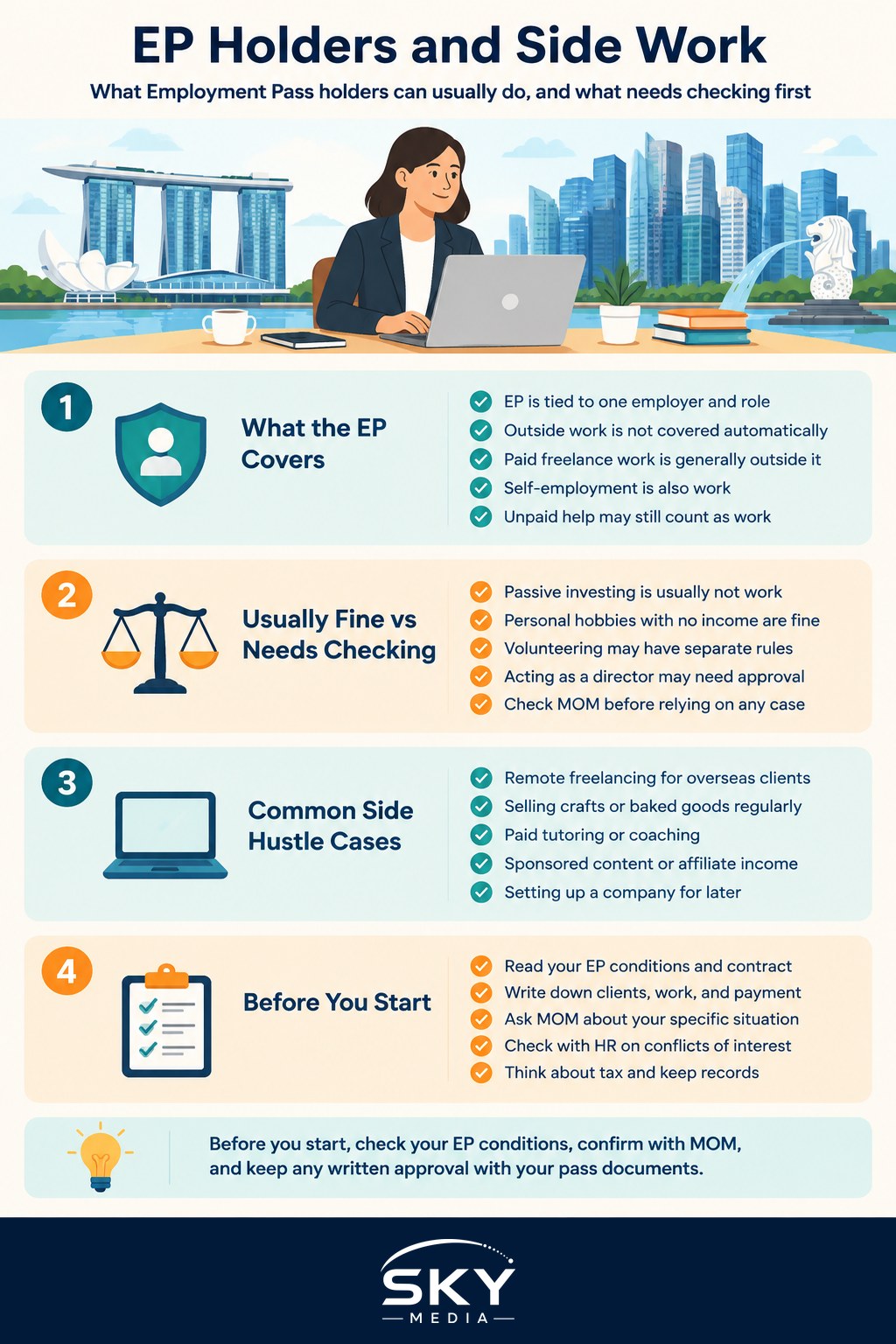
Why the EP Restricts Outside Work
An EP is not a general permission to work in Singapore. MOM approves it for a particular employer, in a particular role, based on that employer’s application. Your pass conditions effectively say: you may work for this company, in this job.
That has some important consequences:
- Working for someone else is work outside your pass. A paid freelance project for another company, even a small one, is generally treated as employment or work that your EP does not cover.
- Self-employment is also work. Running your own business, serving clients or selling services is work in the eyes of the law, even if it happens after hours or from home.
- “Unpaid” does not automatically make it safe. Helping out at a friend’s business in return for nothing may still count as work. MOM looks at the substance of what you are doing, not just whether money changes hands.
- Penalties can be serious. Under the Employment of Foreign Manpower Act, working without a valid pass for that work is an offence. Consequences can include fines, loss of your pass and being barred from working in Singapore in future. Your employer and the other business can also face consequences.
What EP Holders Can Usually Do vs What Needs Permission
The line is not always obvious. The table below gives a general orientation of how common situations tend to be viewed. It is not a ruling on any specific case, so check with MOM before relying on it.
| Activity | General position | What to do |
|---|---|---|
| Investing in shares, funds or property as a passive investor | Usually not treated as work | Keep it genuinely passive; get tax advice where needed |
| Paid freelance work for other clients | Outside the scope of your EP | Do not start without checking with MOM |
| Registering and actively running your own business | Outside the scope of your EP | Check with MOM whether any route applies to you |
| Acting as a director or taking an active role in another company | Depends on MOM rules for your pass | Check MOM’s current guidance before accepting |
| Personal hobbies with no clients or income, such as painting for yourself | Not work | No action needed |
| Volunteering through a registered charity | Rules can apply depending on the activity | Read MOM’s guidance on volunteering by pass holders |
The theme is simple: passive ownership and personal activities are very different from actively working. Owning shares in a company is not the same as running it or serving its customers.
Common Side Hustle Scenarios
Freelancing for overseas clients from home. Many EP holders assume remote work for a foreign client is fine because the client is abroad. But you are physically working in Singapore, and the work is outside your approved employment. Treat this as something to clarify with MOM before taking on, not after.
Selling crafts or baked goods online. If you are making and selling products regularly, that looks like running a business. A one-off sale of your old furniture is different from a recurring home business.
Tutoring or coaching. Paid tutoring, music lessons or fitness coaching for clients is work. Also note that some activities carry their own licensing or registration rules regardless of your pass.
Content creation and online platforms. Earning regularly from sponsored posts, affiliate links or paid content can look like self-employment. Rules in this area are evolving, so check MOM’s latest guidance rather than relying on what others on forums say.
Setting up a company for “later”. Some EP holders want to register a company with ACRA (the Accounting and Corporate Regulatory Authority, which handles business registration through its Bizfile portal) now and start trading once they become a PR. Registration itself has requirements on local directors and other matters. Taking an active role in that company while on an EP is the sensitive part. Get proper advice before setting anything up.
Routes That May Open Up More Flexibility
Your options can change as your status changes. Some routes worth understanding:
- Talk to your employer. Some employers allow limited external activities under a conflict of interest policy. Company approval is not the same as MOM approval, but it is a necessary first step and protects your job.
- Ask MOM directly. MOM has published guidance for pass holders on outside work, and it is the only authority that can confirm what applies to your specific pass. Use official channels, not intermediaries who promise shortcuts.
- Look at other passes. The Personalised Employment Pass (PEP) is not tied to a single employer and has its own rules on what holders may do. Entrepreneurs may also look at the EntrePass. Each has its own eligibility criteria, so read MOM’s pages carefully.
- Permanent residence. Once you are a PR, you no longer need a work pass, and the rules for running a business change considerably. Our guide to starting a side business in Singapore as a PR explains what that looks like.
- Your spouse’s position is different. If your spouse holds a Dependant’s Pass, the rules for them are separate from yours. See our guide on starting a business as a Dependant’s Pass holder.
Practical Steps Before You Start Anything
- Read your EP conditions and your employment contract, including any clauses on outside work, moonlighting or conflicts of interest.
- Write down exactly what you plan to do. Who are the clients, where will you work, how often, and will you be paid? Clear facts make it easier to get a clear answer.
- Check MOM’s website for the current rules on outside work for EP holders, and contact MOM if your situation is not covered.
- Speak to HR if your plan could overlap with your employer’s business, clients or intellectual property.
- Think about tax. Income from any lawful source may need to be declared to IRAS (the Inland Revenue Authority of Singapore). Our guide on reporting freelance and side hustle income to IRAS covers the basics for those who are permitted to earn it.
- Keep records. If you do get written confirmation or approval, save it with your pass documents.
The Bottom Line for EP Holders
An EP gives you the right to do one job well, not to build a portfolio career on the side. Passive investing and personal hobbies are generally fine, but freelancing, consulting, running a business or actively working for another company all need careful checking against MOM’s rules for your pass before you begin. The safest approach is to ask first, get the answer in writing where possible, and treat your pass as something worth protecting. A side income is rarely worth the risk to your ability to live and work in Singapore.
Official sources: Ministry of Manpower (MOM)
Further reading: What Business Visitors Can Do in Singapore Without a Work Pass · Understanding Work Pass Quotas and Levies