

Buying a home with your parents can be a smart, warm decision. Pooling incomes may unlock a larger or better-located property, sharing a roof keeps the family close, and having grandparents nearby is a real help for young families. But co-owning with parents also raises questions that a solo purchase never does: whose name goes on the title, how ownership is split, how Additional Buyer’s Stamp Duty (ABSD) might apply, and what happens if someone dies, falls ill or wants out. This guide walks through the practical and legal issues in plain language. It is general information only, not legal, tax or financial advice, so treat it as a starting point and get advice specific to your family.
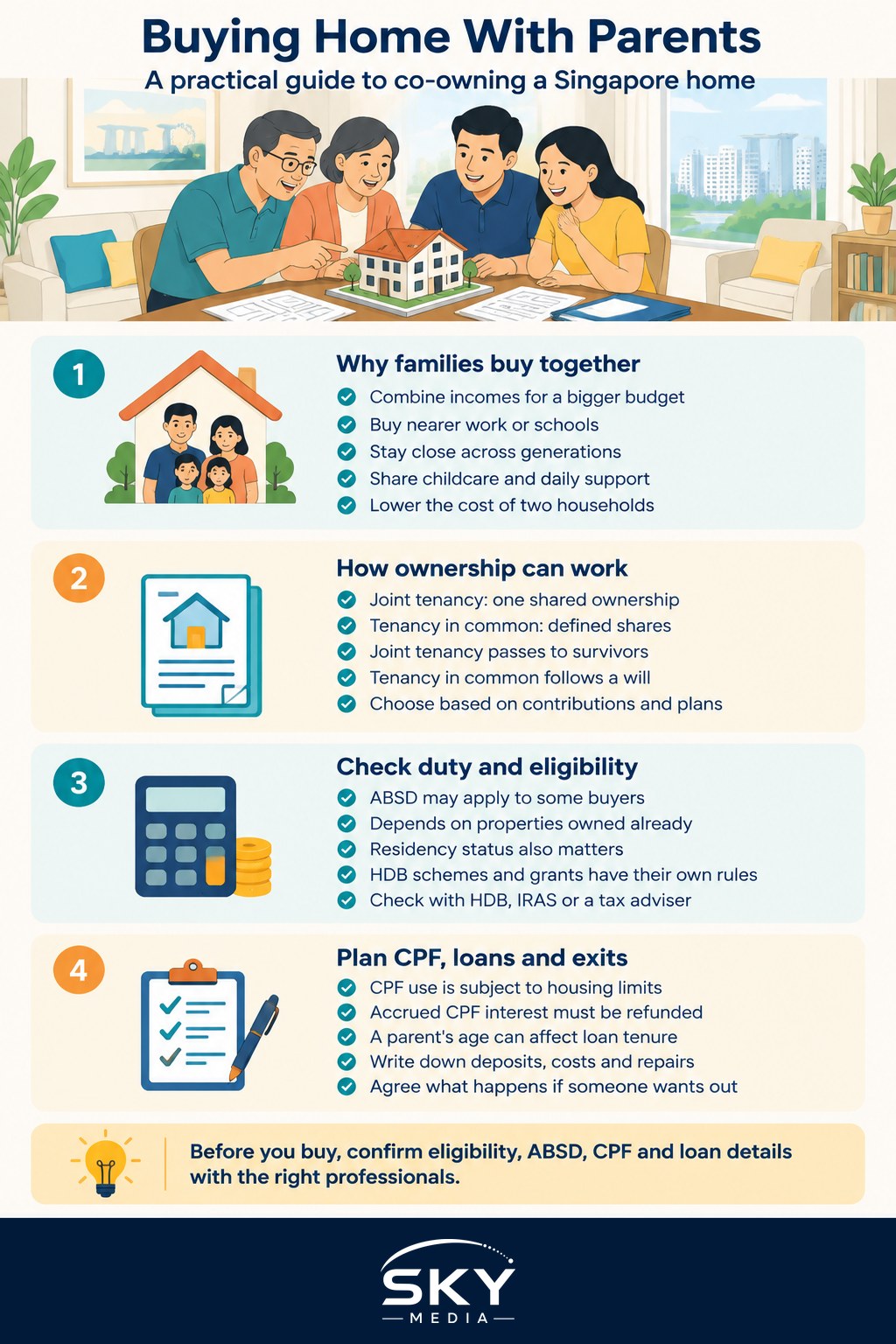
Why Families Buy Together, and What to Weigh
The appeal is easy to understand. Combining incomes can raise borrowing power and let a family afford more space or a spot closer to work and schools. Multigenerational living can lower the total cost of two households, provide built-in childcare, and let ageing parents stay near support rather than living alone.
The trade-offs deserve equal thought. Money and family are a delicate mix, and a home ties everyone together for years. Before committing, talk openly about the things people often avoid:
- Who pays for what, both the deposit and the monthly instalments
- Whose CPF and cash go in, and in what proportion
- What happens if someone’s circumstances change: a job loss, a marriage, an illness
- Whether one party might want to sell or move out later
- How decisions about renovation, tenants or a future sale will be made
Writing these answers down early, before feelings run high, is one of the kindest things a family can do for itself.
How to Hold the Property: Two Ownership Structures
When more than one person owns a home in Singapore, the legal form of that ownership matters a great deal. There are two main structures, and the difference affects tax, inheritance and what happens if one owner dies.
| Feature | Joint tenancy | Tenancy in common |
|---|---|---|
| Ownership shares | All owners hold the whole property together, with no distinct shares | Each owner holds a defined share, such as equal or unequal portions |
| If an owner dies | The share passes automatically to the surviving owners | The share passes under the deceased’s will or intestacy rules, not automatically |
| Common use | Couples or family members who want survivorship | Where owners contribute unequally or want to control who inherits their share |
| Flexibility | Simpler, but less control over a share | More control, but needs clear estate planning |
Neither structure is “better” in the abstract; the right choice depends on how much each person contributes, what you want to happen on death, and your wider estate plans. A conveyancing lawyer can explain how each option plays out for your family and put it into effect correctly. See our guide to engaging a conveyancing lawyer for what to expect.
The ABSD and Eligibility Traps to Check First
This is the area where families are most often caught out, so approach it carefully. ABSD is an extra stamp duty that can apply depending on each buyer’s profile, in particular how many residential properties they already own and their residency status. If a parent already owns a home and is added as a co-owner of a second, ABSD may be triggered on the purchase. The rates and rules change, and they turn on each individual’s situation, so never assume, and never rely on a figure you saw online.
Some families try to sidestep this by having a parent hold only a tiny share, or by using arrangements like the 99-to-1 structure. Be very cautious. IRAS has scrutinised such arrangements where they appear designed to avoid ABSD, and getting it wrong can mean back-duty and penalties. Do not structure a purchase primarily to avoid duty. Instead, get proper tax and legal advice and let the professionals confirm what is legitimate.
Eligibility is the other trap. For HDB flats, schemes and grants have their own conditions on relationships, citizenship, income and existing property, and buying with parents may or may not fit a given scheme. For private property, the loan and ownership rules still apply to each buyer. Confirm your specific eligibility with HDB (for flats) and check the current ABSD position with IRAS or a tax adviser before you commit. Our overview of ABSD explains how the duty works in principle.
CPF, Loans and Working Out What You Can Afford
Pooling resources changes the sums, but it does not remove the limits. Each buyer’s CPF can generally be used towards the purchase within the applicable housing limits, and each person’s use of CPF creates an accrued-interest obligation that must be refunded to their CPF account if the property is later sold. That reduces the cash everyone walks away with, so factor it in from the start.
On the loan side, banks assess borrowers against affordability and loan rules, and a parent’s age can affect the loan tenure the bank will offer, which in turn affects the monthly instalment. A shorter tenure means higher repayments, so the arithmetic of buying with an older co-owner is not always as generous as it first looks. Because CPF limits, loan rules and affordability caps all change and depend on your numbers, model the real figures with your bank and check current CPF rules with the CPF Board. Our guides to how much home you can afford and using CPF for your monthly instalments are useful companions here.
Protecting Everyone: Agreements and Exit Plans
Even the happiest family purchase benefits from a clear, written understanding. Because the home may be held for decades, plan for change rather than assuming things stay the same.
Consider putting the following in place, with a lawyer’s help:
- A record of each person’s contributions to the deposit, instalments and renovation.
- Agreement on how ongoing costs, repairs and property tax are shared.
- A plan for what happens if someone wants to sell, move out or can no longer pay.
- Up-to-date wills that reflect how each owner wants their share to pass on.
- A shared understanding of decision-making for renovation, tenants or a future sale.
These conversations are not a sign of distrust; they are what keeps trust intact when life throws up the unexpected. A young couple weighing this route may also find our guide to buying a home as a young couple helpful for the affordability side.
Above all, remember the limits of any general guide. Ownership structures, ABSD, CPF rules, HDB eligibility and loan limits all change over time and depend on your family’s specific facts. Nothing here is legal, tax or financial advice. Before you buy, speak to a conveyancing lawyer about how to hold the property and protect each person, confirm eligibility with HDB, verify the current ABSD position with IRAS or a tax adviser, and model the loan and CPF numbers with your bank. Done thoughtfully, buying with your parents can be a genuine win for the whole family.
Related across Sky Media: Renting vs Buying a Home When You Arrive · Using Your CPF to Buy a Home in Singapore
Official sources: HDB