

For most people in Singapore, the monthly home loan payment is the single largest bill they will ever commit to. The good news is that you rarely have to pay all of it in cash. Using CPF for instalments lets you tap your CPF Ordinary Account (OA) savings to service your housing loan, which frees up cash for daily life. The catch is that CPF is retirement money, and drawing it down for property has long-term consequences you should understand before you sign anything.
This guide explains how CPF housing payments work, what the accrued interest rule really means, and the trade-offs to weigh. It is general information, not financial advice, and none of the figures below are current rates. Always confirm the numbers that apply to you with the CPF Board and, for loans, a bank or a MAS-regulated adviser.
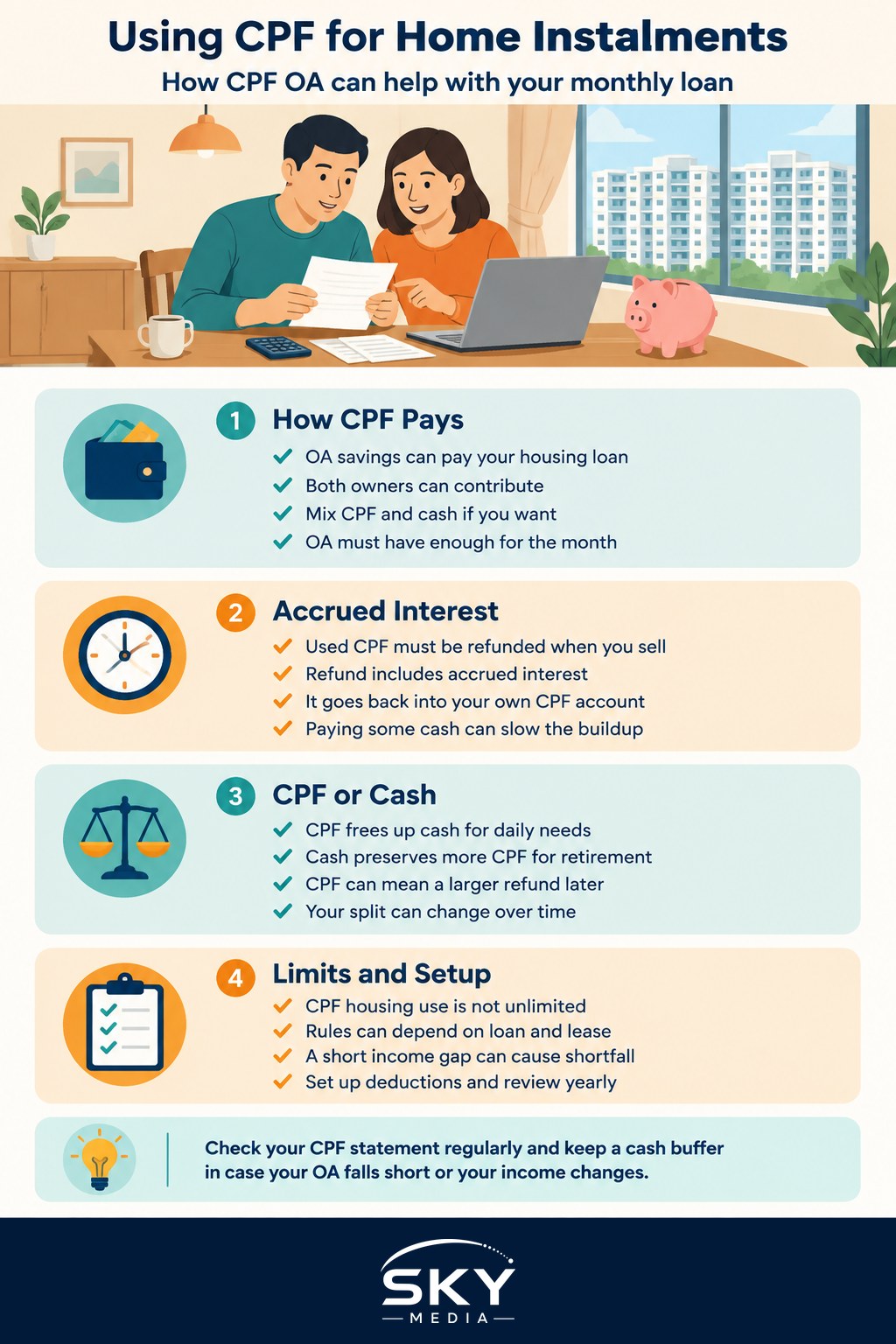
How CPF Pays Your Monthly Instalment
The savings in your CPF Ordinary Account can be used towards buying a home and towards the monthly loan repayment that follows. Once your purchase completes and CPF is set up for housing, the amount due each month is deducted automatically from your OA and paid towards your loan.
A few things are worth knowing up front:
- Both owners can contribute. If a couple owns the home together, each person’s OA can be used to service the shared loan, in whatever split you arrange.
- You can mix CPF and cash. You do not have to pay the whole instalment from CPF. Many owners pay part from OA and top up the rest in cash, or switch the balance over time.
- OA must have enough. CPF only pays what is sitting in your OA. If your OA balance runs dry in a given month, you must cover the shortfall in cash, or the loan falls into arrears.
- The rules differ by loan type. An HDB housing loan and a bank loan have different servicing arrangements, and the amount of CPF you may use can be capped once your loan crosses certain limits set by the CPF Board.
Because CPF contributions from your salary keep flowing into your OA each month, many working owners find the deduction roughly self-sustaining. That balance can change the moment your income stops, so it pays to plan for gaps.
The Accrued Interest You Have to Pay Back
This is the part first-timers most often miss. CPF savings earn interest while they sit in your account. When you use OA money for your home, you are taking those savings out early, so they stop earning that interest. To keep your retirement savings whole, CPF requires that when you sell the property, you refund the amount you used plus the interest that money would have earned had you left it untouched. That refund is called accrued interest.
Accrued interest is not a penalty and it is not paid to anyone else. It goes straight back into your own CPF account. But it compounds year after year, so the longer you hold the property and the more OA you use, the larger the refund becomes. In a flat or falling market, it is possible for the sale proceeds, after clearing the outstanding loan and the CPF refund, to leave you with little or no cash. This is often described as selling with “negative cash”, and it surprises owners who assumed their home was pure profit.
The practical takeaways:
- Track how much OA you have used and roughly what the accrued interest has grown to. The CPF Board shows this in your statement.
- Remember the refund only bites when you sell. If you keep the home, you simply continue holding an obligation to your future self.
- Paying part of your instalment in cash reduces how fast accrued interest builds. Some owners do this deliberately to protect their eventual sale proceeds.
For a fuller picture of what a purchase really costs beyond the loan, see our guide to budgeting for the full cost of buying.
CPF Versus Cash: Weighing the Trade-Off
There is no single right answer. Paying with CPF preserves your cash and liquidity today, while paying with cash preserves your CPF and reduces accrued interest for tomorrow. The table below lays out the broad trade-offs. Treat every entry as a general illustration, not a rule, and check specifics with the CPF Board.
| Consideration | Paying with CPF (OA) | Paying with cash |
|---|---|---|
| Effect on monthly cash flow | Frees up cash for daily needs | Uses cash you could invest or save |
| Retirement savings | Draws down OA, slows CPF growth | Keeps OA compounding for retirement |
| Accrued interest on sale | Builds up, larger refund owed later | Little to none from that portion |
| Best suited to | Owners who need cash flow flexibility | Owners with spare cash prioritising CPF |
| Flexibility | Can switch the CPF and cash split later | Can start using CPF again if needed |
Your right mix depends on your income stability, how long you plan to hold the home, your other savings, and your retirement goals. Someone early in their career with tight cash flow may lean on CPF; someone with comfortable savings and an eye on retirement adequacy may prefer more cash. A mortgage broker or an independent adviser can model this against your actual numbers.
Limits, Eligibility and When CPF Stops Covering It
CPF usage for housing is not unlimited. The CPF Board sets caps on how much OA you can use, and these can depend on the property’s remaining lease, the type of loan, and the loan-to-value position. Once you reach certain thresholds, you may be required to set aside a portion of savings before further OA can be used, or to top up the instalment in cash. These limits and thresholds are reviewed periodically, so never assume the figure a friend quoted a few years ago still applies.
A few situations to plan for:
- The lease is short. For older properties, the amount of CPF you can use may be reduced or restricted, because CPF rules link housing use to the lease covering the youngest owner to a set age. Ageing leases affect both financing and resale value, which we cover in lease decay and property value.
- Your income stops. During unemployment, a career break or retirement, OA inflows pause. If your OA cannot cover the instalment, you need a cash buffer ready.
- You refinance or switch loans. Moving between an HDB loan and a bank loan, or between banks, can change how CPF servicing is arranged.
Before you commit, it helps to know how big a loan you can comfortably carry in the first place. Our guide on how much home you can afford walks through that. Remember that CPF servicing does not make a loan cheaper; it only changes which pocket the money comes from.
Getting the Setup Right
To use CPF smoothly, keep a few habits:
- Make sure your CPF housing deduction is set up correctly at the start, and check that the monthly deduction is actually going through.
- Keep a cash buffer of several months of instalments, in case your OA runs short or your income dips.
- Review your CPF and cash split once a year, or after any big change such as a new job, a new baby, or a refinance.
- Read your CPF statement so the accrued interest figure never comes as a shock at sale.
Using CPF for instalments is a normal, sensible part of home ownership in Singapore, and it makes buying possible for many families. Used thoughtfully, with an eye on the accrued interest you are quietly building up, it is a tool rather than a trap.
This article is general information only and not financial, tax or legal advice. CPF rules, housing limits and interest rates change over time. Confirm the current rules and your own figures with the CPF Board, and speak to a bank or MAS-regulated adviser about your loan before deciding.