
Setting up a home kitchen after moving abroad is one of the small joys of settling in, and getting the right tools makes cooking the food you grew up with far easier. Shopping for chinese cooking equipment singapore residents rely on is straightforward once you know what to prioritise and where to look. This guide walks a newcomer through the core pieces, how to choose well, and how to care for them so they last for years.
Availability and stock change often, so treat the shopping suggestions here as general directions rather than a fixed list, and check current listings.
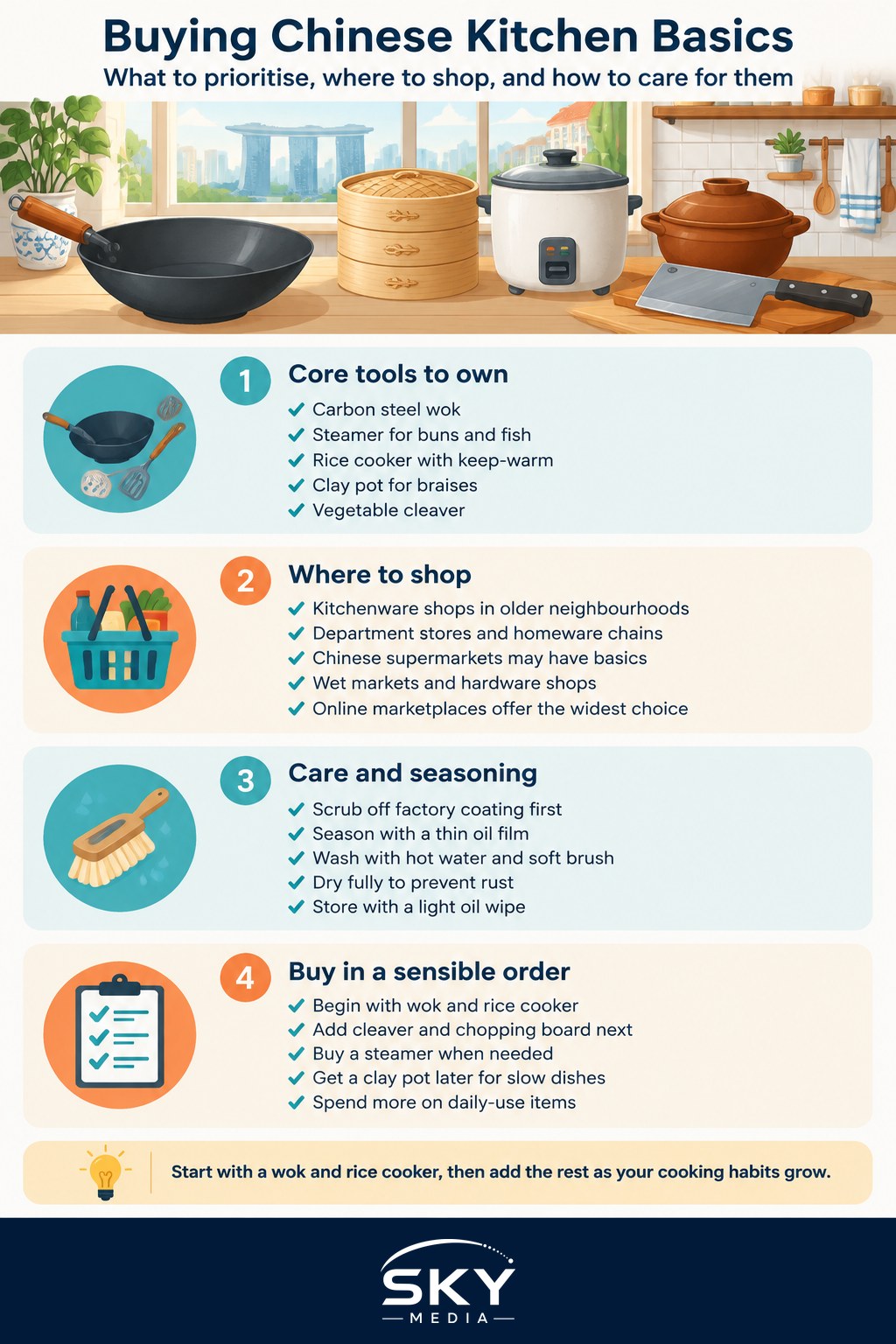
The core pieces worth owning
You do not need a cupboard full of gadgets to cook well. A handful of well chosen tools will cover most home cooking.
| Item | What to look for | Main use |
|---|---|---|
| Carbon steel wok | Thin, light, a flat base for most home hobs | Stir frying, deep frying, steaming |
| Steamer | Bamboo baskets or a stacking metal steamer | Buns, fish, dumplings, vegetables |
| Rice cooker | Size to suit your household, a keep warm function | Everyday rice, congee, some one pot dishes |
| Clay pot | A glazed interior, sound with no cracks | Claypot rice, slow braises, soups |
| Cleaver | A vegetable cleaver for daily use | Chopping, slicing, smashing garlic |
A carbon steel wok is the single most useful item. Unlike a heavy cast iron pan, carbon steel heats quickly, responds fast to changes in heat and stays light enough to toss food. For most flats here with an induction or gas hob, a flat based wok sits more stably than the traditional round based one, which really needs a wok burner. Choose a size that suits your household, as a wok that is too large for a small hob will never heat evenly.
For steaming, you can choose between traditional bamboo baskets, which are inexpensive and impart a gentle fragrance, and a stacking metal steamer, which is more durable and easier to clean. Either sits over a wok or pot of boiling water.
Where to buy in Singapore
You have several good options, and prices and quality vary, so it is worth looking in more than one place.
- Kitchenware shops in older neighbourhoods and around Chinatown often carry traditional woks, cleavers, clay pots and bamboo steamers at reasonable prices, and the staff can advise on sizing.
- Department stores and homeware chains stock rice cookers, non stick pans and mid range equipment, useful if you prefer well known brands with warranties.
- Chinese supermarkets sometimes have a small homeware section alongside the groceries.
- Wet markets and hardware shops can be a surprising source of sturdy, no frills basics.
- Online marketplaces give the widest choice and let you compare brands, though you cannot feel the weight of a wok before buying.
For a first kitchen, buying the wok and cleaver in person is worth the trip, because feeling the balance and weight in your hand tells you a lot that a photograph cannot.
Seasoning and caring for a carbon steel wok
A new carbon steel wok usually arrives with a factory coating that must be scrubbed off before first use, then it needs seasoning to build a natural non stick layer. To season, wash and dry the wok, then heat it and wipe a thin film of high smoke point oil over the inside surface, letting it heat until it darkens. Repeating this builds up a patina over time.
After each use, wash the wok with hot water and a soft brush, avoiding harsh scouring that strips the seasoning. Dry it thoroughly over low heat, because any trapped moisture will cause rust in Singapore’s humidity, then wipe a very light film of oil over the surface before storing. Treated this way, a cheap carbon steel wok will outlast almost any non stick pan and only improve with age.
Caring for steamers, clay pots and cleavers
Bamboo steamers should be rinsed rather than soaked, dried completely before storing, and kept somewhere airy, as trapped damp encourages mould in our climate. Clay pots need gentle treatment: avoid sudden temperature changes, such as putting a hot pot onto a cold surface or adding cold liquid to a hot pot, since the shock can crack the clay. Some cooks soak a new clay pot in water before first use.
A good cleaver deserves respect and a little maintenance. Wash and dry it by hand rather than leaving it in a wet sink or a dishwasher, hone it regularly to keep the edge keen, and store it where the blade is protected. A carbon steel cleaver takes a sharper edge but can rust, so dry it well, while a stainless steel one is lower maintenance. Handled properly, a single good cleaver will serve you for many years.
A sensible order to buy things
A newcomer setting up a first kitchen does not need to buy everything at once, and spreading the purchases out lets you learn what you actually reach for. A practical order is to start with a rice cooker and a carbon steel wok, since between them they handle the bulk of everyday cooking. Add a cleaver and a chopping board next, then a steamer once you start making buns, fish or dumplings, and finally a clay pot when you fancy claypot rice or slow braises. This way your budget follows your cooking rather than your cupboard filling with tools you rarely touch.
When comparing prices, remember that the cheapest option is not always the false economy it appears, nor the most expensive the best. A modest carbon steel wok often outperforms a pricey non stick pan for high heat cooking, while a reliable mid range rice cooker from a known brand is usually worth more than a bargain one that fails within a year. Buy the items you use daily to a good standard, and economise on the occasional pieces. Judging where to spend and where to save comes quickly once you have cooked a few weeks of meals at home.
Explore more
A Chinese Sauces and Condiments Shopping Guide
Chinese Tea Culture in Singapore
Chinese Desserts and Tang Shui
Vegetarian Food in Singapore
Frequently Asked Questions
Can I use a round-bottomed wok on an induction hob in Singapore? Not on a standard flat induction hob, since the pan will not sit stably or heat properly. Choose a flat-based wok for flats, or look for a hob designed for round woks. Check what your own hob supports before buying.
Carbon steel or non-stick wok, which is better for a beginner? Carbon steel handles high heat and lasts for years, but needs seasoning and drying to prevent rust. Non-stick is easier at first but not suited to very high heat. If you cook Chinese stir-fries often, carbon steel is usually worth learning.
What size rice cooker should I buy for my household? Match capacity to how many people you cook for and how often you make extra rice or congee. A slightly larger cooker is more flexible, but too large wastes space. A keep-warm function is handy, and buying a known brand helps with warranty.
How do I get rid of rust on a carbon steel wok? Scrub the rusted area off with a soft scourer, wash, dry thoroughly over low heat and re-season with a thin film of oil. To prevent it recurring in Singapore’s humidity, never leave the wok wet and wipe a light coat of oil after drying.
Is it worth buying a steamer if I already have a rice cooker? If you often make buns, fish, dumplings or vegetables, yes. Some rice cookers have a steaming tray, but a bamboo or stacking steamer over a wok gives more room. Buy it later, once you know you will use it regularly.
Further reading: Taking a Chinese Cooking Class in Singapore