

At some point, many long-term residents start wondering whether to keep renting or to buy. For foreigners, buying property in Singapore is possible, but the rules are specific, and the taxes can be substantial. Knowing what you are allowed to buy, and what it will really cost, saves a lot of wasted viewings and misplaced expectations. This guide sets out the essentials.
This is a general overview, not financial, legal or property advice. Rules, rates and eligibility change, and property is a major commitment, so confirm the current position with the relevant authorities and engage qualified professionals. The Inland Revenue Authority of Singapore (IRAS) handles stamp duties, and rules on residential property ownership are set by the authorities.
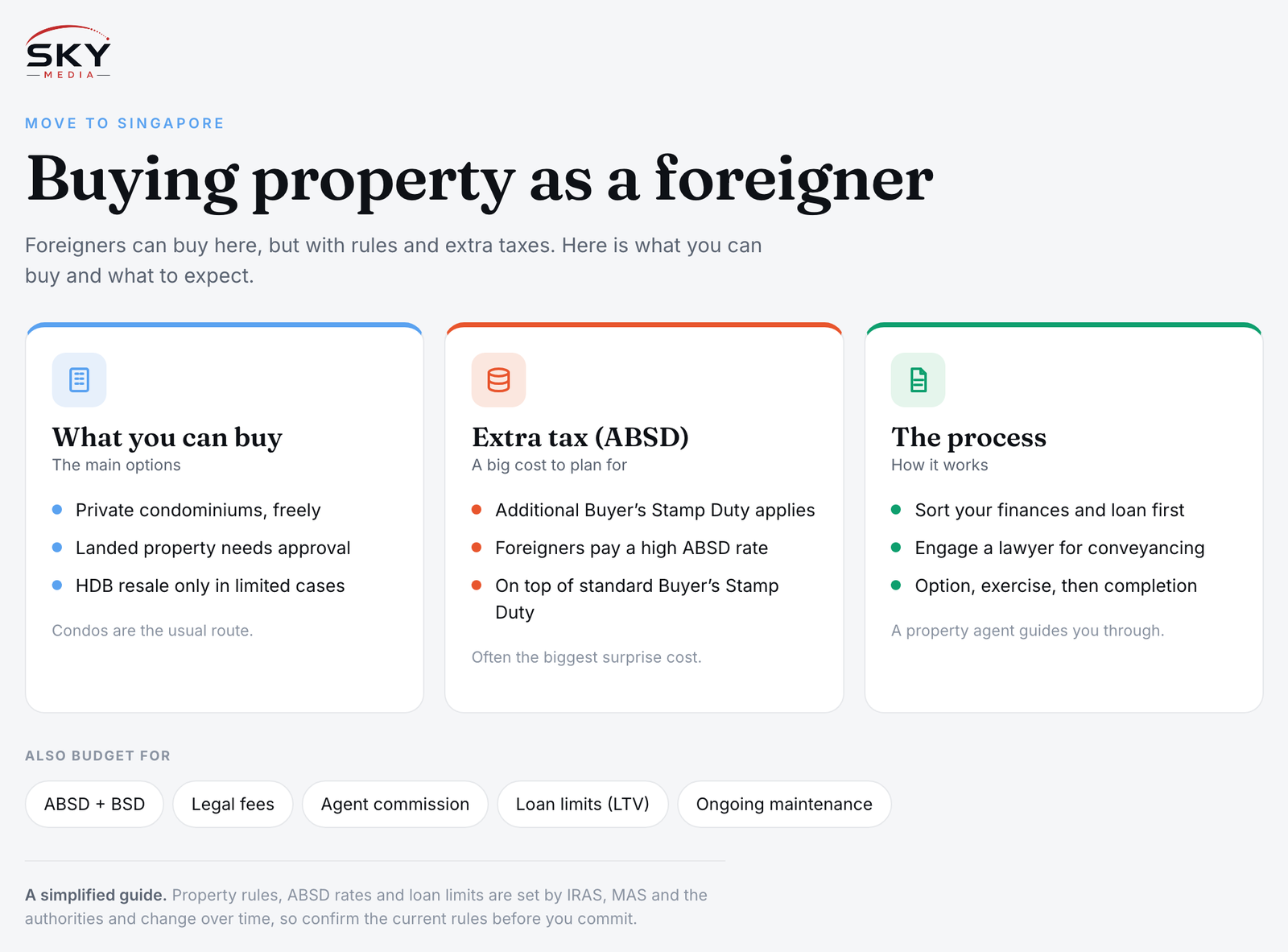
What foreigners can and cannot buy
Not all property is open to foreign buyers, and this is the first thing to understand.
- Private condominiums and apartments are generally the main option open to foreigners, who can typically buy units in these developments without special approval.
- Landed residential property, such as bungalows and terrace houses, is restricted for foreigners and usually requires special approval, which is not routinely granted.
- HDB flats, the public housing where most Singaporeans live, are not available for foreigners to buy on the open market in the way citizens and Permanent Residents access them. Eligibility for HDB is tied to citizenship and residency and various schemes.
For most foreign buyers, the practical universe is private condominiums.
| Property type | Foreigner access | Notes |
|---|---|---|
| Private condo or apartment | Generally open | The usual route for foreign buyers |
| Landed home (bungalow, terrace) | Restricted | Special approval needed, rarely granted |
| New HDB flat | Not open to foreigners | Tied to citizenship and residency |
| Resale HDB | Not open to foreigners on the open market | Eligibility is citizenship and PR based |
The big cost: Additional Buyer’s Stamp Duty
The single most important number for a foreign buyer is the Additional Buyer’s Stamp Duty, or ABSD. This is a tax on residential property purchases that applies on top of the standard Buyer’s Stamp Duty, and the ABSD rate for foreigners is notably high. It is charged as a percentage of the purchase price or valuation, and for foreign buyers it is the highest tier.
This matters enormously because it can add a very large sum to your purchase. Before you fall in love with a unit, calculate the stamp duties, since they materially change your budget. Rates are set by policy and have been adjusted over time, so always check the current ABSD rate for your buyer profile with IRAS rather than relying on an old figure.
The standard Buyer’s Stamp Duty
Separately from ABSD, all buyers pay Buyer’s Stamp Duty, which is calculated on the purchase price or market value in tiers. It applies to everyone, foreigners and locals alike, and is in addition to any ABSD. Factor both into your sums.
Financing your purchase
Foreigners can often obtain a home loan from banks here, but expect conditions.
- Banks assess your income, existing debts and the property, and they cap how much they will lend against the value.
- You will need a cash and savings portion for the deposit, since financing does not cover the full price.
- Loan terms, interest structures and eligibility vary, so compare and get in-principle approval before committing.
Because the upfront cash requirement combines the deposit and the stamp duties, the sum you need available at the start is significant. Plan this carefully.
The buying process step by step
While details vary, a typical private property purchase runs roughly like this:
- Work out your budget, including the deposit, Buyer’s Stamp Duty and ABSD, plus legal and other fees.
- Get financing in principle from a bank so you know your limit.
- View and select a suitable unit, often with a property agent.
- Make an offer and, for resale, secure the unit with an Option to Purchase, paying an option fee.
- Exercise the option within the set period, paying the next portion.
- Engage a conveyancing lawyer to handle the legal transfer and searches.
- Pay the stamp duties to IRAS within the required timeframe.
- Complete the purchase, settle the balance through your financing and funds, and collect the keys.
For a new launch bought from a developer, the sequence differs, with progressive payments tied to construction stages.
Costs beyond the price
Buying involves more than the sticker figure. Budget for:
- Buyer’s Stamp Duty and, for foreigners, ABSD.
- Legal and conveyancing fees.
- Valuation and loan-related costs.
- Agent fees where applicable.
- Ongoing costs after purchase, such as maintenance fees for condominiums, property tax, and home insurance.
Should you buy at all
Given the high ABSD for foreigners, many decide that renting makes more sense unless they are staying long term or have become a Permanent Resident, since PR status changes the stamp duty position compared with a foreigner. Weigh how long you plan to stay, whether your circumstances might change to PR, and the opportunity cost of the large upfront outlay. Property here can be a solid asset, but the entry costs for foreigners are steep, so the maths needs to work for your timeline.
Get the right help
Property is too big a decision to navigate on assumptions. Engage a licensed property agent, a conveyancing lawyer and, if useful, a mortgage adviser. Confirm the current stamp duty rates and eligibility rules with IRAS and the relevant authorities, and make sure you have run the full cost, not just the price, before you commit. Done with eyes open, buying can be a rewarding step. Done in a rush, the taxes and fees can be a painful surprise.
Explore more: Renting in Singapore · Cost of living in Singapore · Moving to Singapore checklist