

If your child is learning English as a second language, or you have just moved to Singapore and want a clear measure of their level, you may have come across the Cambridge English exams for young learners. Parents often ask what these tests actually check, where children can sit them, and whether they are worth the time and money when Singapore schools already teach in English. This guide to Cambridge English exams for kids in Singapore answers those questions so you can decide calmly.
These exams are separate from Singapore’s national exams. The GCE O-Level and A-Level papers are set jointly by the Singapore Examinations and Assessment Board (SEAB) and Cambridge, but the Cambridge English Qualifications described here are optional, international language certificates. They are not part of the MOE curriculum and are not needed for school admission.
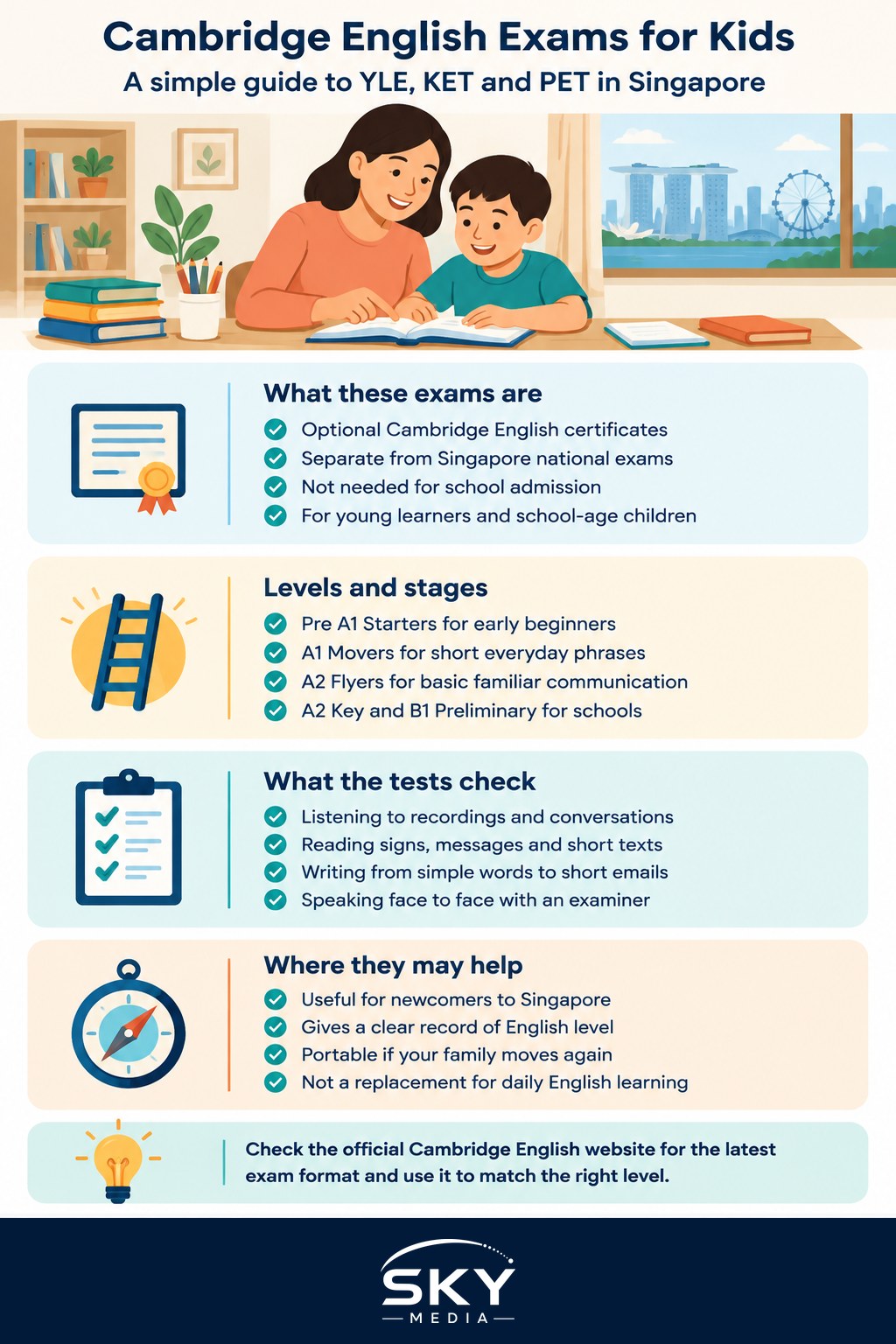
The Cambridge English Levels for Children
Cambridge English Qualifications follow the Common European Framework of Reference for Languages, or CEFR. The CEFR describes language ability in six bands, from A1 (beginner) up to C2 (highly proficient). The young learner and school-age exams cover the lower bands, where most children start.
Young Learners exams (often called YLE):
- Pre A1 Starters: for young beginners who can understand and use simple words and phrases.
- A1 Movers: for children who can handle short, everyday conversations and simple texts.
- A2 Flyers: for children who can manage basic communication in familiar situations.
School-age exams:
- A2 Key for Schools (formerly KET): shows a child can use basic English for everyday tasks, such as simple messages and short conversations.
- B1 Preliminary for Schools (formerly PET): shows a child can use English independently in familiar situations, read straightforward texts and write simple connected pieces.
The “for Schools” versions use the same level as the general exams but with topics designed to interest school-age learners.
| Exam | CEFR level | Typical stage | What it shows |
|---|---|---|---|
| Pre A1 Starters | Pre A1 | Early primary beginners | Recognises basic words, follows simple instructions |
| A1 Movers | A1 | Lower to middle primary | Understands and uses short everyday phrases |
| A2 Flyers | A2 | Middle to upper primary | Handles simple conversations and short texts |
| A2 Key for Schools | A2 | Upper primary to lower secondary | Uses basic English for everyday situations |
| B1 Preliminary for Schools | B1 | Lower to middle secondary | Uses English independently on familiar topics |
The typical stages above are only a rough guide. Cambridge does not fix exams to ages, and what matters is your child’s actual level.
What Each Exam Tests
All the exams check the four main language skills, though the way they are grouped varies by level:
- Listening: understanding short recordings, instructions and conversations.
- Reading: understanding signs, messages, stories and short articles.
- Writing: from copying and completing words at Starters, to short emails and stories at Key and Preliminary.
- Speaking: a short face-to-face test with an examiner, or with another candidate at the higher levels.
The young learner exams are designed to be encouraging. There is no pass or fail in the usual sense. Children receive shields for each skill area, so they can see what they did well and what to work on next. At Key and Preliminary level, candidates receive a score on the Cambridge English Scale and a result that shows whether they reached the target level.
Cambridge publishes the exact format, timing and sample papers for each exam on its official website. Use those as your main reference rather than older materials, because formats are updated from time to time.
Where to Sit the Exams in Singapore
Cambridge English exams are run through authorised exam centres. In Singapore, these typically include some international schools, language schools and established English language providers that are approved by Cambridge.
To find one:
- Use the centre search on the official Cambridge English website and choose Singapore.
- Contact a few centres to ask about upcoming dates, whether they offer paper-based or computer-based versions, and registration deadlines.
- Ask about the exam fee, what is included, and the policy if your child is unwell on the day. Fees are set by each centre and can change, so get the current figure in writing.
- Check what your child needs to bring, such as identification and stationery, and how early to arrive.
Some international schools enter their own students as a group. If your child attends one, ask the school first, because it may be easier than registering independently.
Are Cambridge English Exams Worth It?
The honest answer is that it depends on why you want one.
They can be useful if:
- Your child is new to Singapore and English is not their first language. A recognised level gives you and the school a shared way to talk about progress. If your family has recently arrived from China, our guide on choosing an English holiday camp for kids new from China pairs well with a clear exam goal.
- You may move overseas again and want a portable record of English level.
- Your child enjoys working towards goals and finds a certificate motivating.
- You want an independent check, separate from school marks.
They may not add much if:
- Your child is already doing well in English in a local school. The school curriculum and PSLE preparation are more directly useful for their education in Singapore.
- Your child is anxious about tests. Adding another exam can add stress without clear benefit.
- You are hoping it will help with local school admissions. It is not a requirement, and schools have their own processes.
The exams are not a replacement for regular reading, conversation and play in English. They are a snapshot of where a child is on one particular day.
Preparing Without Pressure
Good preparation looks a lot like good everyday English learning:
- Read together every day. Picture books for Starters, chapter books for older children. Talk about the story afterwards.
- Use official sample papers. Try one under relaxed conditions so your child knows the format and is not surprised on the day.
- Practise speaking naturally. Chat in English about school, hobbies and weekend plans. The speaking test rewards confident, simple answers more than perfect grammar.
- Keep it fun. Games, songs and English videos build vocabulary without feeling like homework.
- Choose the right level. It is better for a child to sit a level they can enjoy and succeed at, then move up, than to struggle with one that is too hard.
If you are helping your child with both languages at home, our guide on how to build Mandarin confidence in English-speaking kids offers the same balanced approach for the other direction.
A Simple Decision Checklist for Parents
Before booking, ask yourself:
- What do I want this exam to tell me or my child?
- Which level matches my child’s current English, based on sample papers?
- Is there an authorised centre with a date that suits our schedule?
- Will preparing for it fit around school without adding too much pressure?
- How will we celebrate the effort, whatever the result?
Cambridge English exams can be a helpful milestone for children in Singapore, especially newcomers. Treat them as one tool among many, check the official Cambridge English website for current formats, and keep your child’s enjoyment of English at the centre.
Further reading: How to Do Synthesis and Transformation in PSLE English