
Many Singapore parents describe the same pattern. Their child has had years of Mandarin at preschool and in primary school, understands most of what grandma says, and can get through a spelling list. Yet when someone actually speaks to them in Mandarin, they freeze, mumble, or answer in English. If you want to improve child Mandarin in Singapore in a home where English is the main language, the gap is usually not exposure. It is confidence.
This guide is for parents whose children already have some Mandarin, and who want them to use it willingly. It is not about raising a bilingual child from birth. It is about turning passive knowledge into a voice your child is comfortable using.
Why Children Who Understand Mandarin Still Refuse to Speak It
Understanding and speaking are different skills. A child can follow a conversation by catching key words and context, but producing a sentence means choosing words, tones and grammar in real time.
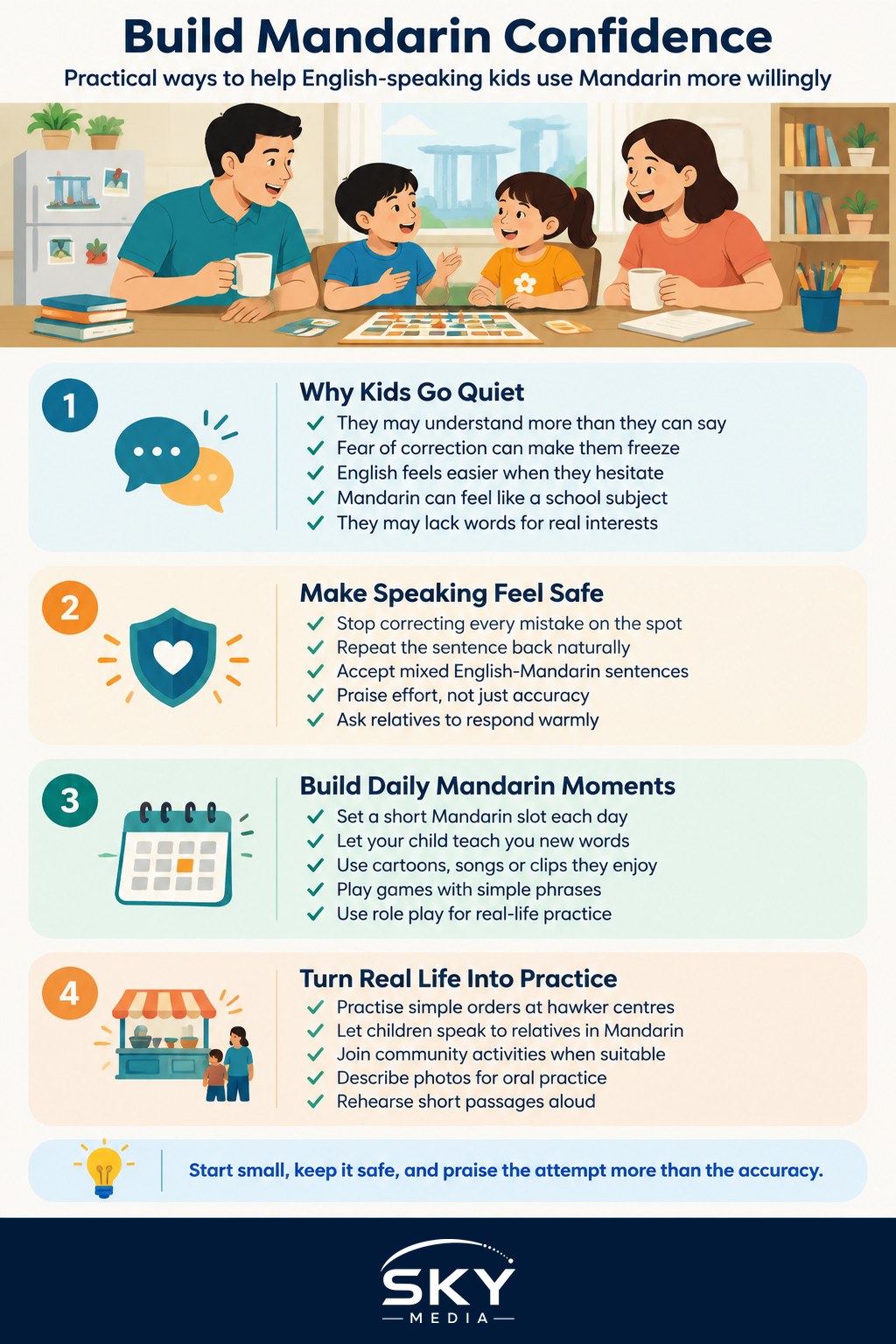
Common reasons a child goes quiet in Mandarin include:
- Fear of being corrected or laughed at. Even gentle correction from relatives can feel like a public mistake, especially for tones.
- English is simply easier. If everyone at home switches to English the moment the child hesitates, the child learns that hesitation works.
- Mandarin feels like a school subject. When the language mostly shows up as worksheets, tingxie (spelling tests) and oral exams, it carries the feeling of being tested.
- Identity and peer signals. Older children may notice which language their friends use and feel that Mandarin is “uncool” or something only for class.
- Limited vocabulary for things they care about. A child may know textbook words but not how to talk about games, football or a YouTube video in Mandarin.
A shy child needs safety. A child who finds Mandarin boring needs relevance. A child who simply defaults to English needs gentle structure.
Lower the Stakes Before You Raise the Standard
The fastest way to build confidence is to make speaking Mandarin feel low risk. That means temporarily caring more about whether your child speaks than about whether they speak perfectly.
Practical ways to lower the stakes:
- Stop correcting in the moment. Instead of pointing out a wrong word, repeat the sentence back correctly in a natural way, as if you are just confirming. Your child hears the right form without feeling caught out.
- Accept mixed sentences at first. A sentence that is half Mandarin and half English is progress. Over time, supply the missing Mandarin word casually and let them pick it up.
- Praise effort, not accuracy. Comment on the fact that they tried, told a story, or explained something, rather than on how many mistakes they avoided.
- Speak imperfectly yourself. If your own Mandarin is rusty, that is useful. Let your child see you look up a word, laugh at a wrong tone, and keep going.
- Brief relatives. Ask grandparents and aunties to respond warmly to any Mandarin attempt rather than teasing or switching to English. A quiet word beforehand makes family gatherings far less stressful.
If your child is generally reserved, the broader ideas in Helping Shy Children Build Confidence apply here too: small wins, predictable situations, and no surprise spotlights.
Create Small, Regular Mandarin Moments at Home
Confidence grows from repetition in safe settings. You do not need to switch the whole household to Mandarin.
Ideas that suit English-speaking families:
- A Mandarin slot in the day. For example, dinner on two weekdays, or the car ride to school, where everyone tries to speak Mandarin. Keep it short and friendly.
- Child as teacher. Ask your child to teach you a word or phrase they learned at school. Children often speak more freely when they are the expert.
- Shared media. Watch a Mandarin cartoon, variety show clip or song your child actually enjoys, then chat about it. Interest drives vocabulary much faster than drills.
- Games with simple scripts. Board games, card games and role play (shopkeeper, hawker, doctor) give a child ready-made phrases to repeat, which reduces the fear of going blank.
The table below compares common approaches parents try and how each tends to affect confidence.
| Approach | Effect on speaking confidence | Best used when |
|---|---|---|
| Correcting every mistake as it happens | Often lowers confidence and makes the child avoid speaking | Rarely; save detailed correction for homework time |
| Recasting (repeating back the correct form naturally) | Builds accuracy without embarrassment | During everyday conversation |
| Short, fixed Mandarin routines (meals, car rides) | Builds habit and predictability | For children who default to English |
| Child teaches parent | Raises status and willingness to talk | For children who know more Mandarin than their parents |
| Extra tuition focused only on exam answers | Can improve marks but may not change willingness to speak | When exam technique is the main gap |
| Real-world use (ordering food, talking to relatives) | Strong boost once the child is ready | After some confidence has been built at home |
Use Real Life in Singapore as Practice Ground
Singapore offers many natural chances to use Mandarin outside the classroom. The key is to choose situations where your child is likely to succeed.
- Hawker centres and coffee shops. Help your child rehearse a simple order, then let them say it. A successful exchange with a friendly stallholder is a powerful confidence boost.
- Grandparents and older relatives. Many children have a relative who prefers Mandarin or a dialect. Give your child one or two questions to ask, such as what the relative did as a child.
- Community activities. Community centres, libraries and cultural groups sometimes run Mandarin storytelling, calligraphy or festival activities. Check the current programmes with the organiser, as offerings change.
Connect Confidence to School Oral Without Making It Scary
Primary and secondary school Chinese includes oral components where children read aloud and discuss a picture or video. These can feel intimidating for a child who rarely speaks Mandarin at home. Building everyday confidence first makes oral practice far easier, and your child’s Chinese teacher can tell you which parts of the current format to focus on.
Helpful habits:
- Practise describing, not reciting. Ask your child to describe a photo from a family outing in Mandarin. This mirrors the oral format without feeling like an exam.
- Build a personal word bank. Keep a small notebook or phone note of useful phrases your child likes to use, such as ways to give opinions or describe feelings.
- Rehearse aloud. Reading a short passage aloud a few times a week builds fluency and comfort with tones.
The skills behind clear speaking in any language overlap, so ideas from Helping Your Child With Public Speaking, such as rehearsing, pausing and making eye contact, transfer well to Chinese oral.
Signs of Progress and When to Get Extra Help
Progress in confidence is often quiet. Look for signs such as your child answering a Mandarin question in Mandarin without being reminded, using a new phrase they picked up from a show, or chatting with a relative for a little longer than before. These matter more than a perfect sentence.
Consider extra support if:
- Your child becomes distressed, anxious or tearful about Mandarin over a long period.
- The gap between understanding and speaking is not narrowing despite steady, low-pressure practice.
- Your child’s teacher raises specific concerns about oral or listening skills.
In those cases, talk to the Chinese teacher or the school’s support staff first. If anxiety seems wider than language, a school counsellor can help. When choosing a tutor or enrichment class, look for one that gives children plenty of speaking time and creates a warm atmosphere, not only exam drilling. For general strategies to support a child’s self-belief across subjects, see How to Build Your Child’s Confidence.
Above all, be patient. A child who feels safe speaking imperfect Mandarin today is far more likely to become a confident speaker over the coming years than one who is pushed to be perfect too soon.
Further reading: Should You Let Your Kids Speak Singlish at Home? · Mandarin at Home: A Practical Plan for Parents Raising Kids in Singapore