

Floor space in a Singapore flat is precious, and a freestanding drying rack eats into it every time it rains. That is why so many homeowners look up instead. When choosing a ceiling laundry rack, Singapore buyers usually want one fixed above the service yard, kitchen or a balcony that lifts clothes out of the way while they dry.
This is a buying guide focused specifically on ceiling-mounted systems: the difference between motorised and manual racks, how your ceiling affects what you can install, and what to check before you pay a deposit. If you are still weighing up floor-standing or window-pole options, see our general guide on how to pick a clothes drying rack for Singapore flats.
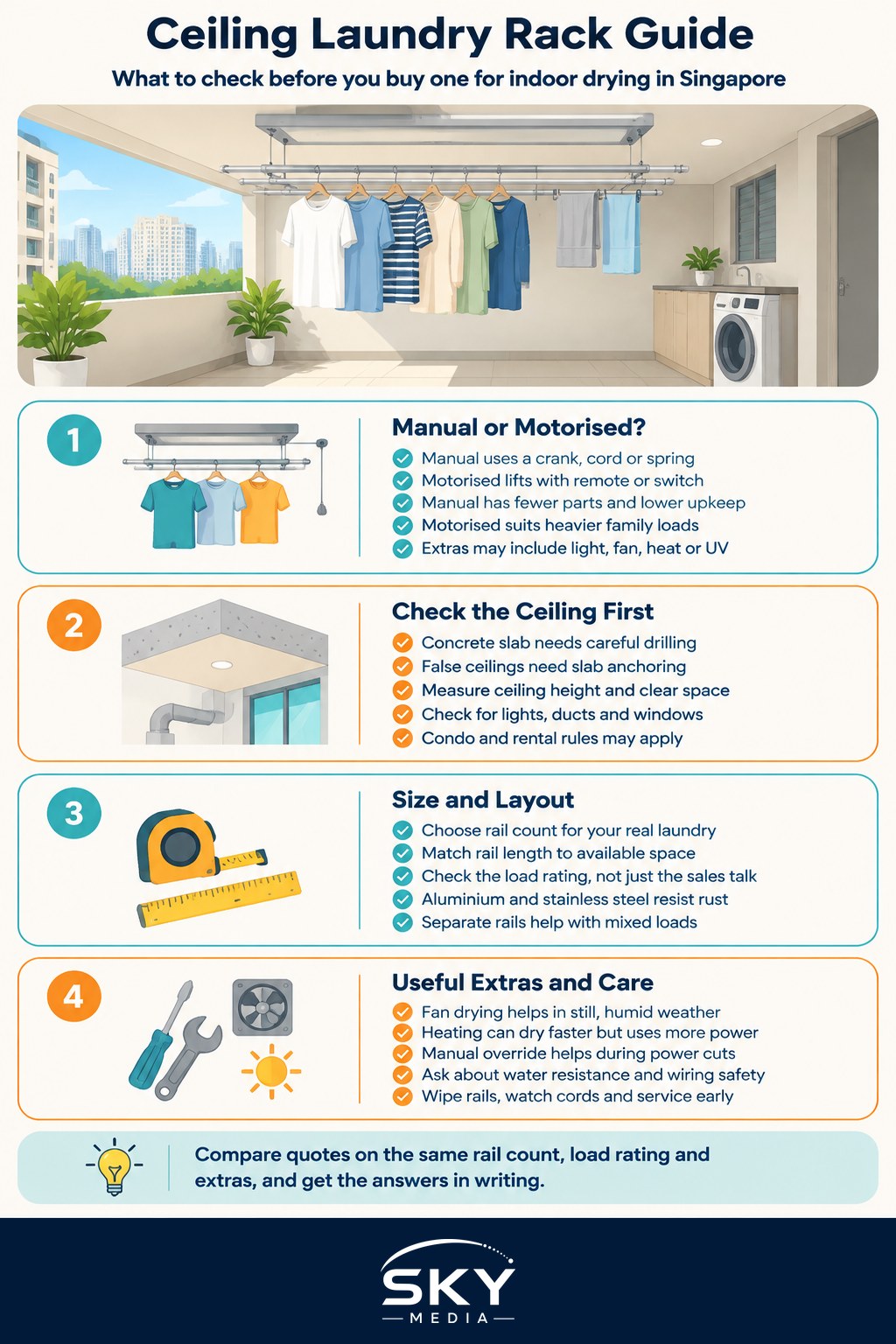
Motorised and Manual Ceiling Racks Compared
Ceiling racks fall into two broad families.
Manual racks use a pulley, winding handle or a spring-assisted mechanism. You lower the rails with a crank or cord, hang the laundry, then raise it again. They have fewer parts, no wiring and generally cost less to buy and maintain.
Motorised racks use an electric motor to raise and lower the rails, usually with a remote control or wall switch. Many models add extras such as built-in lighting, a fan for air drying, a heating element, or a UV lamp. Some can be linked to an app.
| Feature | Manual ceiling rack | Motorised ceiling rack |
|---|---|---|
| How it moves | Hand crank, pulley cord or spring arm | Electric motor with remote or switch |
| Power needed | None | A power point near the ceiling |
| Typical extras | Few or none | Light, fan drying, heat or UV options |
| Effort to use | Some arm effort, more with heavy loads | Push a button |
| Maintenance | Cords, pulleys and cables wear over time | Motor, wiring and remote may need servicing |
| Best for | Smaller loads, tighter budgets, simple needs | Heavy family loads, older users, frequent indoor drying |
Neither type is automatically better. A manual rack can last for years with little fuss, while a motorised rack is genuinely easier for anyone with shoulder or back problems. We cover the motorised side in more depth in an automated laundry drying rack for your home.
Check Your Ceiling Before Anything Else
The rack is only as good as what it is fixed to. Before you shortlist models, find out what is above your service yard or chosen drying spot.
- Concrete slab ceiling: common in HDB flats and many condos. It gives a solid anchor, but installers need to drill carefully and avoid any concealed conduits or pipes.
- False ceiling (board or gypsum): a suspended ceiling cannot carry a laundry rack by itself. The rack must be anchored through to the structural slab above, or the installer needs to add proper support. Ask how they will do this, and do not accept anchors into the board alone.
- Ceiling height: low ceilings limit how far the rack can rise, which matters if long dresses or bedsheets will hang from it. Measure the clear height and compare it to the rack’s lowered and raised positions.
- Obstructions: check for lights, sprinklers in some condos, exhaust ducts, window openings and the swing of any casement window.
For condos, the MCST (Management Corporation Strata Title, the body that manages the estate) may have rules about drilling, contractor access and working hours, so check with the management office. If you rent, you will need your landlord’s written permission before anything is drilled into the ceiling.
Size, Load and Rail Layout
Think about your real laundry, not the brochure photo.
- Number of rails: most racks have two to five poles. A family that washes daily needs more rail length than a couple who washes twice a week.
- Rail length: match it to the space, leaving room to walk and to open windows. Longer rails hold more but may sag if poorly supported.
- Load rating: manufacturers state a maximum load. Wet towels and jeans are much heavier than dry clothes, so leave a comfortable margin. Do not rely on a figure a salesperson gives verbally; check the product documentation.
- Material: aluminium and stainless steel resist rust well in humid weather. Look at the joints and fittings too, since cheaper fasteners are often the first parts to corrode.
- Separate or linked rails: some systems let you raise each pole on its own, which helps if you hang a few heavy items alongside light ones.
Features Worth Paying For on a Motorised Rack
Motorised racks are often sold with a long list of extras. Some are genuinely useful in Singapore’s climate; others mainly add cost.
- Fan drying helps on still, humid days when clothes otherwise stay damp for hours and pick up a musty smell. Our guide to drying laundry in humid weather explains why airflow matters more than heat.
- Heating can speed up drying, but it uses more electricity. Check the power rating and whether it has an automatic cut-off timer.
- UV lamps are marketed for hygiene. Treat specific germ-killing claims with caution unless the manufacturer explains how they were tested.
- Obstacle sensing stops the rack descending onto someone’s head or onto an open window, which is worth having in a busy household with children.
- Lighting is helpful if the service yard is dark at night.
- Manual override lets you lower the rack during a power cut or motor fault. Ask whether the model has one.
Because the motor and wiring sit outdoors or in a damp area, ask what water resistance the unit has and make sure the power point is installed safely. Electrical work should be done by a licensed electrician.
Installation, Warranty and Questions to Ask
Most ceiling racks are sold with installation included or as an add-on. Before you commit, ask the seller:
- Who will install it, and how will they anchor it to my ceiling type?
- What is the warranty on the motor, the frame and the installation, and are they separate?
- Is there a local service team for repairs, and how are spare parts obtained?
- What happens if the remote control is lost or stops working?
- Will they remove my old rack or bamboo pole holders, and patch the holes?
- Are there extra charges for drilling through a false ceiling, extending wiring or working at height?
Get the answers in writing, on the quotation or invoice. Prices vary widely by brand and features, so compare quotes on the same rail count, load rating and extras rather than headline price.
Keeping Your Rack Working for Years
A little care prevents most problems.
- Wipe the rails regularly to remove detergent residue and dust, which can stain clothes.
- Do not exceed the load rating, especially with soaked bedding. Spin clothes well before hanging.
- For manual racks, check cords and cables for fraying and replace them early.
- For motorised racks, keep the remote dry and replace its battery when the response gets sluggish. If the motor strains or makes new noises, stop using it and call for service.
- Raise the rack fully when not in use so it does not get knocked.
Chosen carefully, a ceiling laundry rack frees up floor space, keeps clothes off the corridor and makes rainy-day drying much less of a chore.
Further reading: How to Choose a Laundry Hamper That Works in Humid Homes