

If you run a private limited company in Singapore, two records quietly define who owns it: the register of members and the share certificates issued to shareholders. Many founders only think about them when an investor, bank or buyer asks for proof of ownership, and then discover a missing certificate or an outdated record.
This guide explains how the register of members and share certificate work together for a Pte Ltd, how the Accounting and Corporate Regulatory Authority (ACRA) keeps the register electronically, how to issue certificates properly, and what to do if one is lost. It focuses on record-keeping, not on the process of allotting new shares, which is a separate topic. This is general information, not legal advice. Requirements are set by the Companies Act and ACRA, and can change, so check ACRA’s website or speak to your company secretary for specifics.
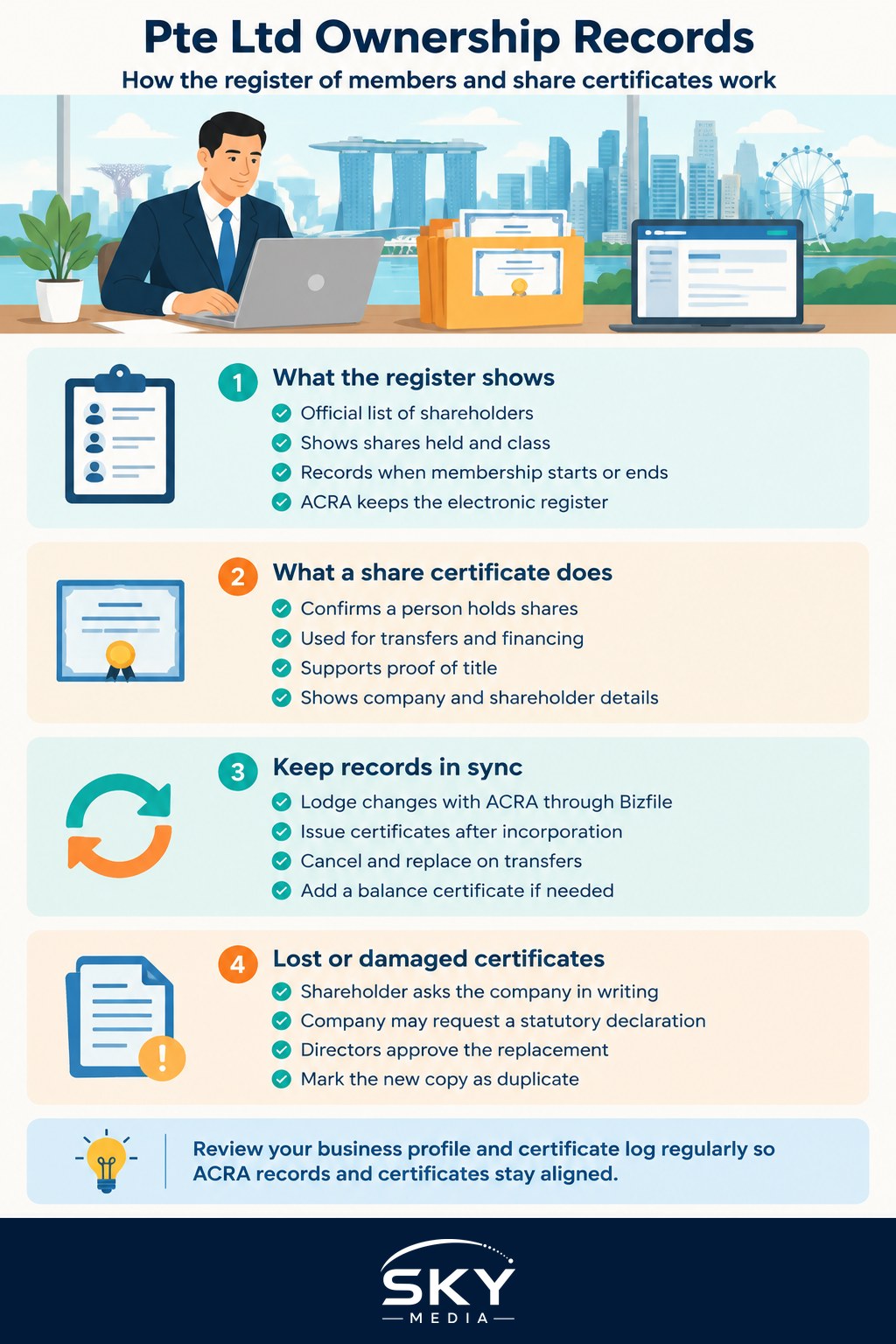
What the Register of Members Is
The register of members is the official list of a company’s shareholders. For each member, it records details such as their name, the number and class of shares held, and when they became or ceased to be a member.
For private companies in Singapore, ACRA maintains this register electronically, commonly called the electronic register of members (EROM). Instead of the company keeping its own paper register as the primary record, the company lodges changes with ACRA through Bizfile, ACRA’s online filing portal, and ACRA’s records are updated.
A few practical consequences:
- ACRA’s register is the reference point. If shareholder details on ACRA are wrong, that is a problem to fix, even if your internal files are correct.
- Changes must be lodged. Allotments, transfers and other changes in shareholding need to be filed with ACRA through the proper transaction, usually by a director or company secretary, or a filing agent.
- Anyone can check. Shareholder information appears in the company’s business profile, which can be purchased from ACRA. Investors and banks routinely rely on it.
Public companies follow different rules and generally keep their own registers. This guide is about private companies.
What a Share Certificate Is, and Why It Still Matters
A share certificate is a document issued by the company confirming that a named person holds a stated number of shares. Even with ACRA’s electronic register, certificates still matter:
- Shareholders often need them for share transfers, bank financing, or due diligence.
- They provide evidence of title alongside the register.
- Investors and acquirers commonly ask to see certificates during a deal.
A certificate typically shows the company name and registration number (UEN, the Unique Entity Number), the shareholder’s name, the number and class of shares, the amount paid on them, a certificate number and date of issue. It is signed or executed in the manner allowed by the Companies Act and the company’s constitution.
The Companies Act sets time limits for issuing certificates after an allotment and after a transfer is lodged. Check the current periods with ACRA or your company secretary and build them into your process.
How Register Updates and Certificates Fit Together
Keeping records consistent is the main goal. The table below shows how common events flow through ACRA’s register and your certificates.
| Event | ACRA register of members | Share certificate action |
|---|---|---|
| Company incorporated | Initial shareholders recorded from the incorporation filing | Issue a certificate to each founding shareholder |
| New shares allotted | Lodge the allotment with ACRA via Bizfile | Issue new certificates for the allotted shares |
| Shares transferred | Lodge the transfer after required steps such as stamp duty | Cancel the seller’s certificate, issue a new one to the buyer, and a balance certificate if part is kept |
| Certificate lost or damaged | No change to shareholding | Follow the replacement process and issue a duplicate |
| Shareholder changes name or address | Update particulars with ACRA as required | Usually no new certificate needed; follow your constitution |
Issuing Share Certificates Properly
A tidy process saves problems later.
- Pass a directors’ resolution approving the issue of certificates, if your constitution or practice requires it.
- Prepare each certificate with a unique running number, the shareholder’s full name as on their ID, the share count, class and amount paid.
- Execute the certificate as permitted by the Companies Act and your constitution, for example signed by authorised directors or a director and the company secretary.
- Record it internally in a certificate log: certificate number, holder, shares, date issued, and date cancelled if applicable.
- Deliver it to the shareholder and keep a copy.
- Cross-check with ACRA’s records so that the business profile and certificates match.
For transfers, remember that share transfers in Singapore attract stamp duty, administered by the Inland Revenue Authority of Singapore (IRAS). Check IRAS’s guidance for when and how it must be paid before the transfer is lodged with ACRA.
Replacing a Lost or Damaged Share Certificate
Certificates go missing, especially in older companies or after an office move. The usual approach is:
- The shareholder makes a written request to the company explaining the loss or damage.
- The company may ask for a statutory declaration (a formal sworn statement, typically made before a commissioner for oaths) confirming the certificate is lost, and an indemnity protecting the company if the original resurfaces and is misused.
- Check the constitution. Some constitutions set extra conditions, such as a fee or a public notice.
- The directors approve the replacement by resolution.
- Issue a replacement certificate clearly marked as a duplicate or replacement, and note in your certificate log that the original is cancelled.
- If the original is damaged rather than lost, collect and cancel it before issuing the new one.
Shareholding on ACRA’s register does not change, because ownership has not changed. Only the certificate is reissued.
Common Record-Keeping Mistakes
- Not lodging changes on time. A deal agreed between shareholders but never filed leaves ACRA’s register outdated.
- Certificates not matching the register. For example, a founder sells some shares but the old certificate is never cancelled.
- Missing balance certificates when a shareholder transfers only part of their holding.
- No certificate log, making it impossible to tell which certificates are valid.
- Spelling differences between ID documents, ACRA records and certificates, which can slow down bank or investor checks.
A quick annual review, often around the time of your annual return, is a good habit. Download your business profile, compare it against your certificate log, and fix gaps.
Where to Get Help
For filings and current rules, ACRA’s website and Bizfile are the authoritative sources. Many small companies rely on their company secretary, who must be appointed under the Companies Act, to manage registers and certificates. For disputes over ownership or complex restructurings, consult a lawyer.
If you are still deciding on your business structure, see our comparisons of sole proprietorship vs Pte Ltd and LLP vs Pte Ltd. Keeping your register of members and share certificates in order from day one makes every later step, from fundraising to selling the business, far smoother.
Frequently Asked Questions
How do I correct a wrong shareholder record on ACRA? Lodge the correction or the missing transaction through Bizfile, usually via a director, company secretary or filing agent. The right filing depends on what went wrong, such as an unfiled transfer or a spelling error. Check ACRA’s current guidance, and gather supporting documents like signed transfer forms.
Does a company with only one shareholder still need a share certificate? Yes, the company should still issue one, because it is evidence of title alongside the register. Banks, buyers and investors often ask for it, even for single-owner firms. Keep the certificate and your log up to date, and issue a new one whenever the shareholding changes.
What happens to a shareholder’s shares if the shareholder dies? The shares generally form part of the deceased’s estate, so the executor or administrator usually deals with them under the constitution and the law. The register is updated only once a valid transmission or transfer is lodged. Speak to a lawyer or the company secretary.
Is the register of members the same as the register of controllers? No. The register of members lists legal shareholders, while the register of registrable controllers records individuals who ultimately own or control the company, even through nominees or layers. Companies are expected to keep both up to date, so check ACRA’s guidance for current requirements.
What shareholding records should I tidy up before an investor or buyer reviews the company? Reconcile ACRA’s business profile with your certificate log, confirm every transfer was lodged and stamped, and cancel old certificates. Make sure names match ID documents and that balance certificates exist for part-transfers. Check these against constitution requirements with your company secretary.
Official sources: ACRA
Further reading: The Register of Registrable Controllers Explained