

Ask a child why people eat mooncakes and carry lanterns at Mid-Autumn, and you will often get a shrug. The festival makes much more sense once children know the stories behind it. This Chang’e story for kids retells the best-known Mid-Autumn legends in simple language: the archer Hou Yi, the moon lady Chang’e, the Jade Rabbit and the woodcutter Wu Gang. Each section ends with questions you can talk about over dinner or while waiting for the moon to rise.
These are old Chinese folk tales, and they have been told in many versions over hundreds of years. Families, books and regions tell them differently, so if your grandparents remember a different ending, that is part of the fun.
Part One: Hou Yi and the Ten Suns
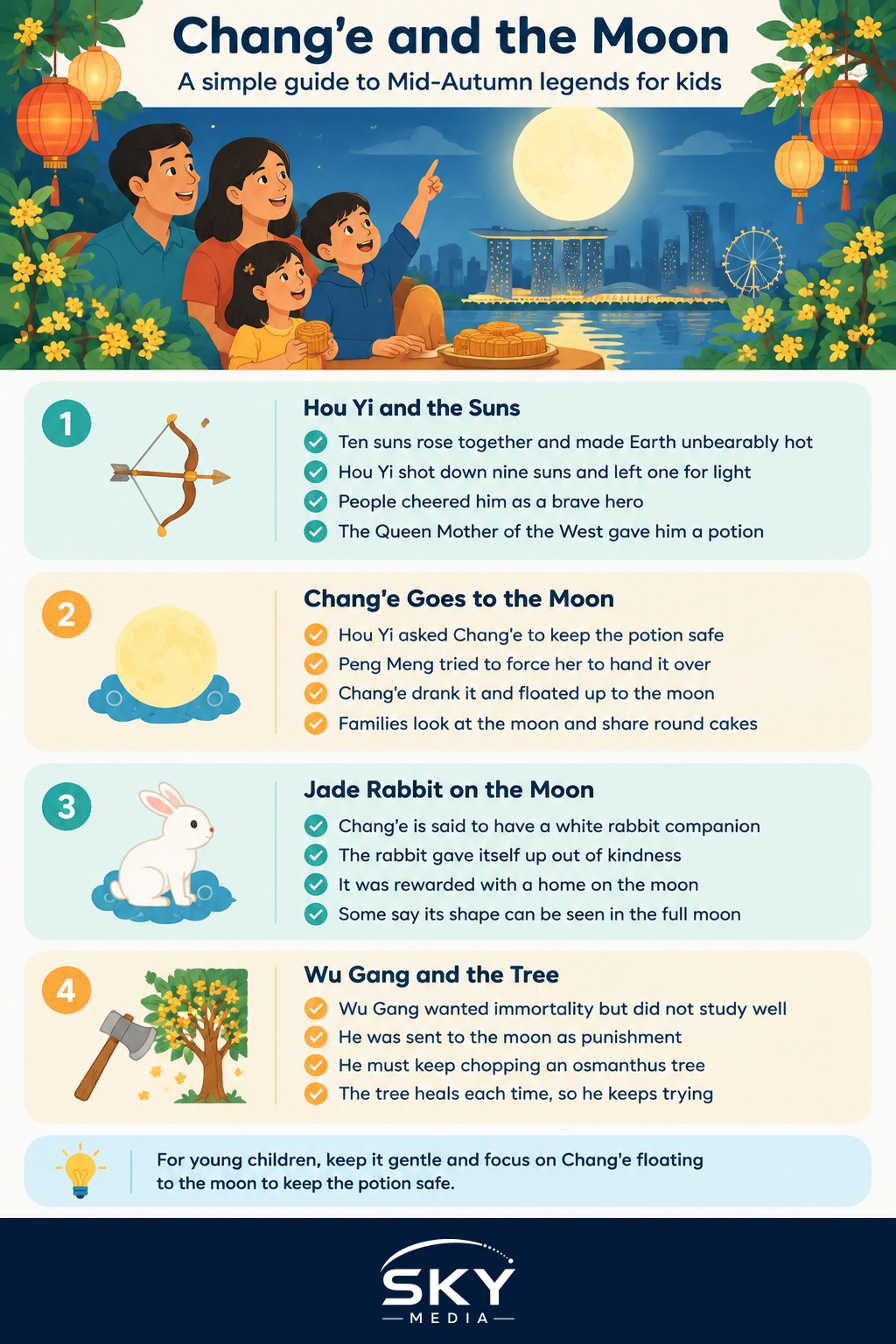
Long, long ago, the sky had not one sun but ten. The ten suns were brothers, and they were supposed to take turns crossing the sky, one each day. But one day, they all decided to come out together.
The world became terribly hot. Rivers dried up, crops withered and people and animals could hardly breathe. Everyone was suffering.
There lived a brave and skilful archer named Hou Yi. He climbed to the top of a mountain, pulled back his mighty bow and shot down nine of the suns, one after another. He left just one sun in the sky, so the world could have light and warmth without burning.
The people cheered. Hou Yi became a hero, and the Queen Mother of the West, a powerful immortal, rewarded him with a special gift: a potion that would let a person live forever and rise up to the heavens.
Talk about it:
– Why do you think Hou Yi kept one sun instead of shooting them all?
– What would happen if we had no sun at all?
Part Two: Chang’e Flies to the Moon
Hou Yi had a kind and gentle wife named Chang’e. Hou Yi did not want to live forever without her, so he did not drink the potion. Instead, he asked Chang’e to keep it safe at home.
In the most popular version of the story, one of Hou Yi’s students, a greedy man named Peng Meng, found out about the potion. One day, while Hou Yi was out hunting, Peng Meng came to the house and demanded that Chang’e hand it over. Chang’e knew that a greedy person must never live forever. With no other way to stop him, she drank the potion herself.
At once, she began to float. She rose out of the window, above the trees and up into the night sky. She floated higher and higher until she reached the moon, the place closest to the earth where she could still look down on her home.
When Hou Yi came back and found out what had happened, he was heartbroken. He looked up at the moon and thought he could see Chang’e there. So he set out a table in the garden with her favourite fruits and cakes, and gazed at the moon, missing her. People who heard the story began to do the same, and this is one reason families still look at the moon together at Mid-Autumn and share round cakes.
Some versions say Chang’e drank the potion out of curiosity, and others give different reasons. You can tell children there is more than one version, and ask which one they like best.
Talk about it:
– How do you think Chang’e felt living far away on the moon?
– Why do families try to be together on Mid-Autumn night?
– Is there someone you miss who lives far away? How could you show them you are thinking of them?
Part Three: The Jade Rabbit
Chang’e was not completely alone on the moon. She had a companion: a white rabbit, often called the Jade Rabbit.
One well-known story tells how the rabbit got there. An old man, who was really a heavenly being in disguise, asked a group of animals for food because he was hungry. The monkey brought fruit and the fox brought fish, but the little rabbit had nothing to give. So the kind rabbit offered itself instead. Moved by such a generous heart, the old man rewarded the rabbit by placing it on the moon, where it could live peacefully forever.
On the moon, the Jade Rabbit is said to pound herbs with a mortar and pestle, making medicine. Look closely at the full moon, and some people say the dark patches look like a rabbit pounding away.
Talk about it:
– What made the rabbit special, even though it had nothing to give?
– What are ways we can be kind when we do not have much?
– When you look at the full moon, what shapes can you see?
Part Four: Wu Gang and the Tree That Never Falls
There is one more character living on the moon: a man named Wu Gang. In the common version of his story, Wu Gang wanted to become an immortal but did not take his lessons seriously. As a punishment, he was sent to the moon and told he could leave once he chopped down a great osmanthus tree growing there.
So Wu Gang swung his axe. But every time he cut into the tree, the cut healed itself immediately. He chopped and chopped, and the tree stayed standing. People say he is still chopping today.
This is why osmanthus flowers are linked with Mid-Autumn, and you may see osmanthus-flavoured mooncakes, jelly or tea in the shops this season.
Talk about it:
– Why do you think the tree kept healing?
– What can Wu Gang’s story teach us about finishing what we start and paying attention when learning?
– Have you ever kept trying at something hard? How did it feel?
Who’s Who on the Moon
| Character | Who they are | What children can learn |
|---|---|---|
| Hou Yi | A brave archer who shot down nine suns | Courage and using strength to help others |
| Chang’e | Hou Yi’s wife, who flew to the moon | Making hard choices to protect others |
| Jade Rabbit | Chang’e’s kind companion on the moon | Generosity and kindness |
| Wu Gang | A man who chops the osmanthus tree forever | Patience, effort and taking learning seriously |
Bringing the Stories to Life at Home
Stories stick better when children can see, touch and play with them. A few easy ideas for Mid-Autumn week:
- Moon-watching storytime. Tell one part of the legend each evening in the days before the festival, then finish the story on Mid-Autumn night while looking at the moon.
- Act it out. Let children play Hou Yi with a pretend bow, Chang’e floating away, and the rabbit with a cup and spoon as a mortar and pestle.
- Draw the moon. Ask children to draw what they think Chang’e’s home looks like, with the rabbit and the osmanthus tree.
- Taste the story. Share a mooncake and some osmanthus tea or fruit, and talk about Hou Yi setting out food for Chang’e.
- Make a lantern. Children love carrying a lantern while hunting for the rabbit in the moon. Simple paper or recycled-material lanterns work well for younger children.
- Ask the elders. Grandparents may know the stories in Mandarin or a dialect such as Hokkien, Teochew or Cantonese. Hearing their version is a lovely way to connect generations.
For very young children, keep the story gentle. You can simply say Chang’e “floated up to the moon to keep the potion safe” without dwelling on the sad parts.
More Festival Stories for Curious Kids
Mid-Autumn is one of several Chinese festivals with a legend at its heart. If your child enjoyed these, try our guide to telling kids the story behind the Dragon Boat Festival, which explains Qu Yuan and why people race boats and eat rice dumplings. For tales closer to home, explore Singapore folklore and legends, from Redhill to Sisters’ Islands.
Whichever version of the Chang’e story you tell, the heart of it stays the same: missing the people we love, being kind, and coming together under the same bright moon.
Frequently Asked Questions
Is the Chang’e story connected to China’s Chang’e moon missions? Yes, China’s lunar exploration programme is named after Chang’e, the moon lady of the legend. Her story is a good way to start talking with children about the moon. You can compare the legend, where she floats up to the moon, with real spacecraft that travel there.
What are the dark patches that look like a rabbit on the moon? They are large, dark plains on the moon’s surface, which people have long imagined as a rabbit pounding herbs, among other shapes. Different cultures see different pictures. Ask your child what shape they can spot, then look at the full moon together.
Are there other Mid-Autumn stories besides Chang’e? Yes. Another popular tale says messages hidden inside mooncakes helped rebels coordinate an uprising against foreign rulers, which is one reason mooncakes are linked to the festival. Like Chang’e, it has been told in many versions, so present it as a folk tale.
How do I explain the sad parts of the Chang’e story to a young child? Keep it gentle: say Chang’e floated up to the moon to keep the potion safe, and Hou Yi set out her favourite fruits and cakes because he missed her. Then talk about people we miss and how to show them we care. Older children can handle more detail.
Where can children hear these legends in Mandarin or a dialect? Grandparents and older relatives often know the stories in Mandarin, Hokkien, Teochew or Cantonese, and hearing their versions is a lovely way to connect generations. Public libraries and preschools may also have picture books and storytelling sessions, so check what is available near you.