

Parents decide to change a child’s name for many reasons: a family reconciling different naming traditions, a remarriage, an adoption, a religious conversion, or simply a name that has caused problems at school. If you want to change a child name in Singapore, the process usually involves a deed poll, an update with the Immigration & Checkpoints Authority (ICA) and, crucially, the right consent. This guide explains how the process generally works for a minor, with a focus on consent rules, which are where most families run into difficulty.
This article is general information, not legal advice. Requirements can change, and family circumstances vary widely, so confirm the current process on the ICA website and speak to a family lawyer if your situation is contested.
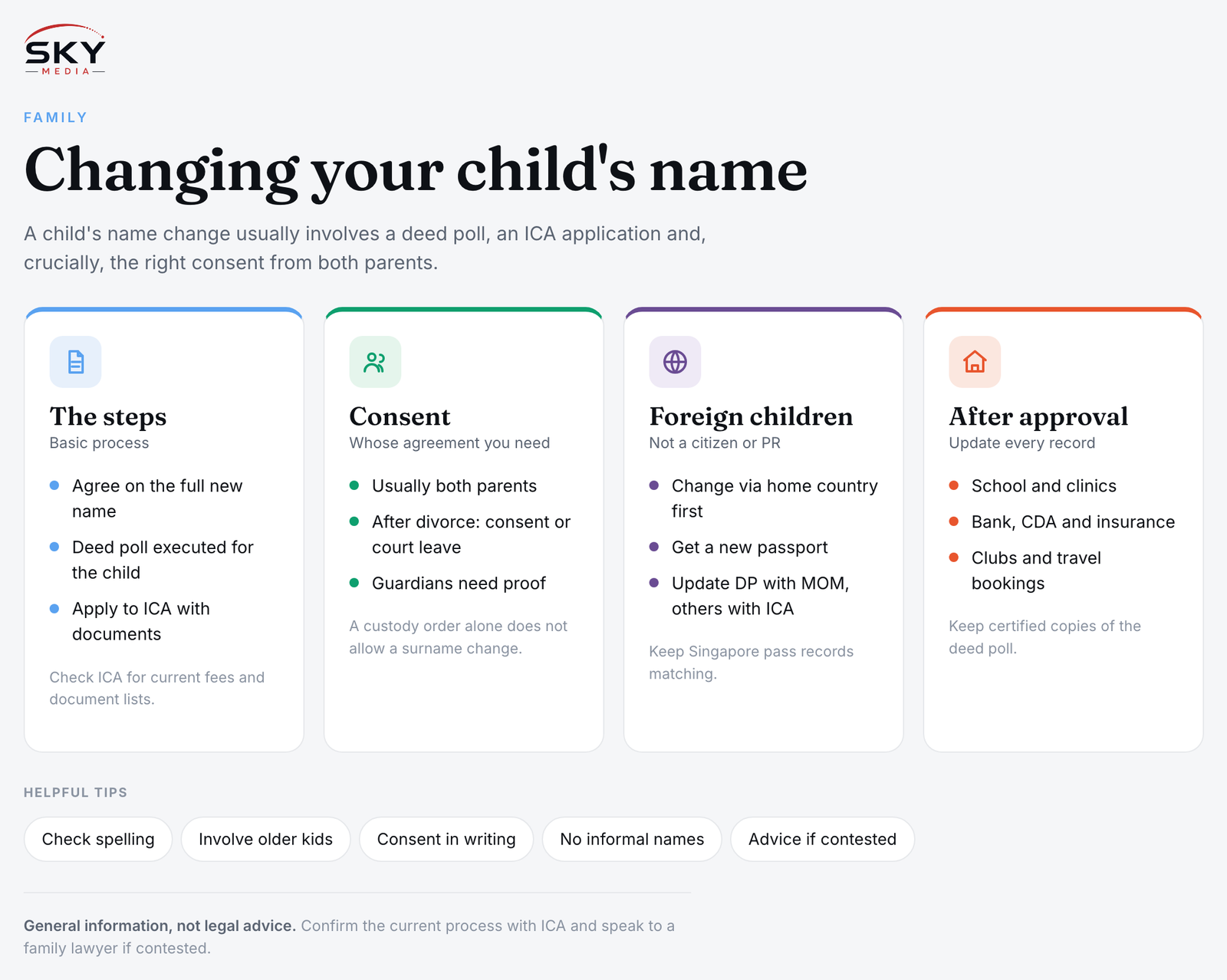
The Basic Steps for a Child’s Name Change
For a Singapore citizen or permanent resident child, the process usually follows this sequence:
- Agree on the new name. Decide on the full name, including spelling, order of names and any Chinese characters or Hanyu Pinyin.
- Prepare a deed poll. A deed poll is a legal document in which a person formally renounces their old name and adopts a new one. For a minor, the deed is executed on the child’s behalf by a parent or legal guardian. Lawyers commonly prepare and witness these, and some notaries public or commissioners for oaths can witness them too.
- Obtain the required consents. Usually this means the consent of both parents, discussed in detail below.
- Apply to ICA. Submit the change of name application with the deed poll and supporting documents through ICA’s official channels. ICA’s website lists which documents are needed and whether the application can be done online or needs an appointment.
- Update the child’s documents. Once approved, ICA updates its records. You may then need to apply for a new passport and, for children who have one, a new identity card.
- Tell everyone else. Update the school, clinics, bank accounts, insurance policies and any government accounts linked to your child.
ICA sets the current fees, processing times and document list, so check its website before you start rather than relying on what a friend did years ago.
Consent Rules: Whose Agreement You Need
Consent is the part of a child’s name change that matters most. Because a name is a significant part of a child’s identity, the law generally expects both parents to agree.
- Married parents living together. Typically both parents sign or give written consent. This is usually straightforward if you agree.
- Separated or divorced parents. Where a court order on custody, care and control is in place, one parent generally cannot change the child’s surname without the other parent’s written consent or the leave (permission) of the court. A custody order does not give one parent the right to change the child’s surname alone.
- One parent cannot be found or has died. Additional documents, such as a death certificate or evidence of efforts to contact the other parent, may be needed. A court order may be required in some cases.
- Legal guardians. If someone other than a parent is the child’s guardian, they will need proof of guardianship.
- Older children. It is good practice, and sometimes required, to involve an older child in the decision. Their view carries weight, especially when changing a surname they have used for years.
If the other parent objects, do not try to work around it by using a new name informally at school. Seek legal advice about applying to the Family Justice Courts, which will consider the child’s welfare as the paramount concern.
Common Situations Compared
The paperwork depends heavily on why the name is changing. This table gives a general picture.
| Situation | What is usually involved | Key point to check |
|---|---|---|
| Adding or correcting a Chinese name or Hanyu Pinyin | ICA application, sometimes with a deed poll | Whether ICA treats it as a correction or a change |
| Changing a first name with both parents agreeing | Deed poll executed for the child, ICA application | Both parents’ consent and IDs |
| Changing a surname after divorce or remarriage | Deed poll plus the other parent’s written consent, or court leave | Any custody order and its terms |
| Name change after adoption | Usually dealt with through the adoption order | What the adoption order states about the child’s name |
| Child holding a foreign passport (e.g. on a Dependant’s Pass) | Change through the home country’s authorities first | Then update Singapore pass records with MOM or ICA |
If Your Child Is Not a Singapore Citizen or PR
For children who are foreign nationals, the name on their passport is controlled by their home country. The usual approach is:
- Change the name according to the laws of the child’s home country, typically through that country’s embassy or high commission in Singapore.
- Obtain a new passport in the new name.
- Update the child’s Singapore pass, such as a Dependant’s Pass, Student’s Pass or Long-Term Visit Pass, with the agency that issued it (MOM for Dependant’s Passes, ICA for Student’s Passes and most Long-Term Visit Passes).
For families from mainland China, a name change for a Chinese citizen child is handled under Chinese rules, which typically involves the household registration (hukou) authorities in China and the PRC Embassy in Singapore for passport matters. Requirements differ by locality, so contact the Embassy for current guidance before making any change, and keep the Singapore pass update in mind so your child’s records match.
Updating Records After the Change
Once ICA has approved the change, plan a short checklist to keep records consistent:
- School: Inform the school office so records and certificates use the new name. Exam registrations for national exams rely on accurate records.
- Healthcare: Let your family doctor, polyclinic and any specialists know. Vaccination records on HealthHub are linked to the child’s identity number, but clinics may hold their own files.
- Banking and savings: Update the child’s bank accounts, including any Child Development Account.
- Insurance: Notify insurers so policies show the correct name.
- Activities and clubs: Swim schools, enrichment centres and sports clubs may need updated details.
- Travel bookings: Make sure any upcoming flights match the new passport name.
Keep several certified copies of the deed poll. Organisations sometimes ask to see proof of the change, particularly for older documents issued in the previous name.
Helping Your Child Through the Change
A name change can be a big deal for a child, even when the adults see it as administrative. Some practical ways to help:
- Explain it simply and honestly, at a level suited to their age.
- Let them have a say, especially older children, in choosing a first name or deciding on a surname.
- Prepare for questions from classmates. Practise a short, comfortable answer together.
- Be patient with the transition. Friends and teachers may take time to adjust.
Our guide on helping your child cope with change has more ideas for supporting children through family transitions. If you are weighing up a Chinese surname choice, Singapore Chinese surnames and clans explains how dialect romanisations and clan links shape surnames here.
Practical Tips Before You Start
- Check the spelling carefully. A second change later means repeating the whole process.
- Think about the long term. A name used throughout school will appear on certificates, CPF records and future documents.
- Keep records of consent. Written consent from the other parent should be clear, signed and dated.
- Do not change names informally. Using a new name at school without completing the legal process can cause mismatched records.
- Get advice for contested cases. Where parents disagree, a family lawyer can explain your options. The Family Justice Courts website also has general information for parents.
Changing a child’s name is usually manageable when both parents agree and the paperwork is in order. Start with ICA’s current requirements, secure consent early, and focus on making the transition smooth for your child.
Further reading: Choosing a Baby Name