
For many couples where one or both partners come from mainland China, a single wedding is not enough. Parents and relatives in China expect a banquet in the hometown, while friends, colleagues and sometimes the Singapore side of the family are here. Planning a China Singapore wedding often means planning two events, in two countries, with two sets of expectations and one shared budget.
This guide is written for mainland-China newcomers and their partners. It covers how to decide what each celebration is for, how to handle the legal side once, how to manage family expectations, and how to keep the logistics and costs under control.
Decide What Each Celebration Is For
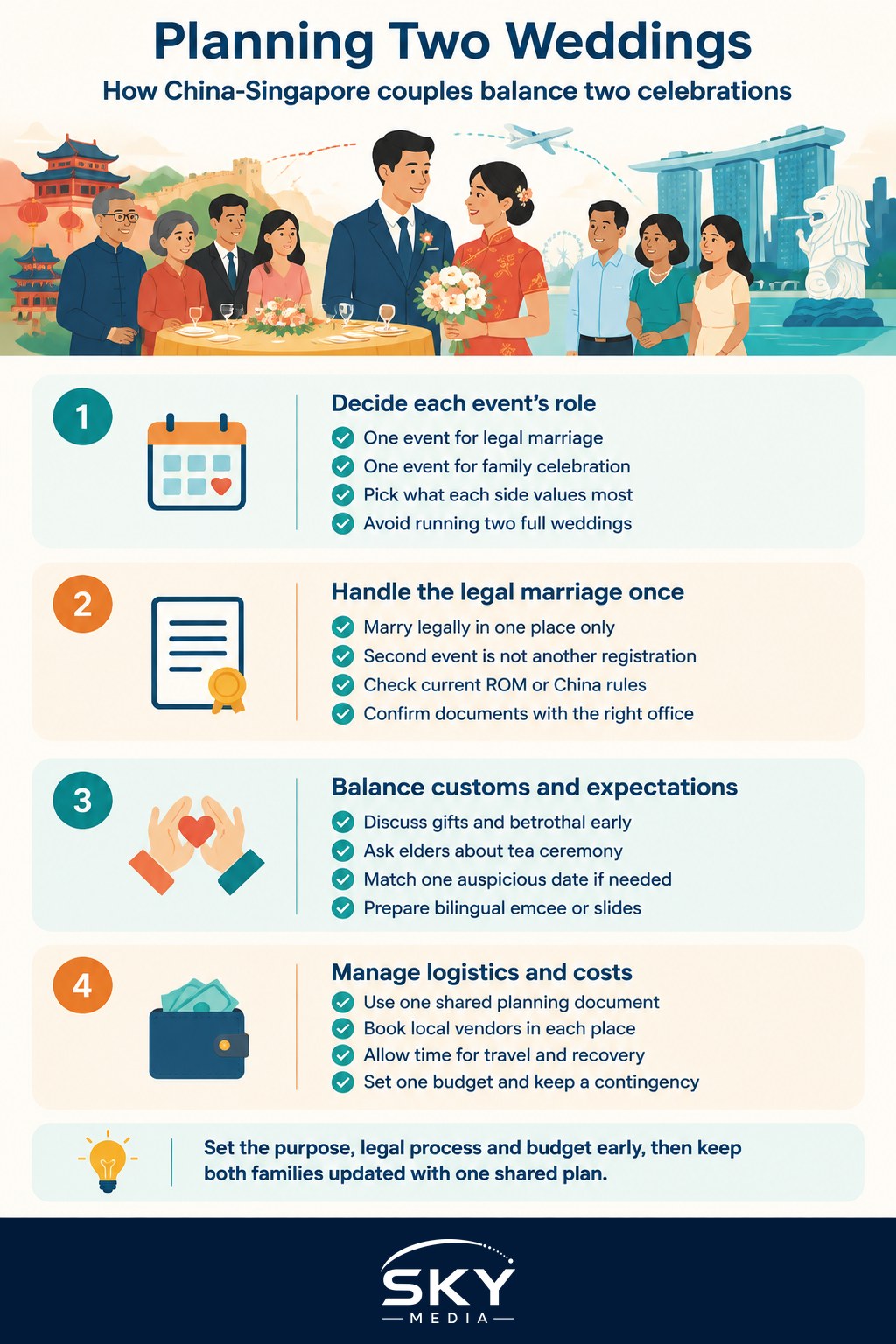
The most useful first step is to give each event a clear purpose. Couples who skip this often end up running two full weddings with double the stress.
Common splits include:
- Legal marriage plus a small celebration in Singapore, and a traditional banquet in China. The Singapore event is often a registry ceremony with a lunch or dinner for friends and colleagues. The China event is the large family banquet with relatives, neighbours and parents’ friends.
- A full Singapore wedding plus a smaller “return banquet” in China. This suits couples whose working life and friends are mostly here, with older relatives who cannot travel.
- A main wedding in China plus a relaxed Singapore party. This works when most guests are in China and Singapore friends are happy with a casual gathering.
Talk openly with both families early. In many mainland families, the hometown banquet carries a lot of meaning for parents, who may want to host their own guests. In Singapore, couples often plan a two-part day with a tea ceremony and a dinner, which we explain in a two-part wedding ceremony and reception.
Handle the Legal Marriage Once, in the Right Place
You only need to be legally married once. The second celebration is a ceremony and party, not another registration. Decide early where the legal marriage will happen, because this affects documents, name records and future applications such as passes or housing.
- Marrying in Singapore. Civil marriages are handled by the Registry of Marriages (ROM). Foreign nationals usually need documents proving they are free to marry, and some documents from China may need to be notarised, translated or legalised. Requirements and notice periods can change, so check the current rules on the ROM website before booking a date. Our guide to planning a registry office wedding in Singapore walks through the process.
- Marrying in China. Marriage registration in mainland China generally happens at the civil affairs office linked to a partner’s household registration, and rules differ when one partner is a foreigner. Check with the relevant civil affairs office and, where needed, the Embassy of the People’s Republic of China in Singapore.
- Using the marriage certificate later. If you marry in one country and need the certificate recognised in the other, you may need certified copies, translation and legalisation. If either of you holds a Singapore pass, check with MOM or ICA about what documents they need when you update your status.
This is general information, not legal advice. Always confirm the current requirements with ROM, the civil affairs office, ICA, MOM or the PRC Embassy before you commit to dates.
Balancing Customs and Family Expectations
Customs vary widely between regions in China and between families in Singapore, so treat these as common practices to discuss rather than fixed rules.
- Betrothal and gifts. Some mainland families expect a betrothal gift or bride price discussion. Singapore Chinese families may follow guo da li, a gift exchange before the wedding. Agree on a combined approach so neither family feels overlooked.
- Tea ceremony. Common in both places, though the order of relatives and the style can differ. Ask the elders on each side what they prefer.
- Auspicious dates. Parents may consult an almanac or fortune teller. With two events, you may only be able to match one date to their preference, so prioritise the one that matters most to them.
- Red packets and gifts. Amounts and customs differ by city and family. Ask a trusted relative rather than guessing.
- Language. Plan an emcee who can switch between Mandarin and English, or prepare bilingual programmes and slides so both sides follow the speeches.
Comparing the Two Celebrations
| Planning area | Singapore celebration | China celebration |
|---|---|---|
| Typical guests | Friends, colleagues, Singapore relatives | Parents’ relatives, neighbours, family friends |
| Who usually leads | The couple | Often the parents, especially in the hometown |
| Legal role | Often where ROM registration happens | Ceremonial if already married in Singapore |
| Main booking tasks | Venue, solemniser, photographer, attire | Banquet restaurant, local emcee, hometown photographer |
| Budget pressure | Venue and catering per table | Number of tables and gifts for relatives |
Logistics Across Two Countries
Running events in two places means more moving parts. A shared planning document, with one tab for each event, keeps both families on the same page.
- Timing. Many couples hold the events a few weeks or months apart, often linking the China banquet to a holiday period such as Chinese New Year when travel is already planned. Allow enough time to recover between them.
- Attire. You can reuse the same gown or suit for both, or choose a Western outfit for one and a qipao or traditional red outfit for the other. Check baggage rules for carrying gowns on flights.
- Vendors. Book local vendors in each place. For the China side, a trusted relative on the ground can visit venues and handle deposits.
- Payments. Moving money across borders for deposits takes planning. Check transfer limits, fees and exchange rates with your bank beforehand.
- Staying in touch. Calling vendors and relatives in China adds up. See our guide to comparing mobile plans for calls to China.
- Guests who travel. If some Singapore friends join the China event, share visa, flight and hotel information early and appoint someone to look after them.
Keeping Two Weddings Within One Budget
Two weddings do not have to cost twice as much. Practical ways to manage the total:
- Set one overall budget first, then divide it between the events based on purpose, not equal halves.
- Agree who pays for what. In some families, parents fund the hometown banquet and receive the red packets from their guests. Clarify this early to avoid awkwardness. Our guide on how to split wedding costs fairly as a couple helps frame the conversation.
- Reuse what you can: outfits, decorations, favours and a single pre-wedding photoshoot.
- Scale one event down. A smaller, warmer event is often remembered more fondly than a second large banquet.
- Keep a contingency fund for travel changes, exchange rate swings and last-minute guest additions.
A China Singapore wedding is a chance to honour both homes. With a clear purpose for each celebration, the legal side settled once and honest conversations with both families, two weddings can feel like one story told in two places.
Further reading: Bride Price Expectations for China-Singapore Couples