

If you are spending your first Lunar New Year in Singapore, you may notice friends rushing to finish their spring cleaning, booking haircuts weeks ahead or quietly hiding the broom on the first morning. These habits come from Chinese New Year taboos, a set of customs built on the idea that how you behave at the start of the year shapes the luck that follows.
This guide focuses only on the festive period, mainly the eve and the first few days, rather than everyday superstitions. It explains the most common taboos, the thinking behind them and, most importantly for a guest or newcomer, how seriously Singapore families tend to take them today. Practices vary widely by family, dialect group and generation, so treat these as commonly seen customs rather than fixed rules.
Why the First Days Carry So Much Weight
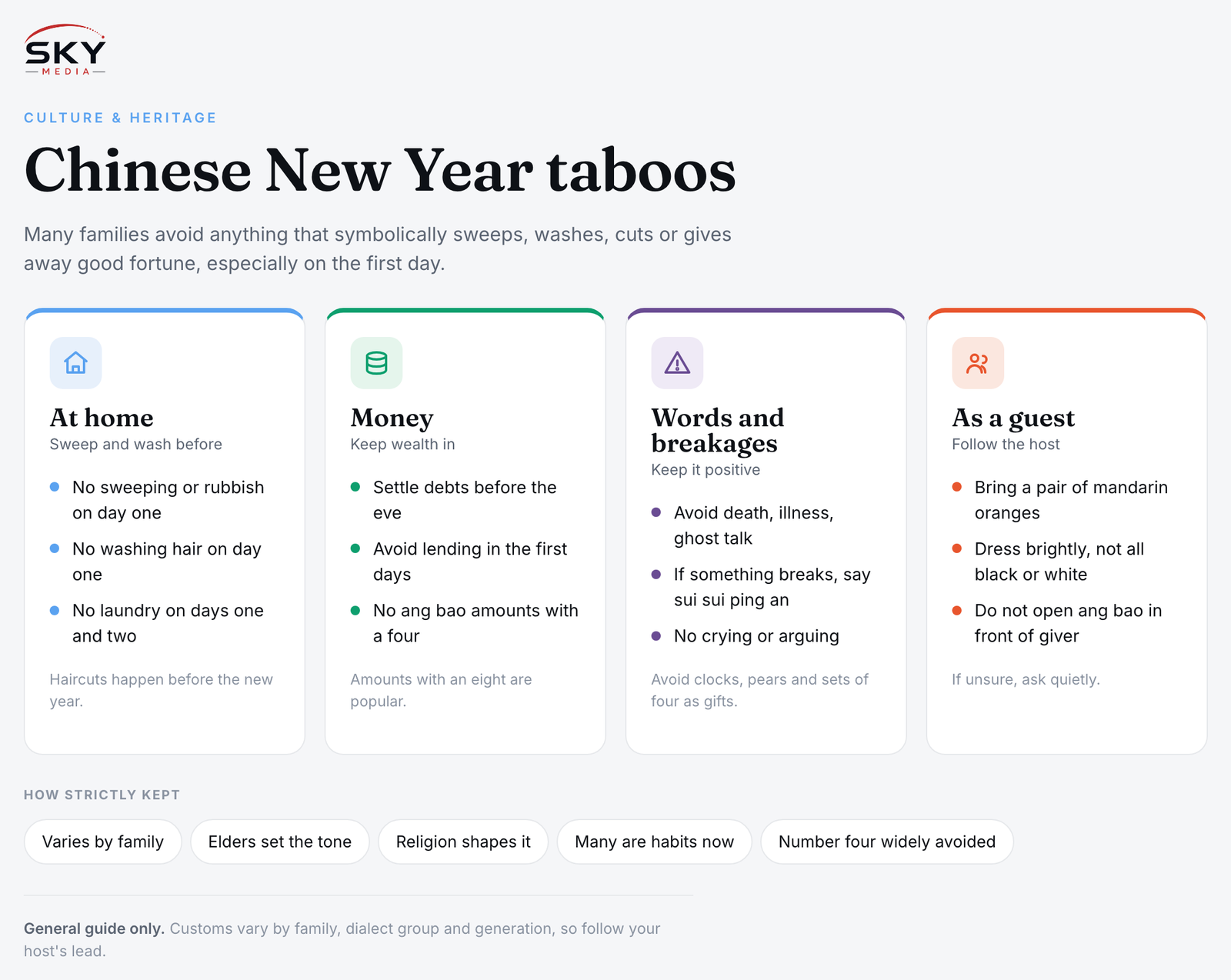
The underlying belief is simple: the new year is a fresh start, and good fortune arrives with it. Anything that symbolically sweeps, washes, cuts, breaks or gives away that fortune is avoided, especially on the first day. Many taboos also rely on wordplay, because several Chinese words sound alike. Hair (发, fà) shares a sound with prosperity (发财, fācái), and the number four sounds like death.
Most of the strictest customs apply to the first day, with some families extending them to the first three days or until the fifteenth day, Chap Goh Mei. If you are curious about one milestone in between, our piece on Ren Ri, the seventh day of Chinese New Year explains why that day is treated as everyone’s birthday.
Household Taboos: Sweeping, Washing and Cleaning
This is where you will see the biggest burst of activity, because the cleaning has to happen before the new year, not during it.
- No sweeping or taking out the rubbish on the first day. Sweeping is believed to brush away the good luck that has just arrived. Families who keep this custom finish a thorough clean before the eve. If something must be tidied, some sweep inwards towards the centre of the room and leave the pile until a later day.
- No washing hair on the first day. Because of the “fa” wordplay, washing hair is seen as washing away prosperity. Many people wash their hair on the eve instead.
- No laundry on the first two days. In some traditions, these days are associated with the birthday of the water god, so washing clothes is skipped.
- Haircuts happen before, not after. Cutting hair in the first lunar month is avoided by some families, which is why barbers and salons get extremely busy in the weeks before. Our guide to booking your pre-CNY haircut covers the timing.
Money, Debt and Lending
Money customs are among the most widely followed, even by younger Singaporeans who say they are not superstitious.
- Settle debts before the new year. Starting the year owing money is thought to set a pattern of owing all year. People often try to repay friends and family before the eve.
- Avoid lending money in the first days. Lending is seen as letting your wealth flow out. If a friend asks during this period, many people politely suggest sorting it out after the festive days.
- Do not give amounts with a four. Ang bao (red packet) amounts avoid the number four. Even numbers are preferred, and numbers containing eight are popular because eight sounds like prosperity.
- Keep your wallet full. Some people avoid spending big or emptying their purse on the first day, preferring to start the year with money in hand.
Words, Behaviour and Things to Avoid Breaking
Much of the festive atmosphere is about keeping everything positive, including conversation.
- Avoid unlucky words. Words such as death, illness, poverty, ghost and “finished” are generally avoided. People also try not to tell ghost stories or discuss sad news during visits.
- Do not break things, and if you do, say a good phrase. Broken plates or glasses are linked to broken relationships or luck. If something does break, many people wrap the pieces in red paper and say “suì suì píng ān” (岁岁平安), which sounds like “broken” and means peace year after year. Hosts usually laugh it off.
- No crying or arguing. Tears and quarrels at the start of the year are thought to set the tone for the months ahead. Parents may go easier on scolding children during these days.
- Be careful with sharp objects. Scissors and knives are sometimes kept away on the first day because cutting is linked to cutting off luck. Many households prepare food in advance for this reason.
- Avoid certain gifts. Clocks (送钟, “giving a clock”, sounds like attending a funeral), pears (sounds like separation), sharp items and anything in sets of four are best avoided as festive gifts.
How Strictly Singapore Families Keep These Taboos
This is the question newcomers ask most. The honest answer is that it depends on the household, and the range is wide. The table below gives a general sense of what you will commonly see.
| Taboo | Belief behind it | How commonly kept in Singapore |
|---|---|---|
| No sweeping on day one | Sweeps away incoming luck | Widely kept, often by finishing cleaning before the eve |
| No washing hair on day one | “Fa” sounds like prosperity | Common, especially in families with elders at home |
| No lending money | Wealth flows out | Widely followed in practice, even by younger people |
| Avoid the number four | Sounds like “death” | Very widely kept, especially for ang bao amounts |
| No laundry on days one and two | Linked to the water god’s birthday | Kept by more traditional households |
| No haircuts in the first month | Cuts off prosperity | Mixed; many simply cut before the festive period |
A few general patterns are worth knowing:
- Elders set the tone. Families often follow customs out of respect for grandparents, even if younger members are relaxed about them. When visiting, the older generation’s preferences matter most.
- Religion shapes practice. Christian, Buddhist and Taoist Chinese families may keep different customs, and some skip taboos entirely while still celebrating.
- Many taboos have become habits. Plenty of Singaporeans clean before the eve and avoid the number four without thinking of it as superstition. It is simply what the festive season looks like.
For context on how these customs compare with practice across the border, see how Chinese New Year differs between China and Singapore.
Practical Tips If You Are Visiting a Family
You do not need to memorise every taboo to be a good guest. A few considerate habits cover most situations.
- Bring a pair of mandarin oranges. Even numbers and the colour orange are auspicious. Offer them with both hands when you arrive.
- Dress brightly. Red, gold and cheerful colours are welcome. All-black or all-white outfits are often avoided because they are linked to mourning. Our guide on what to wear for Chinese New Year has more ideas.
- Keep conversation light. Ask about the food, the children and plans for the year. Save heavy topics for another time.
- Do not offer to help sweep or wash up on day one. In a traditional home, your kind gesture may be politely declined. Follow the host’s lead.
- Accept ang bao with both hands and do not open them in front of the giver.
- If unsure, ask quietly. Most hosts are happy to explain their family’s customs, and asking shows respect.
If your own household wants to observe some of these customs for the first time, start with the easy ones: clean before the eve, prepare food in advance and avoid giving gifts or amounts involving four. You can adopt as many or as few as feel meaningful.
Chinese New Year taboos are less about fear and more about starting the year with care and good intentions. Understanding them helps you read the room, avoid an awkward moment and appreciate why the days before the festival are so busy.
Further reading: Kai Gong: First Day Back at Work After Chinese New Year · The Second Day of Chinese New Year: Married Daughters Returning Home