
If you have ever torn the house apart looking for your keys before a Grab arrives, you already understand the appeal of a small tag that helps you find your things. A bluetooth tracker singapore shoppers can buy today is a coin-sized gadget you attach to keys, a wallet, a bag or a luggage case, and then locate through an app on your phone. This guide explains how these item finders actually work, what features are worth comparing, and the privacy and safety points you should keep in mind before you buy.
How item finders actually work
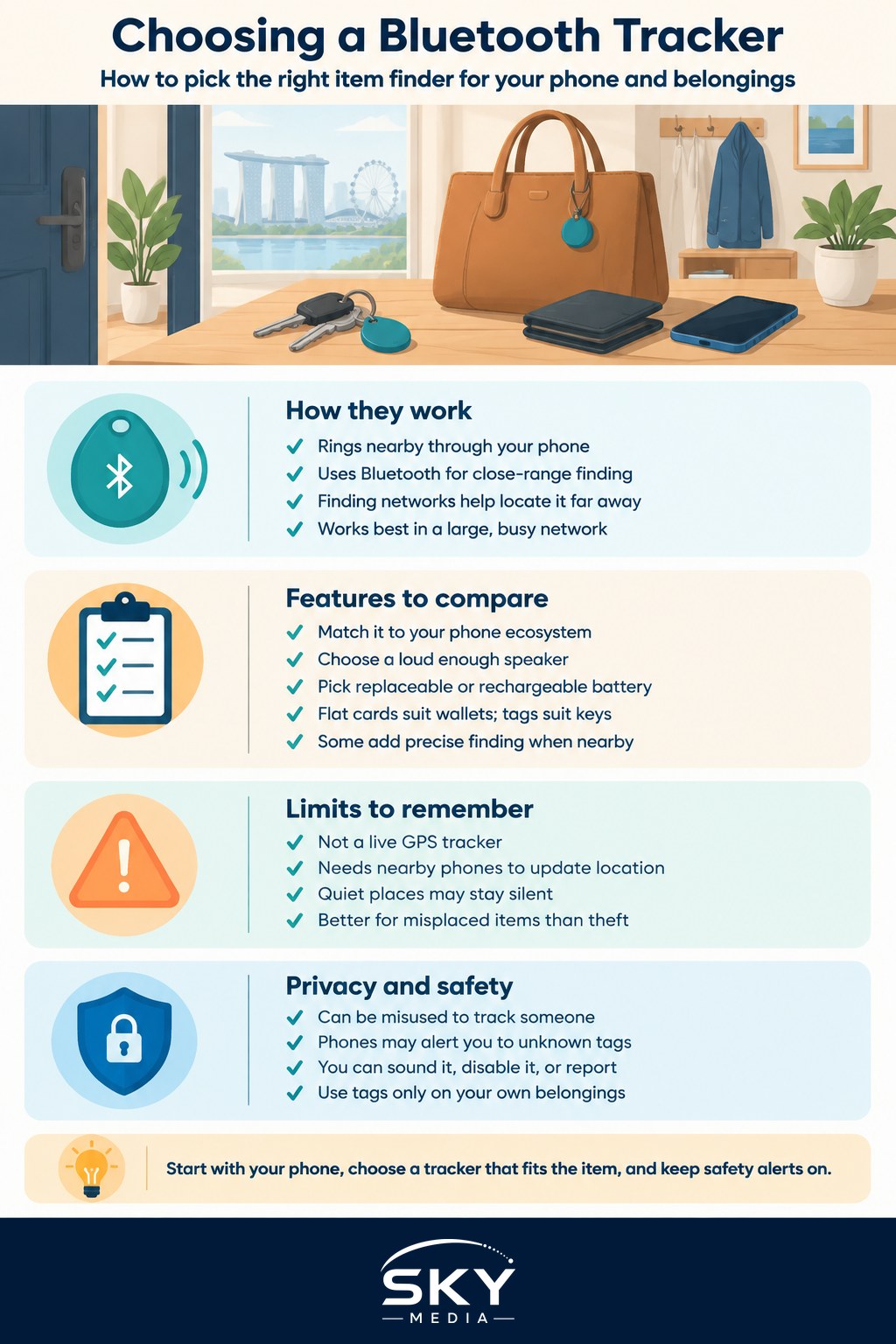
A bluetooth tracker is a little tag with a battery, a speaker and a short-range radio. When your phone is within roughly a room or two of the tag, it connects over Bluetooth and can make the tag ring so you can follow the sound. That is the simple, close-range case, and it is genuinely useful for keys and remotes that slip down the sofa.
The clever part is what happens when your item is far away. The bigger trackers plug into a “finding network”, which quietly uses other people’s phones. When any phone in that network passes near your lost tag, it anonymously reports the location back to you, so you might see that your bag was last near an MRT station even though your own phone is nowhere close. This is why the size of the network matters so much. A tracker tied to a huge, popular ecosystem will usually update its location far more often in busy Singapore than a tracker on a small or obscure network.
There are a few different approaches on the market. Some trackers are built to work best with one phone brand’s built-in finder app, others use their own separate app, and a growing number support the newer cross-platform “find my item” standards so they work across different phones. Which one suits you depends heavily on the phone you carry, so start there rather than with the tag itself. If you are still deciding on hardware in general, our guide to setting up a new phone in Singapore is a useful companion read.
Features worth comparing
Rather than chasing a single “best” tag, think about how you will actually use it and weigh these features.
- Network and phone compatibility. Match the tracker to your phone’s ecosystem and check that it uses a finding network that is widely used here. A larger network means more location updates when your item is out of range.
- Range and loudness. All Bluetooth has a limited direct range, and walls and crowds cut it further. A louder speaker helps you find a bag buried under cushions or in a cupboard.
- Battery. Some tags use a replaceable coin cell that lasts about a year, while others are sealed and rechargeable. Replaceable is convenient if you dislike charging one more thing; rechargeable avoids hunting for the right battery.
- Form factor. Flat card-style trackers slip into a wallet or passport holder, while keyring-style tags suit keys and bags. Pick the shape that fits the item.
- Precise finding. Higher-end tags add a feature that points you in the exact direction of the item once you are close, which is handy in a cluttered home.
- Water resistance and build. Useful if the tag rides on a water bottle, a gym bag or a bike in our humid, rainy climate.
Be realistic about what a tracker is not. It is not a live GPS tracker with its own mobile connection, so it cannot follow a moving item in real time on its own. It relies on nearby phones, so a tag left somewhere quiet with no passers-by may simply go silent until someone walks past. Treat it as a strong aid for finding misplaced things, not a guarantee of recovering stolen ones.
Privacy and stalking safety
This is the part that deserves real attention. Because these tags are small, cheap and silent, they can be misused to track a person without their knowledge by slipping one into a bag, a car or a coat. The industry has responded with safety features, and you should understand them.
Modern phones can alert you if an unknown tracker seems to be travelling with you over time, and the major platforms have worked towards a shared standard so these alerts work across different phone brands. If your phone warns you that an unfamiliar tag is moving with you, take it seriously. You can usually make the tag play a sound to locate it, view instructions to disable it by removing its battery, and report the matter. If you feel unsafe or believe you are being followed, contact the Police.
The same caution applies to your own tags. Only ever use a tracker on your own belongings, never to monitor another adult without their clear consent. If you lend a bag or hand over a car, remember there may be a tag inside. For a wider view of keeping your movements and data to yourself, see protecting your privacy settings on your phone and our overview of managing your digital footprint.
A practical way to decide
Start with your phone and pick a tracker that works smoothly with it and taps a large finding network. Buy the shape that matches the item, favour a loud tag for things that hide, and decide whether you prefer replaceable or rechargeable batteries. Check current reviews close to when you buy, since models and app support change over time, and match the choice to your own needs and budget. Finally, keep the safety side in mind: enable your phone’s unknown-tracker alerts, use tags only on your own things, and you will get the convenience of never losing your keys again without the downsides.
Frequently Asked Questions
Can I put a Bluetooth tracker in my checked luggage when flying? Many travellers do, but rules depend on the airline and the battery type. Check the airline’s policy and the airport’s guidance before you travel. Remember that the tracker only updates its location when other phones pass near the bag.
Is a Bluetooth tracker suitable for tracking a pet or a child? Not really. These tags were designed for objects such as keys and bags, and they depend on nearby phones, so they are not reliable for a wandering pet or child. Use a product designed for that purpose, and never treat it as a replacement for supervision.
Do trackers still work when I travel overseas? The tag still works, but its far-range location depends on how many compatible phones are nearby. Coverage may be thinner in quiet places than in busy cities. Close range ringing works wherever your phone and tag are near each other.
How do I know when the tracker battery is running low? Most apps show a battery warning or status for each tag. Check it now and then, and replace or recharge the battery before a trip. Keeping a spare battery at home is handy for replaceable models.
Can I share a tracker with family members? Some systems let several people see or ring the same tag, which is helpful for a shared car key or a family bag. Check whether your chosen brand supports sharing and how it works before you buy. Only share with people you trust.
Further reading: How to Use Smart Tags to Track Keys, Bags and Pets