

Picking a martial art singapore beginners can actually stick with is less about finding the “best” style and more about finding the one that fits your body, your schedule and what you enjoy. The good news is that Singapore is spoiled for choice. From established taekwondo and karate dojos in the heartlands to modern Brazilian jiu-jitsu and Muay Thai gyms in the city, there is a discipline for almost every temperament and goal. This guide walks you through how to think about the decision, what the main styles feel like, and how to try before you commit.
Before we go further, a quick and important note: this is general information to help you get started, not medical or coaching advice. Combat sports are physical, so consult a doctor before beginning a new exercise programme, especially if you have a health condition, are older, or are returning after a long break. Once you begin, warm up properly, progress gradually, focus on good form, and listen to your body.
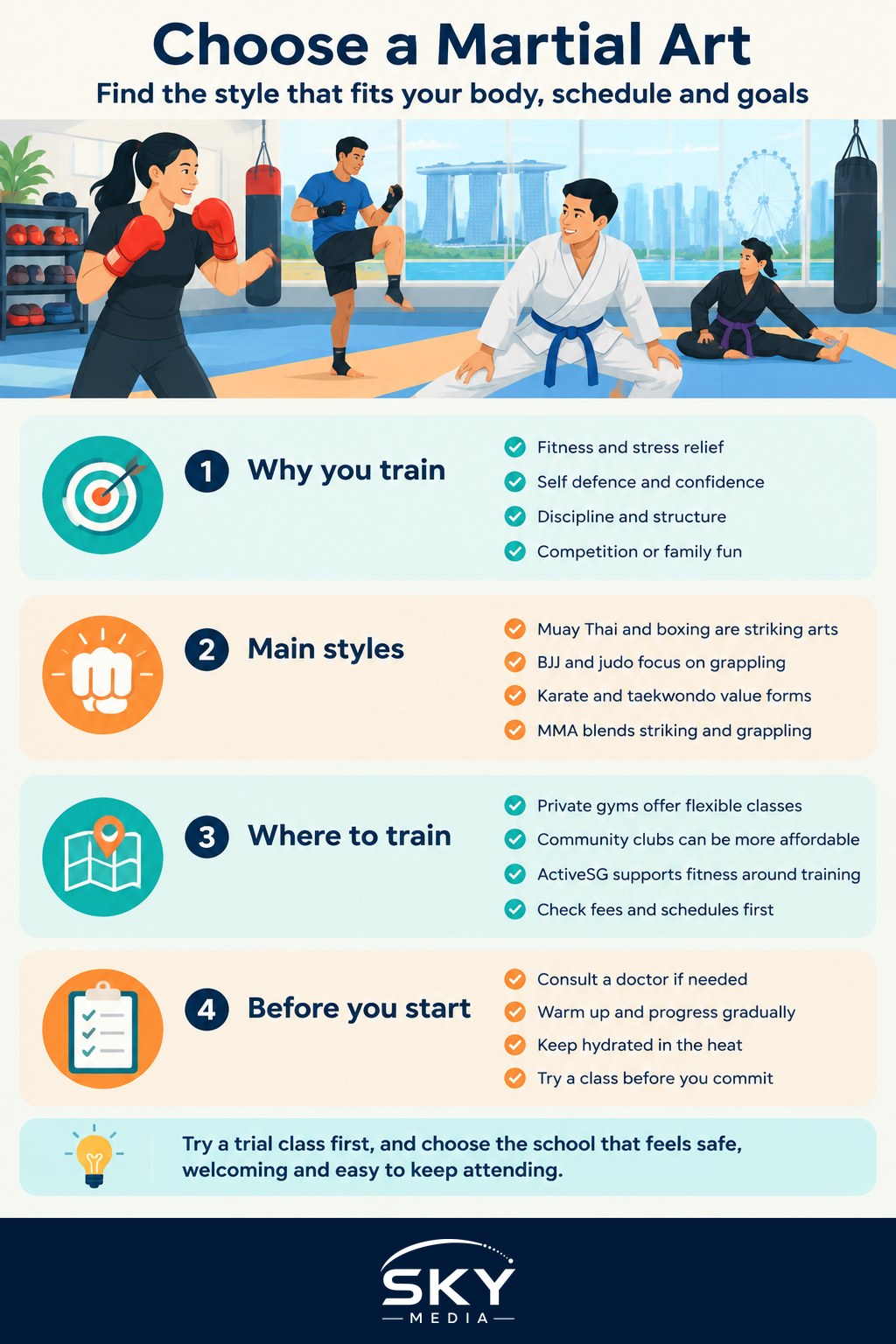
Start with why you want to train
The clearest way to narrow the field is to name your main reason for training. Most people come to martial arts for one of a few reasons, and the “right” art depends heavily on which one is yours.
- Fitness and stress relief: You want a hard, fun workout that clears your head. Striking arts like Muay Thai and boxing, or a busy mixed class, deliver this well.
- Self defence and confidence: You want practical skills. Grappling arts such as Brazilian jiu-jitsu (BJJ) and no-nonsense striking both build real awareness and composure under pressure.
- Discipline, tradition and structure: You value ranks, forms and etiquette. Traditional arts like karate, taekwondo and aikido offer a clear progression and a strong culture.
- Competition: You enjoy testing yourself. BJJ, Muay Thai, judo, boxing and taekwondo all have active local and regional competition scenes.
- Family activity: You want something the kids can do too. Taekwondo, karate and judo have well-run children’s programmes across the island.
There is no single winner here. Someone chasing stress relief after desk-bound days will thrive in a place that would bore a competitor, and the reverse is just as true. Be honest about your “why” and the shortlist shrinks quickly.
The main styles you will find here
Singapore’s martial arts scene broadly splits into striking arts, grappling arts, traditional systems and mixed approaches. Here is a plain-language sense of what each feels like.
Striking arts teach you to punch, kick, and use footwork and distance. Muay Thai, the “art of eight limbs”, adds elbows and knees and is famously good conditioning. Boxing is pure hands and movement, sharp and accessible. Both suit people who like intensity and rhythm.
Grappling arts are about control on the ground and in the clinch. BJJ has boomed here, prized for letting smaller people neutralise larger opponents through leverage and technique. Judo, an Olympic sport with a strong local base, focuses on throws and pins. Wrestling is less common as a standalone class but feeds into mixed programmes.
Traditional systems such as karate, taekwondo, aikido and wing chun emphasise forms, technique and etiquette, usually with a coloured-belt syllabus. Taekwondo, with its dynamic kicks, is especially popular for children and is well supported nationally. Mixed martial arts (MMA) blends striking and grappling and tends to attract people who want the full picture, though it is demanding for absolute beginners.
Comparing popular options for beginners
The table below gives a rough sense of how common beginner-friendly styles compare. Treat intensity and cost as general guidance only; every gym is different, and you should always check current fees and schedules directly with the school.
| Style | Main focus | Contact level | Typical vibe | Good if you want |
|---|---|---|---|---|
| Muay Thai | Striking (8 limbs) | Moderate to high | Energetic, sweaty | A tough, fun cardio workout |
| Brazilian jiu-jitsu | Ground grappling | Moderate | Problem-solving, close contact | Practical self defence and technique |
| Boxing | Hand striking | Low to high | Rhythmic, focused | Fitness, coordination, footwork |
| Taekwondo | Kicking, forms | Low to moderate | Structured, family-friendly | Belts, discipline, kids’ classes |
| Judo | Throws, pins | Moderate to high | Traditional, athletic | Olympic-style grappling |
Notice that “contact level” matters as much as style. Many gyms let beginners drill and spar lightly for months before any hard contact, so do not let the intensity column scare you off. Ask each school how they ease newcomers in.
Where and how to train in Singapore
You have three broad routes. Private commercial gyms, often clustered in the city and larger malls, offer polished facilities and flexible class times, usually at a higher price. Community options through the People’s Association community clubs and various clubs run taekwondo, karate, wushu and more at friendlier rates, though schedules can be limited. Some sports also run through national associations and school or university clubs.
For general fitness to support your training, ActiveSG gyms and swimming pools across the island are affordable and easy to book through the ActiveSG app, and they pair well with a striking or grappling schedule. Fees, class times and available programmes change, so check current availability and pricing with ActiveSG, Sport Singapore or the specific gym before you sign anything.
A few practical Singapore realities to plan around:
- The heat and humidity. Many gyms are not fully air-conditioned. You will sweat heavily, so hydrate before, during and after, and bring more water than you think you need.
- Location and consistency. The dojo nearest your home or office is often the one you will actually attend. Consistency beats prestige, so weigh the commute honestly.
- Hygiene, especially for grappling. In close-contact arts like BJJ, clean kit, trimmed nails and a quick shower afterwards keep everyone safe and comfortable.
Try before you commit
Almost every reputable school offers a trial class or short intro package. Use it. One session tells you more than any review. When you visit, pay attention to how beginners are treated, whether coaching is hands-on, and whether the room feels welcoming rather than intimidating. Watch how sparring is run; safe, controlled partners are a sign of a healthy gym.
Ask about beginner pathways, class sizes, and what gear you need to start. Many arts require very little at first, perhaps just comfortable clothes and hand wraps, with a gi or gloves added later. Give a style at least a few weeks before judging it, because the first sessions of anything feel awkward.
Finally, respect your limits. Skip sessions when unwell, tap early when grappling, and treat pain as information, not weakness. Minor knocks are normal; for anything that swells, does not settle within a reasonable time, or affects a joint, stop and see a doctor or physiotherapist. Do not train through a genuine injury.
Explore more
If you are weighing up a striking discipline, read our companion guide on boxing and Muay Thai in Singapore for a closer look at those two. New to exercise in general? Start with how to start working out in Singapore to build a base first, and see staying fit in Singapore’s heat so your training survives the humidity.
Further reading: Choosing a Martial Arts Class for Your Child: Taekwondo, Karate, Judo or Wushu · Malay Silat: A Martial Art And Cultural Heritage · Brazilian Jiu-Jitsu for Beginners in Singapore