
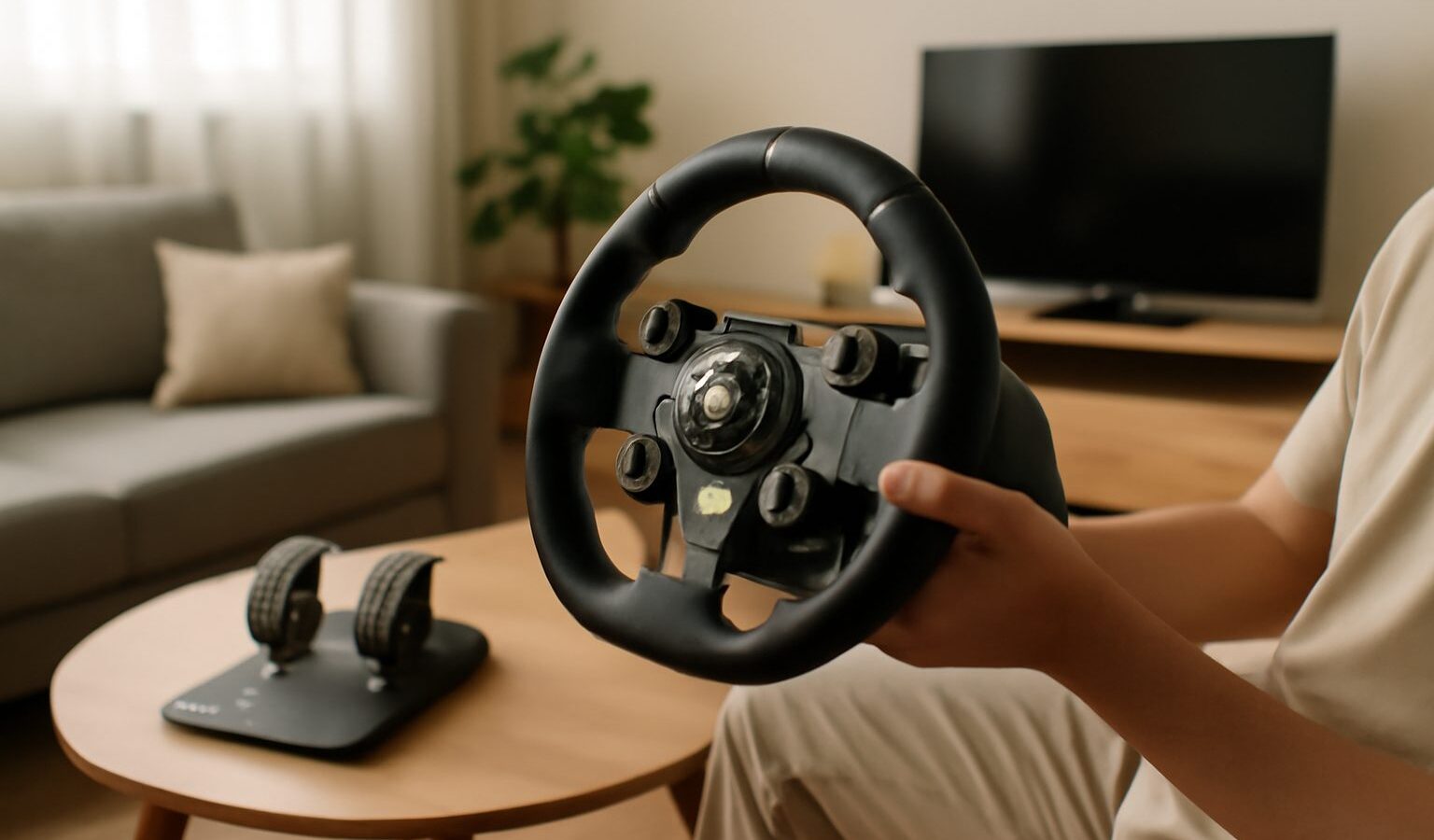
A good wheel transforms racing games from a fun distraction into something that feels close to driving. But the world of sim racing gear can be confusing, with different technologies, add-ons, and mounting options to weigh up. This guide keeps things simple, walking through the main categories so you can pick a racing wheel singapore sim racers will actually enjoy in a typical home or HDB setup.
Why a Wheel Feels So Different
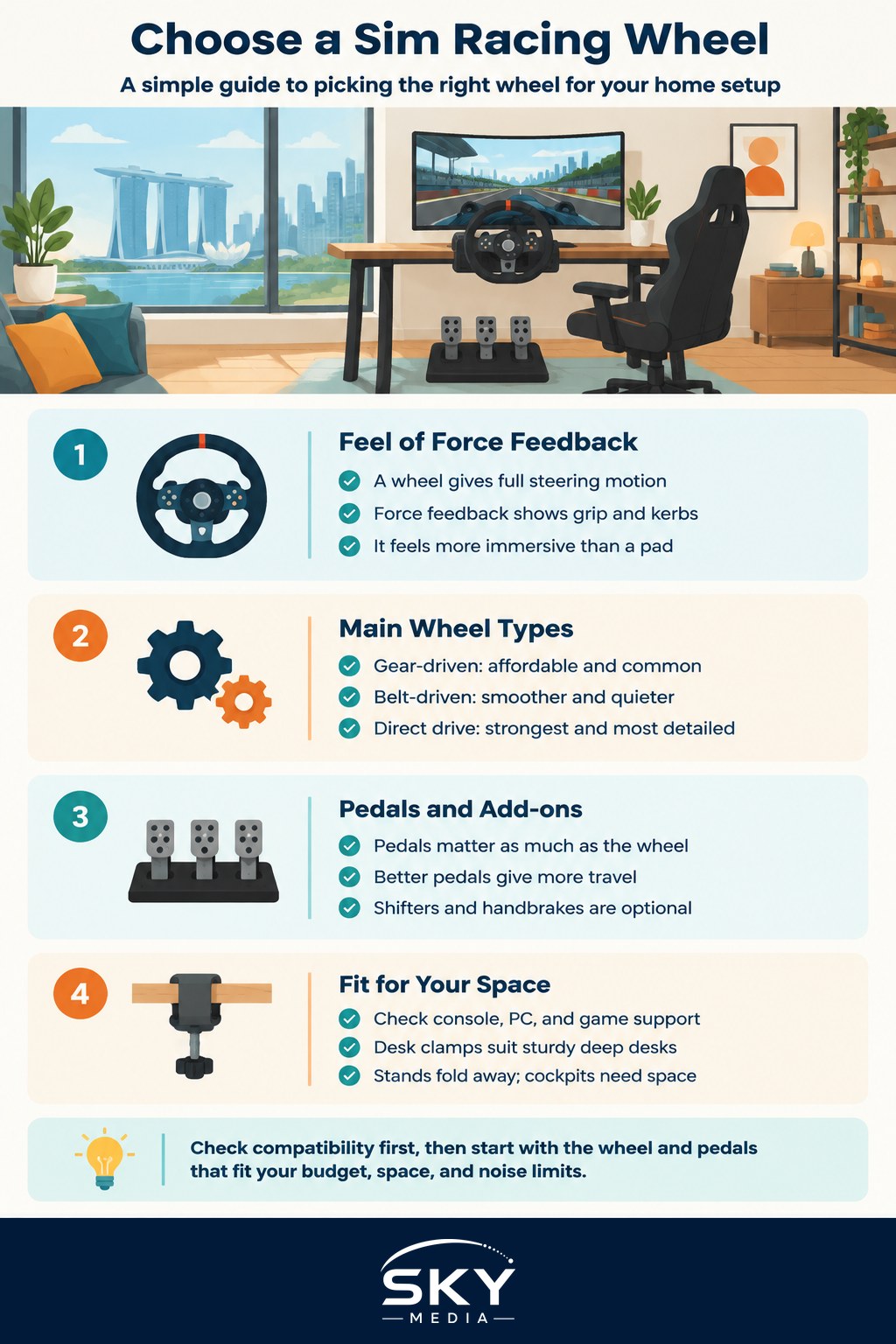
A controller or keyboard gives you on and off inputs, so steering is often a quick flick that the game smooths out. A wheel gives you a full range of motion and, crucially, force feedback: the wheel pushes back against your hands to communicate grip, kerbs, and the road surface. That feedback is what makes a wheel feel immersive and helps you drive more precisely once you adjust. If you are new to the genre, our guide on getting into racing and sports games is a good starting point before you invest in hardware.
The Main Types of Force Feedback
The single biggest difference between wheels is how they generate that force feedback. There are three broad categories, and each is a general family rather than a specific product.
Gear-driven wheels
These use small gears to transmit force to the wheel. They are the most affordable entry point and are common among newcomers. The feedback can feel a little notchy and the gears make some noise, but they are a genuine way to experience force feedback without a large outlay.
Belt-driven wheels
These use belts and pulleys instead of gears, which smooths out the feedback and makes it quieter and stronger. They sit in the middle of the market and are a popular step up for people who race regularly.
Direct drive wheels
Here the wheel mounts straight onto the motor, with no gears or belts in between. This gives the most detailed and powerful feedback, but direct drive setups are the most expensive and the strong forces mean solid mounting matters more. They are aimed at dedicated enthusiasts.
There is no single “best” type. The right one depends on your budget, how serious you are, and how much space and noise your home can absorb.
Pedals, Shifters, and Add-Ons
A wheel is only part of the picture. Most wheels come bundled with a pedal set, and the pedals matter as much as the wheel for lap times and feel.
- Pedals: entry sets use simple sensors, while better sets add more travel and, on some, a firmer brake that you press by pressure rather than distance. Firmer brakes take practice but reward consistency.
- Shifters: many racers are happy with the paddle shifters built into the wheel. A separate H-pattern shifter or sequential shifter adds realism for older cars and rally, but it is optional.
- Handbrake: useful mainly for rally and drifting, and very much a nice-to-have rather than a must.
Start with the wheel and pedals, then add pieces later only if you find you want them.
Compatibility Comes First
Before anything else, check what the wheel works with. Wheels are not universally compatible across every platform, and a wheel made for one console may not work on another or on PC without the right support. Confirm that the wheel you are eyeing supports your specific console or your PC, and that it works with the racing games you actually play. Getting this wrong is the most common and most avoidable mistake.
Mounting and Space in a Singapore Home
Force feedback pushes and pulls, so the wheel needs to be held firmly or it will slide around and feel vague. This is a real consideration in a compact flat.
- Desk clamps: most wheels clamp to a desk. This works well if your desk is sturdy and deep enough, and it is the most space-friendly option.
- Wheel stands: a foldable metal stand holds the wheel and pedals together and can be packed away, which suits shared or small spaces.
- Cockpits: a full rig with a seat is the most stable and immersive, but it takes up permanent floor space that many HDB setups simply do not have.
Think about noise too. Stronger wheels transmit more vibration into a desk or floor, which can carry through walls in a flat, so consider your neighbours and the time of day you race. For a wider look at fitting gear into a small home, see our guide on setting up a gaming corner in your HDB flat.
Matching the Wheel to You
A simple way to decide is to be honest about how you will use it.
- Casual and curious: a gear-driven bundle with basic pedals lets you try sim racing affordably.
- Regular racer: a belt-driven wheel with a better pedal set is a comfortable long-term home.
- Dedicated enthusiast: direct drive with quality pedals and solid mounting, if your budget and space allow.
You do not need the most powerful setup to have fun or to improve. Many skilled racers run modest gear and focus on practice instead.
The Practical Takeaway
Choosing a racing wheel comes down to force feedback type, the pedals it ships with, whether it is compatible with your platform and games, and how you will mount it in your space. Confirm compatibility first, start with a wheel and pedal bundle that fits your budget and your flat, and add extras only when you know you want them. Get those basics right and you will have a setup that makes every lap more enjoyable.
Frequently Asked Questions
Will a racing wheel work on both my PC and my console? Not always. Wheels are usually made for specific platforms, and some work on several while others do not. Look at the supported platforms on the box or manufacturer page, and check that your particular racing games support that wheel.
How do I stop my wheel from shaking my desk and annoying neighbours? Use a sturdy desk or a foldable stand, tighten the clamps, and lower the force feedback strength in the game settings. A thick mat under a stand can soften vibration. In a flat, avoid late-night sessions with strong settings.
Can I learn to drive in real life by using a racing wheel? No. A wheel helps with car control concepts in a game, but it is not a substitute for lessons with a qualified driving instructor. Real driving involves traffic, judgement and road rules that a simulator cannot properly teach.
Is it worth buying a used racing wheel? It can be, if you can test it first. Check that the force feedback is smooth, the pedals respond evenly and the buttons all register. Confirm it is compatible with your platform and still has working software support, since older models can lose it.
Further reading: Where to Try Sim Racing and F1 Simulators in Singapore