

Some games hand you a problem and one correct answer. Immersive sims hand you a problem and quietly hope you surprise them. This is one of the most respected corners of the hobby, and immersive sim games in Singapore have a small but passionate fan base who love the feeling of a world that actually responds to their choices. The name is a bit of jargon, so let us unpack what it really means and why so many designers treasure the genre.
The Idea Behind The Genre
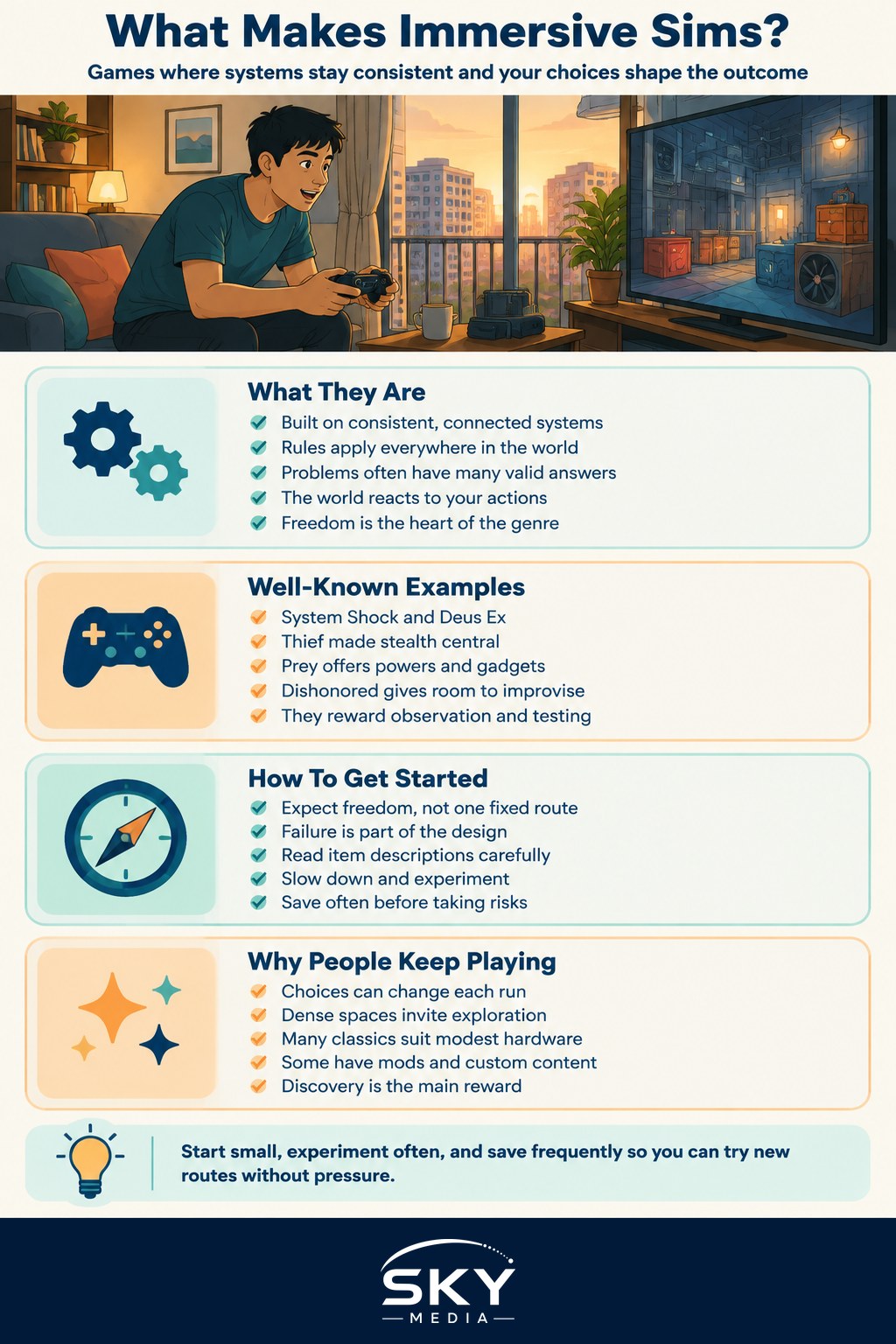
An immersive sim is built around consistent, interconnected systems rather than scripted, one way solutions. In plainer terms, the game has a set of rules about how the world works, and those rules apply everywhere. If fire spreads across wood, it will spread whether you are in a kitchen or a warehouse. If guards can hear noise, you can use noise to lure them anywhere, not just in the one spot a designer planned for.
Because the systems are consistent, you are free to combine them in ways the developers may never have specifically anticipated. Faced with a locked door, you might pick the lock, hack a nearby terminal, find a key, crawl through a vent, stack crates to reach a window, or simply blast through if you have the tools. None of these is the “right” way. They are all valid because the world plays fair with its own rules. That freedom is the whole point, and it is what separates the genre from more linear designs. If the broader map of gaming labels is still new to you, our primer on video game genres is a helpful place to zoom out.
Real Examples You Can Point To
The genre has a clear lineage. The System Shock and Deus Ex series are often named as founding pillars, blending shooting, stealth, hacking, and role playing choices in ways that let players craft their own path. The Thief series leaned hard into stealth, teaching a generation that shadows and sound were tools you could master. Prey and the Dishonored games are more recent standard bearers, giving you a toolkit of powers and gadgets and then stepping back to see what you do with them.
What these titles share is a deep respect for player intelligence. They rarely hold your hand. Instead they trust you to observe, experiment, and draw your own conclusions. That overlap with character growth and player choice means the genre sits close to the role playing game family, and many immersive sims let you build a very different character from one playthrough to the next. They also tend to feature dense, explorable spaces, which gives them a kinship with the freedom you find in open world games, even when the actual maps are smaller and more handcrafted.
Getting Into Them Without Feeling Lost
Here is the honest catch. The very freedom that makes immersive sims special can feel paralysing at first, especially if you are used to games that point a big glowing arrow at your next objective. When every problem has five solutions, some players freeze up.
The trick is to give yourself permission to experiment and, crucially, to fail. Immersive sims are designed with failure in mind. A blown stealth attempt often turns into a memorable escape rather than a hard game over. Try things, poke at the systems, and pay attention to how the world reacts. Read item descriptions, because a seemingly minor gadget is often the key to a clever route. Save often so you feel safe taking risks, and do not chase a mythical perfect run on your first go.
It also helps to slow down. These games reward patience and observation far more than speed, so a quiet evening at home suits them better than a rushed half hour. They generally run well on modest hardware since they favour clever design over cutting edge graphics, which makes them a comfortable fit for a laptop in a small HDB setup. Many of the classics resurface in digital sales, so you can sample the genre without a big outlay. Some also have thriving communities that build mods and custom content, extending the systems in fun new directions long after release.
Give the genre a fair shot and something clicks. You stop looking for the intended solution and start looking at the world as a box of tools. That shift, from following a path to writing your own, is the quiet magic that keeps immersive sim fans coming back, and it will change how you look at every other game you play afterwards.
Further reading: Getting Into Life Sim Games