

Sending money home is one of the first things many newcomers need to do, and getting it right matters when every dollar counts. Choosing a remittance service in Singapore comes down to a few clear habits: use providers that are properly licensed, compare the true cost of each transfer, and keep good records. This is general information to help you decide, not financial advice. Rates and fees change constantly, so always check current figures with the provider before you send.
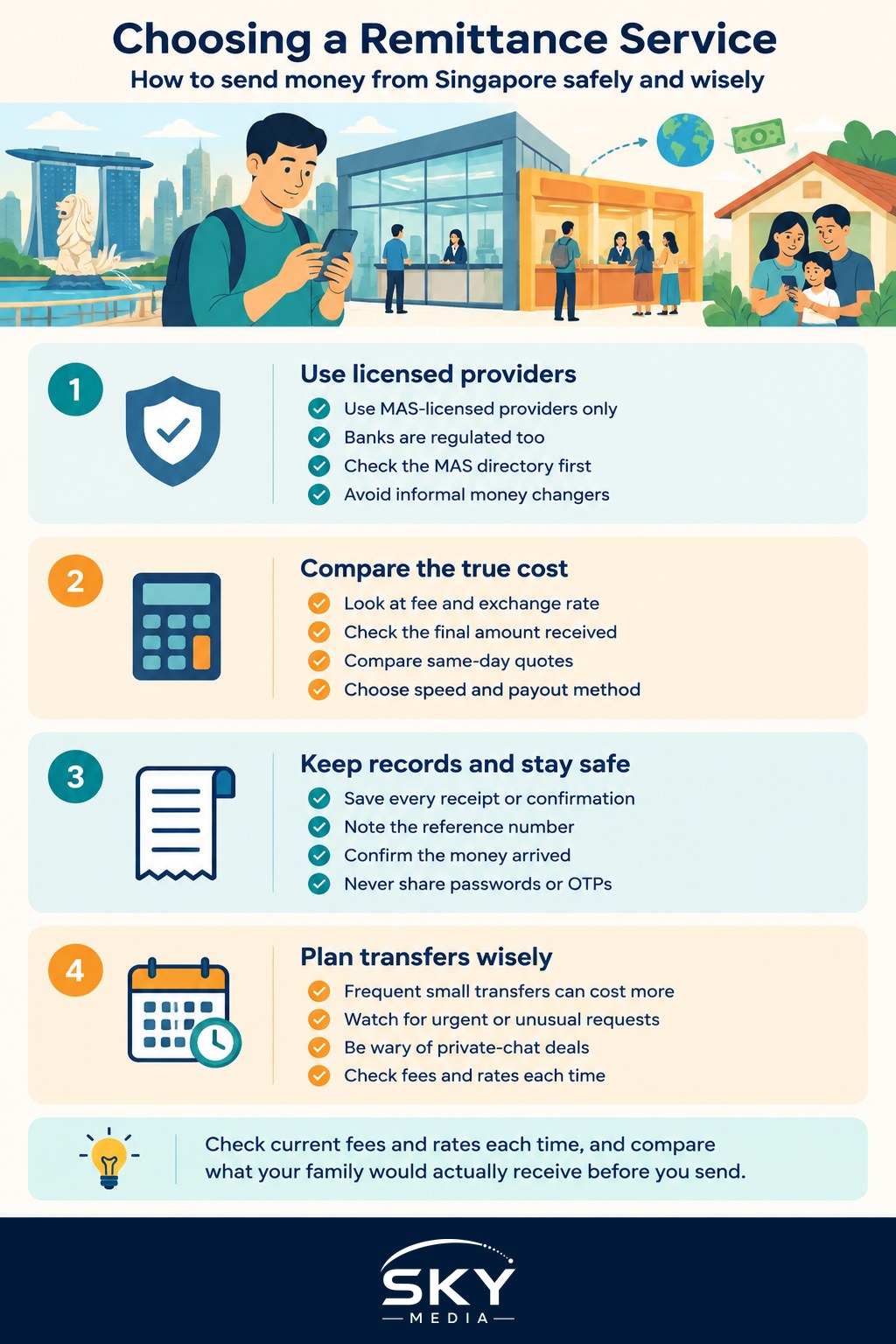
Start with licensed providers only
The single most important rule is to use providers that are regulated. In Singapore, remittance and money transfer businesses are overseen by the Monetary Authority of Singapore (MAS), and licensed providers must meet standards designed to protect your money. Banks also offer international transfers and are regulated too.
Before using any service, confirm that it is licensed. You can check the official MAS financial institutions directory rather than trusting a shop sign or an advertisement. Avoid informal or illegal money changers and anyone who offers to move money through unofficial channels, even if the rate sounds better. Those arrangements carry no protection, and if something goes wrong you may have no way to recover your funds.
Your realistic options generally fall into these groups:
- Licensed remittance companies, including the counters you see in malls and heartland centres, and their apps.
- Banks, through their branches and online banking transfer services.
- Licensed digital transfer apps that let you send from your phone.
Each has trade-offs in speed, cost, and convenience, which is where comparison comes in.
Compare the real cost, not just the headline rate
A remittance service in Singapore rarely advertises a single all-in price, so you need to look at two things together: the transfer fee and the exchange rate. A service might wave a low fee while quoting a weaker exchange rate, which quietly eats into the amount your family receives. The number that matters is how much lands in the recipient’s account, in their currency, after everything.
Here is a simple way to weigh your options.
| Factor | What to check | Why it matters |
|---|---|---|
| Transfer fee | The flat or percentage fee per transfer | Small fees add up on frequent sends |
| Exchange rate | The rate offered versus the market rate | A poor rate can cost more than the fee |
| Amount received | The final figure in the recipient’s currency | This is the true bottom line |
| Speed | Same day, next day, or a few days | Urgent transfers may cost more |
| Payout method | Bank deposit, cash pickup, or wallet | Must suit how your family receives money |
A practical approach is to pick a fixed amount, ask two or three licensed providers what your family would actually receive, and compare those final figures on the same day. Rates move, so the best choice this week may not be the best next month. For larger or recurring transfers, even a small difference in rate is worth a few minutes of checking.
Do not send money on the promise of an unusually good rate from an unlicensed source. If an offer seems far better than everyone else, treat it as a warning sign rather than a bargain.
Keep records and stay safe from scams
Once you choose a service, protect yourself with a few simple habits. Keep the receipt or digital confirmation for every transfer, note the reference number, and confirm with your recipient that the money arrived. Records help you trace a transfer if it is delayed and are useful for your own budgeting.
Be alert to scams, which often target newcomers who are sending money regularly. Be wary of anyone who contacts you unexpectedly asking you to send money urgently, of requests to change a recipient’s account at the last minute, and of deals offered only through private chats. Never share your banking passwords or one-time passwords with anyone. A legitimate provider will not ask for them.
If you send money to family abroad often, it helps to plan around fees rather than making many tiny transfers, since each one may carry a cost. Our related guide on sending money to China from Singapore walks through a common corridor in more detail.
Fit remittance into your wider money setup
Remittance is one piece of settling in financially. Understanding your income and deductions makes it easier to plan how much you can send each month, so our overview of understanding your Singapore payslip and CPF is worth a read, as is our guide to income tax filing for newcomers in Singapore once you are earning here.
Sending with confidence
Choosing a remittance service in Singapore is not complicated once you know what to look for. Stick to MAS-licensed remittance companies and banks, compare the final amount received rather than the headline rate, keep every receipt, and stay firmly away from illegal money changers and pressure tactics. Check current fees and rates with the provider each time, because they change, and confirm with your recipient that the money has arrived. With those habits, you can send money home reliably and safely, and keep more of your hard earned income where you want it to go.
Frequently Asked Questions
How can I check whether a remittance company is licensed in Singapore? Look the company up in the official MAS financial institutions directory instead of trusting a shop sign or advert. If it is not listed, do not use it. Licensed providers are required to meet standards that help protect your money.
Is it cheaper to send money through a bank or a remittance company? It varies, so there is no standing winner. Compare the fee and the exchange rate offered, then look at how much your family would actually receive. Ask two or three licensed providers the same day with the same amount.
How long does an overseas transfer usually take? It depends on the provider, the payout method and the destination, from the same day to a few days. Faster options may cost more. Ask the provider for a delivery estimate before you pay, and plan ahead for anything urgent.
What can I do if my transfer is delayed or never arrives? Contact the provider with your receipt and reference number and ask for a trace. Confirm the recipient’s details were right. If it is not resolved, you can raise it with the provider’s complaints channel, and a licensed provider gives you a route to do so.
How can I avoid scams when sending money abroad? Only send money to people you know, through licensed providers, and be wary of urgent requests or sudden changes of account details. Never share passwords or one-time codes with anyone. If something feels wrong, stop and verify directly with the recipient first.
Official sources: Monetary Authority of Singapore (MAS)
Further reading: Singapore to China Remittance: Banks vs Apps Compared