

Few newborn decisions stir up as many opinions as circumcision. Grandparents may have firm views, friends swear by one approach or the other, and online forums swing between extremes. If you are researching circumcision in Singapore for your baby, this guide lays out the main medical and cultural reasons families consider it, when it tends to be done, what the process and aftercare usually involve, and the questions worth asking your doctor. It is general information, not medical advice. Every child is different, so the final word should come from your paediatrician or a paediatric surgeon.
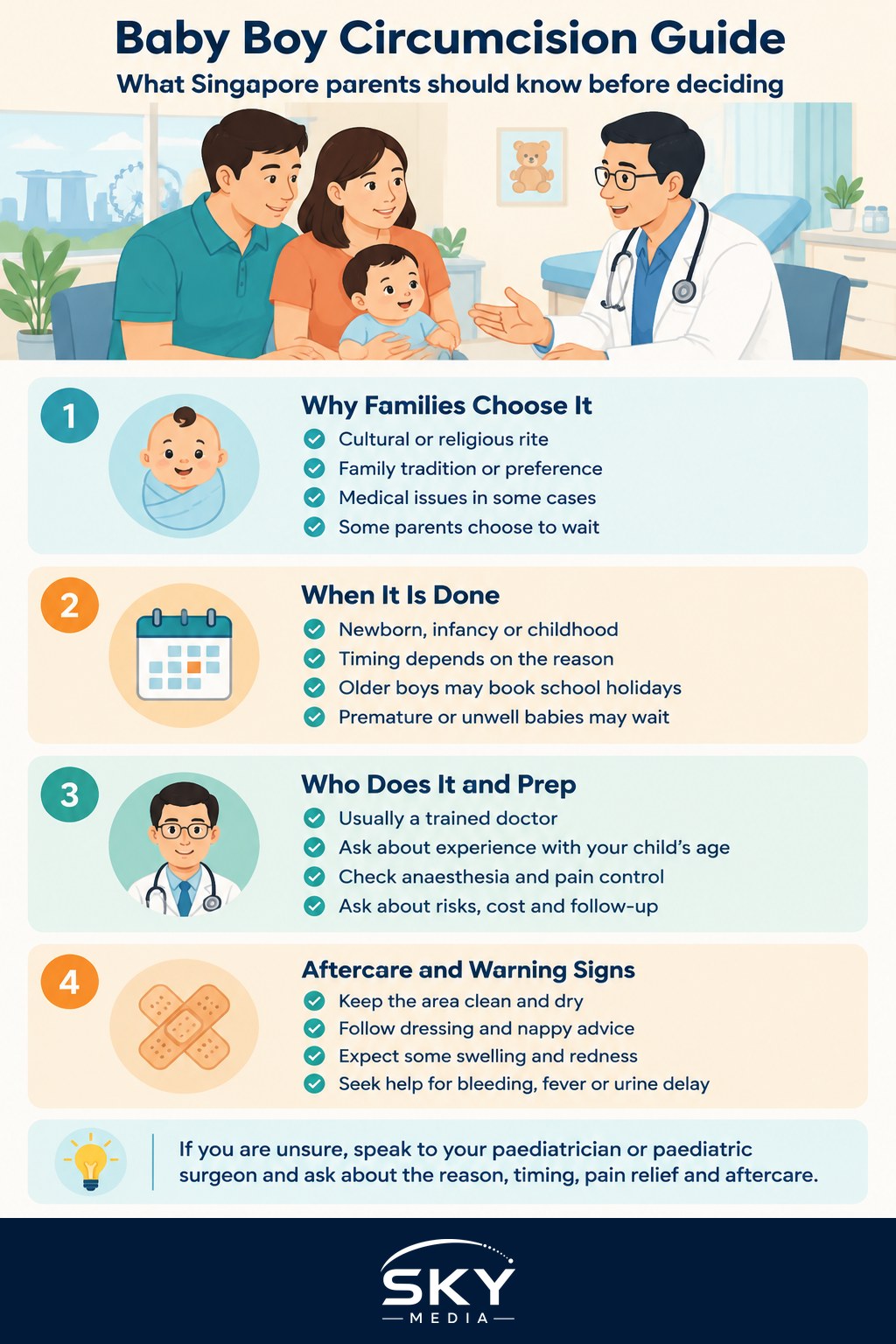
Medical and Cultural Reasons Families Consider It
Circumcision is the surgical removal of the foreskin, the fold of skin covering the head of the penis. Families in Singapore come to the decision from quite different starting points.
Cultural and religious reasons. For many Muslim families, circumcision (often called khatan or sunat in Malay) is an important rite. For Jewish families, it is part of the brit milah ceremony traditionally held in the first days of life. Some other families follow a family custom or simply prefer it. Practices and timing vary from family to family, and many households combine religious guidance with medical advice when deciding how and when.
Medical reasons. A doctor may recommend circumcision when there is a specific problem, for example:
- Repeated infections or inflammation of the foreskin or the head of the penis.
- A foreskin that stays tight and causes problems as the child grows older, beyond what is normal for his age.
- Some recurrent urinary tract issues, where a specialist judges circumcision may help.
It is worth knowing that a baby’s foreskin is normally tight and attached to the head of the penis. That is expected, not a disease, and it usually loosens naturally over the years. A tight foreskin in a baby on its own is not usually a reason for surgery, which is why a proper assessment matters.
Reasons some families choose not to. Many parents leave their son uncircumcised, because there is no medical need or because they prefer to let him decide later. With good hygiene, most uncircumcised boys have no problems at all.
There is no single right answer. Major medical bodies around the world differ in how they weigh the possible benefits and risks of routine newborn circumcision, so a conversation with your own doctor is far more useful than a general verdict online.
When Circumcision Is Usually Done
Timing depends on the reason, the family’s practice and the child’s health. Broadly:
| Timing | Common reasons | What it usually involves | Points to discuss with the doctor |
|---|---|---|---|
| Newborn period | Religious rite, family preference | Shorter procedure, usually with local anaesthesia | Baby’s weight and health, any bleeding disorders in the family, who performs it |
| Infancy (after the newborn weeks) | Family preference, follow-up after assessment | May need a different technique or anaesthesia | Why it is being done now, anaesthesia options, recovery time |
| Childhood (school-going age) | Cultural rite, medical indication | Often done in hospital or a day surgery setting | Child’s readiness, timing around school holidays, pain management |
| Not done | No medical need, parents prefer to wait | Routine foreskin hygiene at home | How to care for the foreskin, signs that need a check-up |
In Singapore, many Malay-Muslim families traditionally arrange circumcision when their son is older rather than as a newborn, often during the school holidays so he can rest at home. Other families prefer the newborn period. Either way, the doctor will consider whether your son is well enough, and premature babies or babies with certain conditions may be advised to wait.
Who Performs It and How to Prepare
In Singapore, circumcision for babies and children is usually done by doctors such as paediatric surgeons, paediatric urologists, or general practitioners and surgeons with experience in the procedure, in hospitals or licensed clinics. Some practices focus on newborns, others on older children.
Before you book, consider asking:
- How much experience does the doctor have with children this age? Techniques for newborns and older boys differ.
- What anaesthesia is used, and why? Ask the doctor to explain the options and how pain will be managed during and after the procedure.
- Which technique will be used? Different methods involve different dressings, stitches or devices. Ask what that means for aftercare.
- What are the risks? Ask about bleeding, infection and the chance of needing a further procedure, so you go in with realistic expectations.
- What does it cost and what might be covered? Charges differ between hospitals and clinics. Whether MediSave, MediShield Life or private insurance can help often depends on whether the procedure is medically indicated, so check with the provider, your insurer or HR, and the CPF Board rather than assuming.
- What follow-up is included? Find out when the review appointment is and who to call after hours.
If you are still in pregnancy planning, it can help to raise the topic early, alongside other decisions in preparing for your first baby, and to factor possible costs into your new baby budget.
Aftercare at Home
Your doctor will give you instructions specific to the technique used, and those always take priority. Common themes parents hear include:
- Keep the area clean. You will usually be shown how to clean around the wound and when baths are allowed again.
- Protect it during nappy changes. Some doctors suggest applying a product to stop the wound sticking to the nappy, and fastening nappies a little looser. Use only what your doctor advises.
- Expect some swelling and redness. Mild swelling, redness and a yellowish film while healing are often normal in the first days. Ask your doctor what normal healing looks like so you can compare.
- Handle pain as advised. Only give pain relief that your doctor has recommended, at the dose they specify for your child.
- Dress older boys comfortably. Loose clothing helps. Older children may need a few days of quiet rest and a break from active play.
- Keep the follow-up appointment. Even if everything looks fine, the review lets the doctor confirm healing.
Warning Signs That Need Medical Attention
Contact your doctor promptly, or go to a children’s emergency department if it is urgent, if you notice:
- Bleeding that does not stop with gentle pressure, or a nappy soaked with blood.
- Your baby not passing urine within the time your doctor told you to expect.
- Fever, unusual drowsiness or poor feeding.
- Redness or swelling that spreads, worsens, or comes with pus or a foul smell.
- Anything else that worries you. Trust your instincts and call.
Caring for an Uncircumcised Baby
If you decide against circumcision, care is simple. Wash the outside of the penis gently with water at bath time, as you would any other part of the body. Do not pull back a baby’s foreskin to clean underneath, because forcing it can cause pain and injury. As your son grows, the foreskin usually separates naturally, and later you can teach him to clean underneath gently as part of normal hygiene. If you notice redness, swelling, pain when passing urine, or ballooning that seems to bother him, see your GP or paediatrician.
Talking It Through as a Family
Circumcision can be an emotional topic, especially when grandparents and parents come from different traditions. It helps to agree on who makes the final call, gather information from your doctor together, and remember that both choices are common and loving ones. If there is no medical urgency, you do not need to decide in the first few days. Take the time to ask questions until you feel comfortable.
Explore more: Planning for a Baby in Singapore.
Official sources: HealthHub
Further reading: Hydrocele and Inguinal Hernia in Baby Boys: What Parents Should Know · Undescended Testes in Baby Boys: What Parents Should Know