
Shopping overseas can be cheaper than it looks on the price tag, because many countries let tourists reclaim the consumption tax built into the price. In Europe it is called VAT (value added tax), in Japan it is consumption tax, and South Korea has its own tax refund system. Getting a VAT refund abroad is not complicated, but each country has its own steps, and missing one, such as the customs stamp, can cost you the whole refund.
This guide explains how tourist tax refunds generally work in popular destinations for Singaporean travellers, and the airport steps that trip people up. Rules, minimum spends and refund methods change, so check the official tax or customs authority of the country you are visiting before you shop.
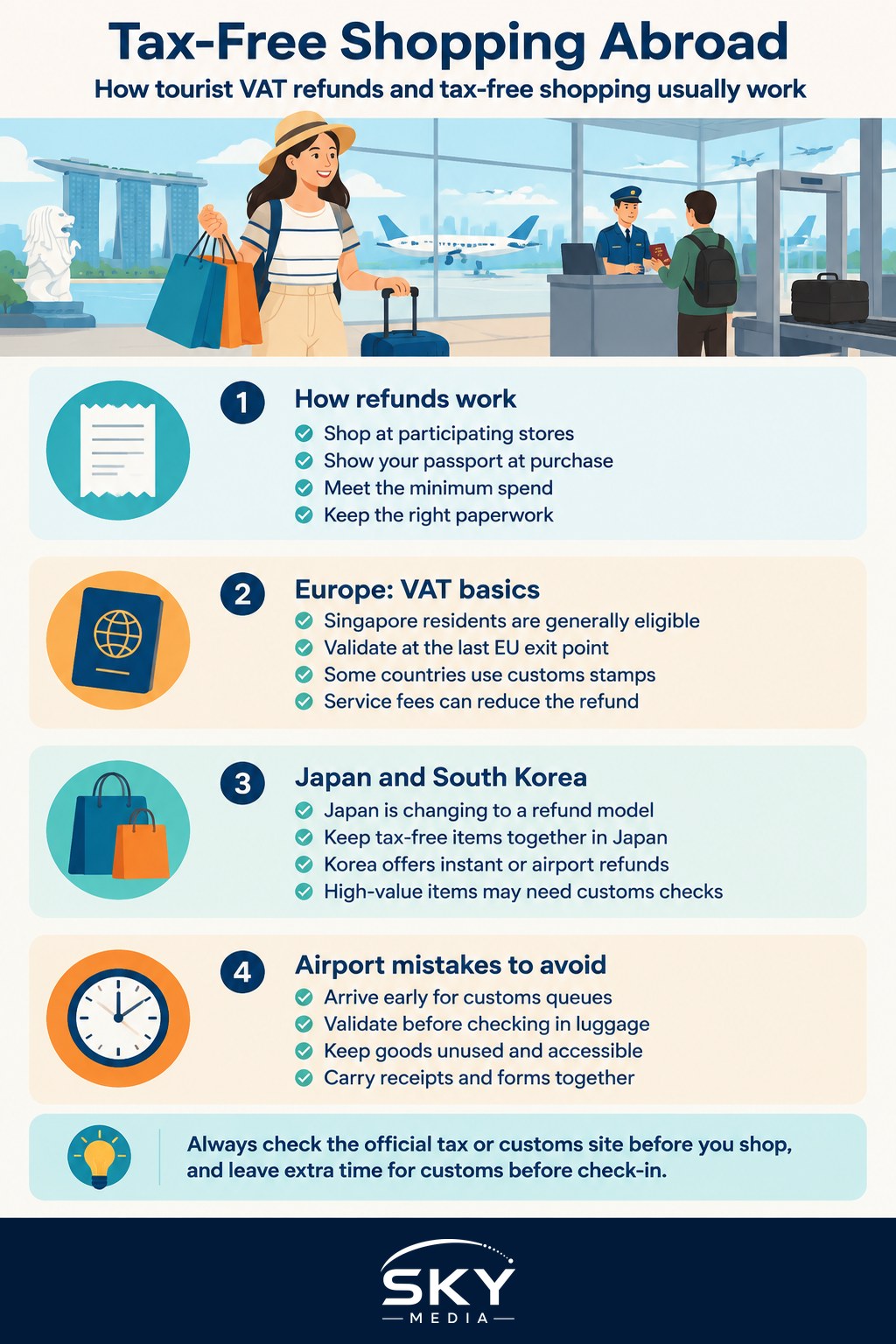
How Tourist Tax Refunds Work in General
Most schemes follow the same basic logic. Tax is charged on goods sold in the country, but goods that leave with a visitor are not consumed there, so the visitor can reclaim the tax.
The general pattern is:
- Shop at a participating store that offers tax-free or tax refund service. Look for signs at the till or ask staff.
- Show your passport at the time of purchase. Most schemes require the physical passport, not a photo.
- Meet the minimum spend, which usually applies per store and sometimes per day. Thresholds differ by country.
- Get the right paperwork, either a printed form or an electronic record linked to your passport.
- Validate at departure, usually at customs at the airport, before you check in your luggage if the goods are in it.
- Receive the refund, in cash, to a card, or deducted at the till in some systems.
Refunds are rarely the full tax amount. Many stores use refund operators who deduct a service fee, so the amount you get back is smaller than the headline tax rate.
Europe: VAT Refunds for Non-EU Residents
As a Singapore resident, you are generally eligible for VAT refunds when shopping in European Union countries as a tourist.
- At the shop. Ask for a tax-free form at participating stores and show your passport. Fill in your details accurately, including your home address in Singapore.
- Last EU exit point. You validate your purchases when you leave the EU, not when you leave each country. If you fly from Paris to Rome and then home, you validate in Rome.
- Customs validation. Some countries use self-service electronic kiosks that scan your form, while others need a customs officer to stamp it. Officers may ask to see the goods, so keep them unused and accessible.
- Getting the money. After validation, you collect the refund at a refund counter at the airport, or mail the form or drop it in a box for a card refund. Card refunds can take some weeks.
Note on the UK: the United Kingdom ended its tourist VAT refund scheme for most in-store purchases after leaving the EU. Do not expect a VAT refund on shopping in Britain, and check the UK government’s site for any updates.
Switzerland and Norway are not in the EU but have their own tourist refund schemes, so the forms and validation points are separate.
Japan: Tax-Free Shopping
Japan has been popular with Singaporeans for tax-free shopping, but its system works differently from Europe’s, and it has been changing.
- Traditional model. For years, participating shops deducted the consumption tax at the till when you showed your passport. Purchases were recorded electronically and linked to your passport.
- Consumables and general goods. Consumable items such as cosmetics, food and medicines have often had special rules, including sealed packaging and a ban on using them in Japan. General goods such as clothing and electronics are treated separately.
- The shift to refunds. Japan announced a move toward a refund model, where tourists pay the full price and receive the tax back after confirmation at departure. If you are travelling, check the Japan National Tax Agency and Japan Tourism Agency for how the current system works.
- At departure. Customs may check that you are taking the goods out of Japan. Keep tax-free items together and do not pack them deep in checked luggage until you know whether they need to be shown.
South Korea: Instant and Airport Refunds
South Korea offers several ways to get tax back, which makes it one of the easier destinations.
- Instant refunds at participating stores. Many shops in shopping districts deduct the refund at the till when you show your passport, within set spending limits per purchase and per trip.
- Airport refund kiosks. For purchases that are not refunded instantly, you can claim at kiosks or counters at the airport. Have your passport and receipts ready.
- Downtown refund points. Some city areas have refund counters where you can claim before you leave, though you may still need to complete departure checks.
- Customs check. High-value items may need a customs check at departure before check-in. Allow extra time.
Country Comparison at a Glance
| Destination | How the refund works | Where you validate | What to watch |
|---|---|---|---|
| EU countries | Pay full price, get a tax-free form, claim after departure | Customs at the last EU exit point | Validate before checking luggage; service fees reduce the refund |
| Japan | Historically deducted at the till; moving toward refunds after departure | Customs at departure | Consumables rules; check the current system before you shop |
| South Korea | Instant deduction at many stores, or claim at the airport | Airport kiosks or customs counters | Spending limits for instant refunds; customs check for big items |
| United Kingdom | No general tourist VAT refund on in-store purchases | Not applicable | Do not budget on getting VAT back |
Airport Steps and Common Mistakes
Most failed refunds come down to timing or missing paperwork.
- Arrive early. Customs and refund queues can be long, especially at major European hubs. Add time to your usual check-in buffer.
- Validate before checking in. If tax-free goods are in your checked bag, go to customs first with the bag. Once it is checked in, you cannot show the goods.
- Keep goods unused. Wearing the new jacket on your trip or opening sealed cosmetics can void the refund.
- Carry receipts and forms together in one folder or envelope.
- Check the card or currency. A cash refund may be in a foreign currency with a poor rate. A card refund is often better value but takes longer.
- Know the deadlines. Many schemes require validation within a set period after purchase. Shopping weeks before departure can be risky.
Bringing Goods Back to Singapore
Getting a VAT refund abroad does not mean the goods are tax-free when you land. When you return to Singapore, you are allowed a GST relief on goods bought overseas, depending on how long you were away. If the total value of your purchases exceeds the relief, you may need to declare and pay GST at Changi. Singapore Customs explains the current relief amounts and how to declare through its website and app.
If something you buy overseas is faulty, refunds depend on the store’s policy and the country’s consumer laws, which can be harder to pursue from home. For how returns work locally, see our guide to consumer rights, returns and refunds in Singapore. For the basics of how GST itself works, our guide to claiming GST input tax explains the tax from a business angle.
A little preparation turns tax-free shopping into a real saving. Keep your passport handy, read the signs at the till, and leave time for customs on the way home.
Frequently Asked Questions
Is it worth claiming a tax refund on a small purchase? Often not. Most schemes have a minimum spend per store, and refund operators deduct a service fee, so a small purchase may return very little for the time spent in queues. It makes more sense on larger purchases, where the refund is meaningful. Check the minimum spend in that country before you shop.
Can I get tax back on restaurant meals or hotel stays abroad? Usually not. Tourist refund schemes generally cover goods that you take out of the country, not meals, accommodation or other services consumed there. Rules differ by destination, so ask the shop or check the country’s tax or customs authority if you are unsure.
What if I left my passport at the hotel when shopping? You may not be able to get the tax-free form or instant deduction, since most schemes need the physical passport at the till. A photo is usually not accepted. Carry your passport on shopping days, and if you forget it, ask the store whether they can still help before you pay.
How long does a card tax refund take to arrive? Card refunds can take some weeks after your forms are validated and posted or dropped off. Cash at the airport is quicker but may be in a foreign currency at a poor rate. Keep copies of your forms and receipts so you can follow up with the refund operator if nothing arrives.
Can Singapore PRs and foreigners living here claim tourist refunds? Eligibility generally depends on where you live and the passport you show, not on citizenship alone. Residents of Singapore are normally treated as visitors in the EU, but each country sets its own rules. Check the scheme’s eligibility terms on the official tax or customs website before you shop.
Further reading: Getting the Best Exchange Rate Abroad