

If you have browsed property listings, you may have seen the phrase “co-broke welcome” or been told by an agent that they will “co-broke” a unit. Co-broking property in Singapore simply means two agents, one acting for each side, working together to close the same transaction. It is extremely common, but many buyers, sellers, landlords and tenants are not sure who the agents actually represent or who pays which commission.
This guide explains how co-broking works, how commission typically flows between the two agents, and what you should agree in writing. It is general information. Commission is negotiable and not fixed by law, so always confirm the arrangement in your agreement with your own agent.
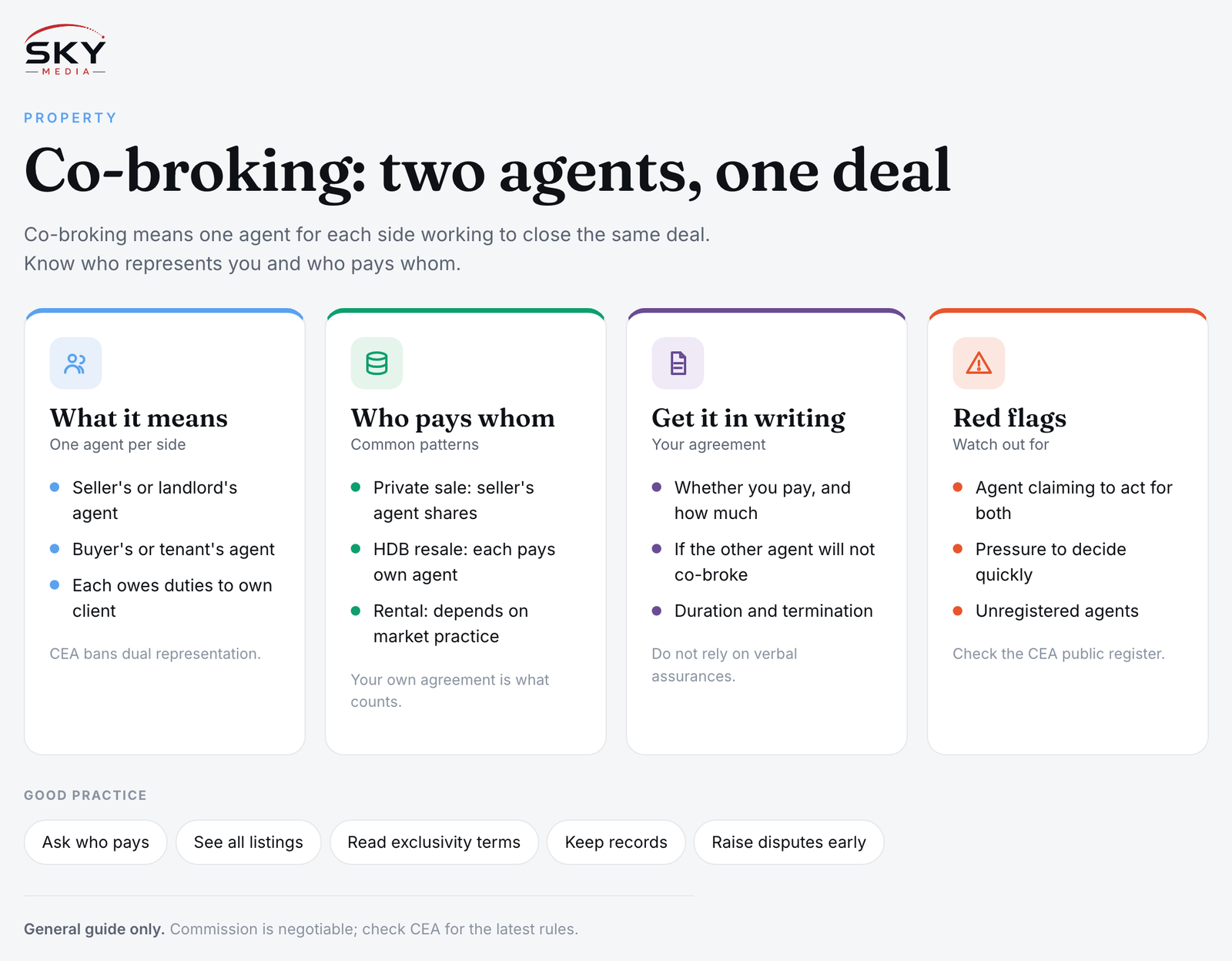
What Co-Broking Means
In a co-broke deal there are two agents:
- The seller’s or landlord’s agent, who markets the property and negotiates for the owner.
- The buyer’s or tenant’s agent, who finds suitable properties and negotiates for the buyer or tenant.
The two agents may be from the same agency or from different agencies. They cooperate to arrange viewings, pass on offers and coordinate paperwork, but each one owes duties to their own client, not to the other party.
This matters because the Council for Estate Agencies (CEA), which regulates property agents in Singapore, does not allow an agent to represent both sides of the same transaction. This is known as a ban on dual representation. Co-broking is the normal way a deal works when both sides have agents. If one agent acts for the seller, the buyer either has their own agent or deals directly without one.
How a Co-Broke Deal Usually Works
- The listing goes out. The owner’s agent advertises the property, often noting that other agents can bring in buyers or tenants.
- A second agent brings a client. The buyer’s or tenant’s agent contacts the listing agent, confirms co-broke terms, and arranges a viewing.
- Offers go through the agents. Each agent advises their own client on price and terms, then the agents relay offers and counter-offers.
- Commission terms are confirmed between agents. Before or during negotiation, the two agents agree how commission will be shared or who will collect from whom.
- Paperwork and completion. The agents coordinate the Option to Purchase or the tenancy agreement, timelines and handover, while each client remains responsible for their own legal and financial steps.
Who Pays Whom: Common Arrangements
There is no single rule. Common market practice varies by property type and whether it is a sale or rental. The table below shows typical patterns, but your own agreement is what counts.
| Scenario | Who typically pays commission | How the agents usually share it |
|---|---|---|
| Private property sale with co-broke | The seller pays their agent; the buyer often pays nothing | The seller’s agent commonly shares part of the commission with the buyer’s agent, often split evenly, though terms vary |
| HDB resale with co-broke | The seller pays their agent, and the buyer pays their own agent separately | Each agent is paid by their own client, so there may be no split |
| Rental with co-broke | Often the landlord pays their agent; whether the tenant also pays depends on the rent level and market practice | Either each agent collects from their own client, or the landlord’s agent shares with the tenant’s agent |
| One agent, one unrepresented party | Only the represented party pays | No split, since there is only one agent |
A few points to understand:
- A “split” is usually between agents, not clients. When the seller’s agent shares commission, the seller normally does not pay more; their agreed commission is divided between the two agents.
- Some buyers pay their agent even in private sales, for example when they want a dedicated search service. This must be agreed in writing.
- Practices shift over time. Market norms, especially for rentals, can change. Ask your agent to explain what is typical right now and why.
For the fee side itself, see property agent commissions and fees explained.
What to Agree in Writing With Your Agent
CEA requires agents to use proper estate agency agreements. Before you start, make sure yours covers:
- Whether you will pay commission, and how much. If you are a buyer or tenant, ask directly: “Will I be paying you, or will you be paid through a co-broke share?”
- What happens if the other agent will not co-broke. Occasionally a listing agent may not share commission. Ask your agent whether they would then expect you to pay them.
- Exclusivity. If you sign an exclusive agreement as a seller, other agents can still bring buyers through co-broking, but your agent controls the listing. Our guide to property agent exclusive agreements explains how these work.
- Duration and termination. Know how long the agreement lasts and how to end it.
Do not rely on verbal assurances. If the agent says you will not have to pay, ask for that in the agreement.
Pros and Cons of Co-Broking for Each Side
For sellers and landlords:
– More agents bringing buyers or tenants usually means more viewings and a better chance of a fair price.
– Sharing commission may mean your agent earns less per deal, so make sure they still put effort into marketing and negotiation for you.
For buyers and tenants:
– Your own agent can help you shortlist, check facts and negotiate, rather than relying on the owner’s agent, who works for the other side.
– Your agent may naturally favour listings that offer a co-broke share. Ask them to show you all suitable options, not only co-broke listings.
Red Flags and Good Practice
- An agent who claims to act for both of you. That is not allowed. Each side should have its own agent or none.
- Pressure to decide quickly so the co-broke “does not fall through”. The agents’ arrangement should never rush your decision.
- Unclear commission talk. If you cannot get a straight answer on who pays what, pause.
- Unregistered agents. Every agent should be registered with CEA. You can verify them easily, as shown in how to check a property agent on the CEA public register.
If Something Goes Wrong
If you have a dispute over commission or conduct, first raise it with the agent and their agency’s key executive officer. If it is not resolved, CEA provides information on complaints and dispute resolution options for commission disputes and agent misconduct. Keep copies of your agreement, messages and any receipts.
Co-broking is not something to worry about. It is how most agent-assisted deals in Singapore get done. Knowing who represents whom, and who pays whom, simply lets you go into the deal with clear eyes.
Official sources: Council for Estate Agencies
Further reading: Can One Property Agent Represent Both Buyer and Seller in Singapore?