
Many older adults wear hearing aids happily for years. But for some, hearing loss becomes so severe that even the most powerful hearing aids make sounds louder without making speech clearer. Conversations at the dinner table, phone calls and television become a strain, and people start to withdraw. For this group, a cochlear implant may be worth discussing. A cochlear implant for the elderly is not only possible but increasingly common, and age by itself is usually not a barrier.
This guide explains who may be a candidate, what the assessment and surgery involve, what life after implantation looks like, and how costs and MediSave work in general terms. It is general information, not medical advice. Only an ear, nose and throat (ENT) specialist and audiologist can tell you whether an implant is suitable.
How a Cochlear Implant Differs From a Hearing Aid
A hearing aid amplifies sound so the damaged inner ear can pick it up. When the hair cells in the inner ear (cochlea) are badly damaged, amplified sound is still distorted, so speech remains unclear.
A cochlear implant works differently. It has two parts:
- An internal implant, placed surgically under the skin behind the ear, with a thin electrode inserted into the cochlea.
- An external sound processor, worn on the ear or the side of the head, which picks up sound and sends signals to the implant.
The implant bypasses the damaged hair cells and stimulates the hearing nerve directly. The brain then learns to interpret these signals as sound. It does not restore “normal” hearing, but many users understand speech much better than they did with hearing aids.
| Feature | Hearing aid | Cochlear implant |
|---|---|---|
| How it works | Makes sounds louder | Stimulates the hearing nerve directly |
| Suitable for | Mild to severe hearing loss | Severe to profound loss with limited benefit from hearing aids |
| Surgery needed | No | Yes, usually under general anaesthesia |
| Adjustment period | Days to weeks | Months of programming and listening practice |
| Removable | Fully | External processor only |
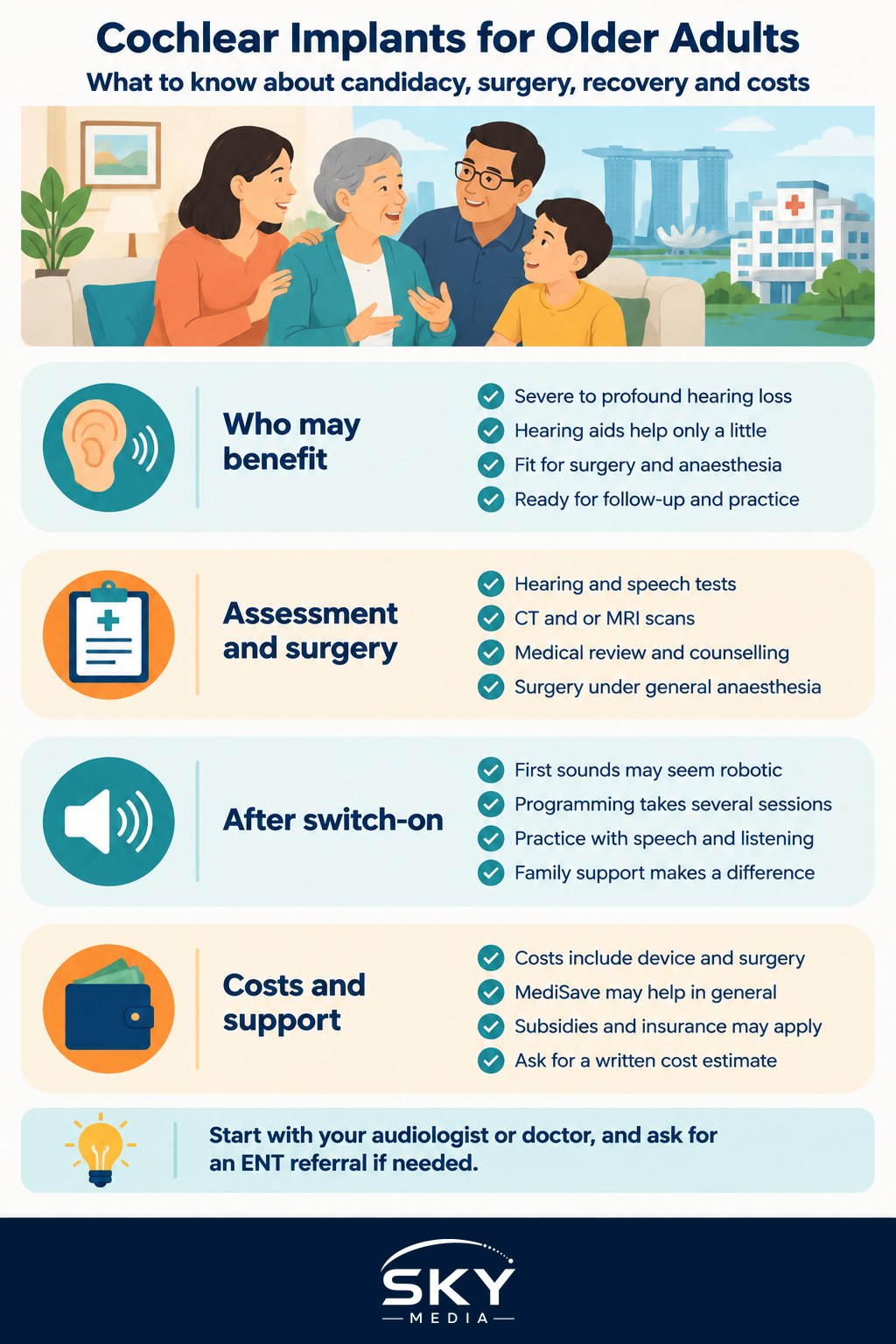
Who May Be a Candidate
Specialists generally consider a cochlear implant when:
- hearing loss in one or both ears is severe to profound
- well-fitted hearing aids give limited help in understanding speech, despite a fair trial
- the person is medically fit enough for surgery and anaesthesia
- the person, and ideally family, are motivated to attend follow-up appointments and practise listening
Signs it may be time to ask your doctor include frequently asking people to repeat themselves even with hearing aids on, relying heavily on lip reading, struggling on the phone, and avoiding social activities because conversation is exhausting. Untreated hearing loss has also been linked with social isolation and other health concerns in older adults, which is another reason not to put off the conversation.
The best starting point is your current audiologist or GP, who can refer you to an ENT clinic at a public hospital or a private specialist. Several public hospitals in Singapore run hearing implant services. If you have many health conditions, a geriatrician can help weigh up overall fitness for surgery alongside your other treatments.
The Assessment Process
Assessment usually takes a few appointments and may include:
- detailed hearing tests, with and without hearing aids
- speech understanding tests in quiet and noise
- CT and/or MRI scans to look at the inner ear and hearing nerve
- a medical review of general health, medications and anaesthesia risk
- counselling about realistic expectations and the commitment involved
Some people learn they would gain more from optimising their hearing aids first. Others may be suitable for an implant in one ear while continuing a hearing aid in the other ear, which is sometimes called bimodal hearing.
Surgery and Recovery
Cochlear implant surgery is usually done under general anaesthesia. The surgeon makes a small cut behind the ear, places the implant, and threads the electrode into the cochlea. Depending on the hospital and the patient’s health, it may be a day surgery or involve a short hospital stay.
After surgery, patients may experience some soreness, dizziness or ringing for a while, and should follow the surgical team’s instructions on wound care, activity and warning signs. Ask your team about possible risks, such as infection, changes in taste or balance, or loss of any remaining natural hearing in the operated ear.
The implant is not switched on immediately. Activation typically happens a few weeks later, once healing has progressed.
Life After Switch-On
The first sounds can be strange, often described as robotic or beeping. This is normal. The brain needs time to adapt.
- Programming (mapping). An audiologist adjusts the processor settings over several sessions in the first months, then less often.
- Listening practice. Auditory rehabilitation, apps, audiobooks and daily conversation help the brain relearn sounds.
- Family support. Speaking clearly, facing the person and reducing background noise all help.
- Device care. Learn to charge batteries, keep the processor dry and clean, and know who to call if it breaks.
Progress varies a lot between people. Many older adults notice clearer speech and easier phone use over time, but results cannot be guaranteed. Always tell other doctors you have an implant, since some procedures, including certain MRI scans, need special precautions.
Costs, MediSave and Financial Support
Cochlear implants involve several costs: assessment, the implant device, surgery, hospital stay, and long-term follow-up and processor upgrades. Costs differ between public and private hospitals, and with your ward type and subsidy status.
In general terms:
- MediSave can usually be used for approved surgical procedures and hospital stays, subject to withdrawal limits.
- MediShield Life and any Integrated Shield Plan may help with eligible hospital bills, subject to policy terms, deductibles and co-insurance.
- Government subsidies at public hospitals depend on citizenship, residency and means testing.
- Medical social workers at public hospitals can advise on financial assistance schemes if costs are a concern.
Ask the hospital for a written cost estimate, and confirm coverage details with your insurer and with CPF Board or MOH. Limits and schemes can change, so always check current information rather than relying on older figures.
Talking It Over as a Family
Deciding on surgery later in life can feel daunting. It may help to attend appointments together, write down questions beforehand, and speak to other implant users through hospital support groups. The decision belongs to the older adult, but family involvement makes rehabilitation much smoother.
Hearing better often means getting back to the activities that keep seniors active and connected, from family meals to group hobbies like gaming for older adults. If you think a cochlear implant might help, start with a conversation with your audiologist or doctor.
Frequently Asked Questions
Can a cochlear implant work if I have been deaf for many years? It depends on your hearing nerve, the cause of hearing loss and how long hearing has been very poor, so a specialist assessment is needed. Some people with long-standing loss still benefit, but results vary, so ask the ENT team what to realistically expect.
Can I shower or swim with a cochlear implant? The external processor is generally removed for showering and swimming unless it is a water-resistant model, so follow the manufacturer’s and your audiologist’s guidance. Keep the processor dry and clean, and ask your team about safe water-related activities.
What are the alternatives for older adults who do not qualify for an implant? Options may include better-fitted or more powerful hearing aids, assistive listening devices and hearing rehabilitation, and sometimes other implantable devices. Ask your audiologist or ENT specialist which choice suits your type of hearing loss.
Can someone with memory problems manage a cochlear implant? It is possible with family support, but rehabilitation and daily device care need commitment, so the team will consider memory, coordination and who can help. Discuss this openly at assessment and ask a geriatrician about overall suitability for surgery.
Official sources: HealthHub