

A coding bootcamp in Singapore promises a fast route into tech: a few intense months of learning, a portfolio of projects, and a shot at a junior developer, data or product role. For some career switchers it works very well. For others it becomes an expensive detour. The difference usually comes down to three things: choosing the right format, using the funding support available to you, and being realistic about how hiring works for people without a computing degree.
This guide focuses on those three decisions. If you are still deciding whether to change careers at all, start with our broader guide to switching careers in Singapore first, then come back here once tech is firmly on your shortlist.
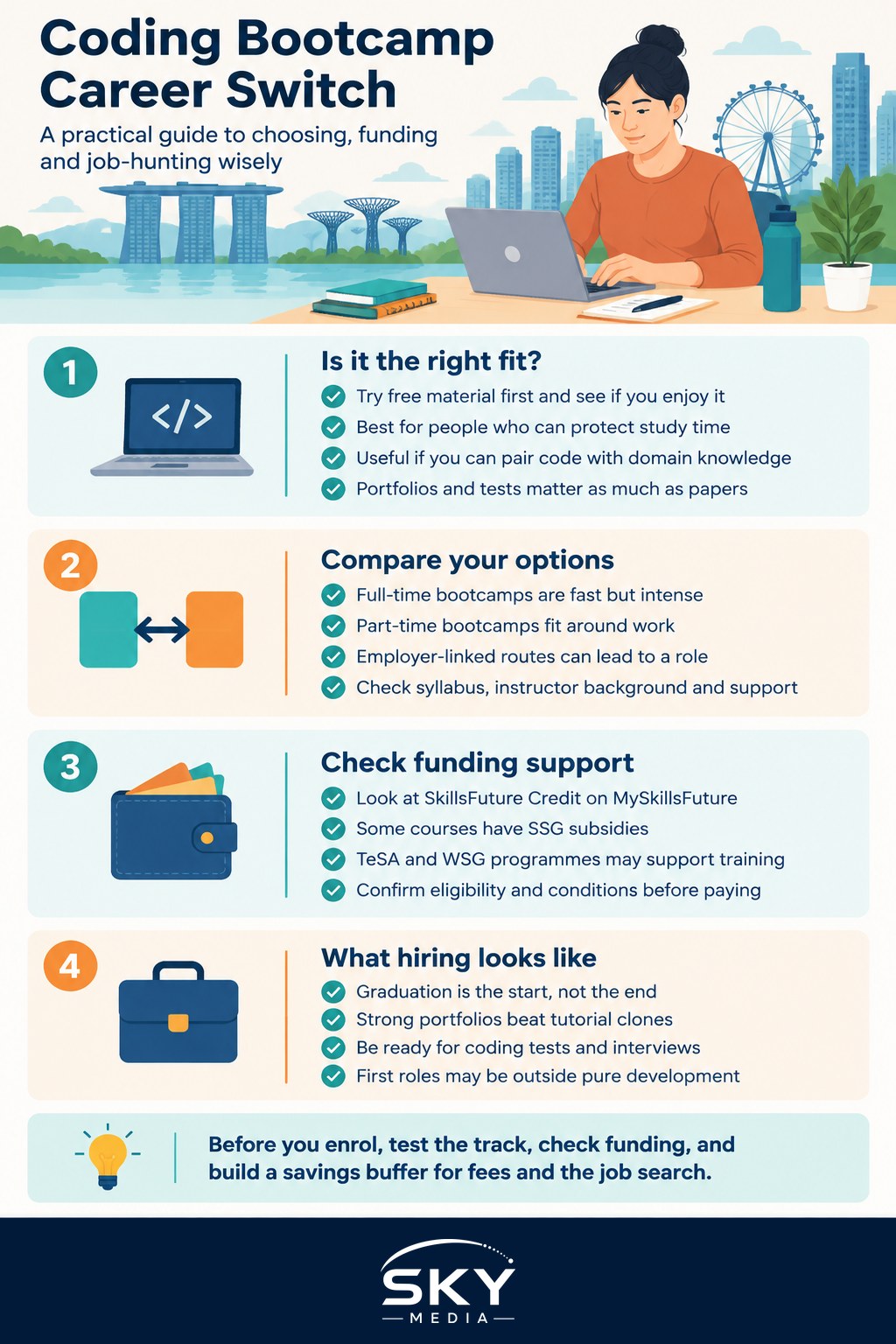
Is a Bootcamp the Right Route for Your Switch?
A bootcamp is a short, structured, project-heavy programme that teaches job-ready skills in one track, such as web development, data analytics, cybersecurity or UX design. It is not a degree, and it does not try to be one. It trades depth of theory for speed and practical output.
Bootcamps tend to suit you if:
- You have already tried free material (online tutorials, a beginner course) and enjoyed it, rather than just liking the idea of tech.
- You learn well under pressure and can protect serious study time every week, whichever format you choose.
- Your previous career gives you domain knowledge you can combine with code, such as finance, logistics, healthcare or marketing.
- You want a role where portfolios and technical tests matter as much as paper qualifications.
A bootcamp may be the wrong first step if you have never written a line of code, if you need a recognised qualification for a specific employer or visa reason, or if you are hoping to move straight into senior pay. Our guide to changing careers through learning covers slower, cheaper alternatives such as part-time diplomas, modular courses and self-study, which can be a sensible way to test the waters before committing.
Comparing Bootcamp Formats and Other Pathways
Not all options labelled “bootcamp” are alike. Some are full-time immersive courses, some run on evenings and weekends, and some are tied to employers through government-supported conversion or traineeship schemes. Here is how the main routes compare in general terms.
| Pathway | Typical time commitment | Who it suits | Main trade-off |
|---|---|---|---|
| Full-time immersive bootcamp | Several months, daytime, intensive | People who can pause work and want the fastest switch | Loss of income while studying |
| Part-time bootcamp | Longer duration, evenings and weekends | People keeping their current job | Slower progress, risk of burnout |
| Employer-linked conversion or traineeship programme | Training plus on-the-job placement | Mid-career switchers who want a role lined up | Fewer places, selective intake |
| Self-study plus short courses | Flexible, self-paced | Disciplined learners on a tight budget | No structure or career support |
| Part-time diploma or degree | One to several years | People who need a formal qualification | Much slower, higher total commitment |
When comparing specific providers, ask for:
- The full syllabus, not just the headline. Check that it covers fundamentals (version control, testing, databases) and not only one trendy framework.
- Instructor background. Practising engineers or analysts usually teach more relevant habits than career trainers.
- Class size and mentor time. Being stuck for days on a bug is where many students drop out.
- Career support in writing. Mock interviews, portfolio reviews and employer introductions should be specific, not vague promises.
Be cautious about any provider that guarantees a job or a particular salary. Ask how they define “placed”, how many graduates their figures include, and over what period they were measured.
Funding Support and How It Works
Course fees vary widely, so funding can make a real difference. Singapore has several government-linked support routes, though names, eligibility and amounts change over time, so always confirm the current details with the official agency before you sign up.
- SkillsFuture Credit. Singapore Citizens receive credit from the Skills and Workforce Development Agency (SWDA, formed in 2026 from Workforce Singapore and SkillsFuture Singapore) that can be used on eligible courses listed on the MySkillsFuture portal. Mid-career Singaporeans have also received additional top-ups in past schemes. Check your balance and which courses qualify on MySkillsFuture.
- Course fee subsidies. Some courses are subsidised by SWDA, with enhanced subsidies for certain groups such as mid-career citizens. The subsidy is usually applied by the provider, so ask whether a course is SWDA-funded and what you will pay after subsidy.
- TechSkills Accelerator (TeSA). This initiative by the Infocomm Media Development Authority (IMDA) supports training and job placement in tech. Its programmes have included mid-career conversion tracks that pair training with hiring companies. Look at IMDA’s TeSA pages for current programmes.
- SWDA Career Conversion Programmes. SWDA supports employers who hire and retrain mid-career switchers. In these programmes you are hired first and trained on the job, which reduces your financial risk.
A few practical tips:
- Funding usually applies only to approved courses and approved providers. A course being “popular” does not mean it is eligible.
- Some funded programmes require you to complete the course, meet attendance thresholds or stay employed for a period. Read the conditions carefully.
- Ask your current employer whether they sponsor upskilling. Some will fund a course if it supports an internal move into a tech or data role, which can be easier than switching companies.
This is general information, not financial advice. Treat any fee you pay out of pocket as an investment that needs a realistic payback plan.
What Hiring Outcomes Really Look Like
Graduating from a bootcamp is the start of the job search, not the end. Employers hiring juniors often receive many applications, and bootcamp graduates compete with fresh computing graduates and polytechnic diploma holders.
What tends to help career switchers stand out:
- A portfolio with depth. Two or three solid projects that solve real problems beat ten tutorial clones. Show your code on a public repository, write clear README files and explain your decisions.
- Your previous industry. A former nurse building health scheduling tools, or an ex-logistics planner building route dashboards, tells a compelling story. Target companies in your old sector first.
- Technical interview practice. Expect take-home assignments, live coding and questions about how you approach problems. Practise explaining your thinking aloud.
- Flexibility on first role title. Roles like QA engineer, technical support, data analyst, solutions engineer or internal tools developer can be strong stepping stones into pure development.
Be prepared for a starting salary that may be lower than your current one, especially if you are mid-career. Build a savings buffer that covers both the course and a job search lasting several months.
Also note the role of AI tools. Coding assistants are now part of everyday work, and interviewers increasingly want to know you can use them well while still understanding the code they produce. Our guide to AI coding assistants for beginners is a useful primer before you start a course.
A Step-by-Step Plan Before You Enrol
- Test your interest for a month. Work through free beginner material in the track you are considering. If you are still curious after the frustrating parts, that is a good sign.
- Pick a track based on job listings. Browse current openings for junior roles and note which skills appear repeatedly.
- Shortlist two or three providers. Attend info sessions, ask to speak with recent graduates, and compare syllabuses side by side.
- Check funding eligibility. Look up the course on MySkillsFuture, ask the provider about SWDA subsidies, and check IMDA and SWDA for conversion programmes.
- Plan your finances. Work out what you need to cover fees, living costs and a job search period.
- Prepare before day one. Basic familiarity with programming concepts makes the intensive weeks far less overwhelming.
- Start networking during the course, not after.
A coding bootcamp can be a powerful lever for a career switch in Singapore, but only when it is matched to your goals, funded wisely and followed by a focused, patient job search.
Official sources: SkillsFuture (SWDA)
Further reading: How to Prepare for a Technical or Coding Interview · Women in Tech in Singapore: Programmes, Networks and Career-Switch Routes