

An invitation to “grab a coffee” with a hiring manager can feel confusing. It is not a formal interview, but it is not a casual catch-up either. A coffee chat with a hiring manager sits somewhere in between: an informal conversation that lets both sides see whether there might be a fit, often before a role is advertised or before formal interviews begin.
Done well, a coffee chat can put you on a hiring manager’s radar and give you insights no job posting will. Done poorly, it can quietly close a door. This guide explains what these conversations are for, how to prepare, what to ask, and how to follow up.
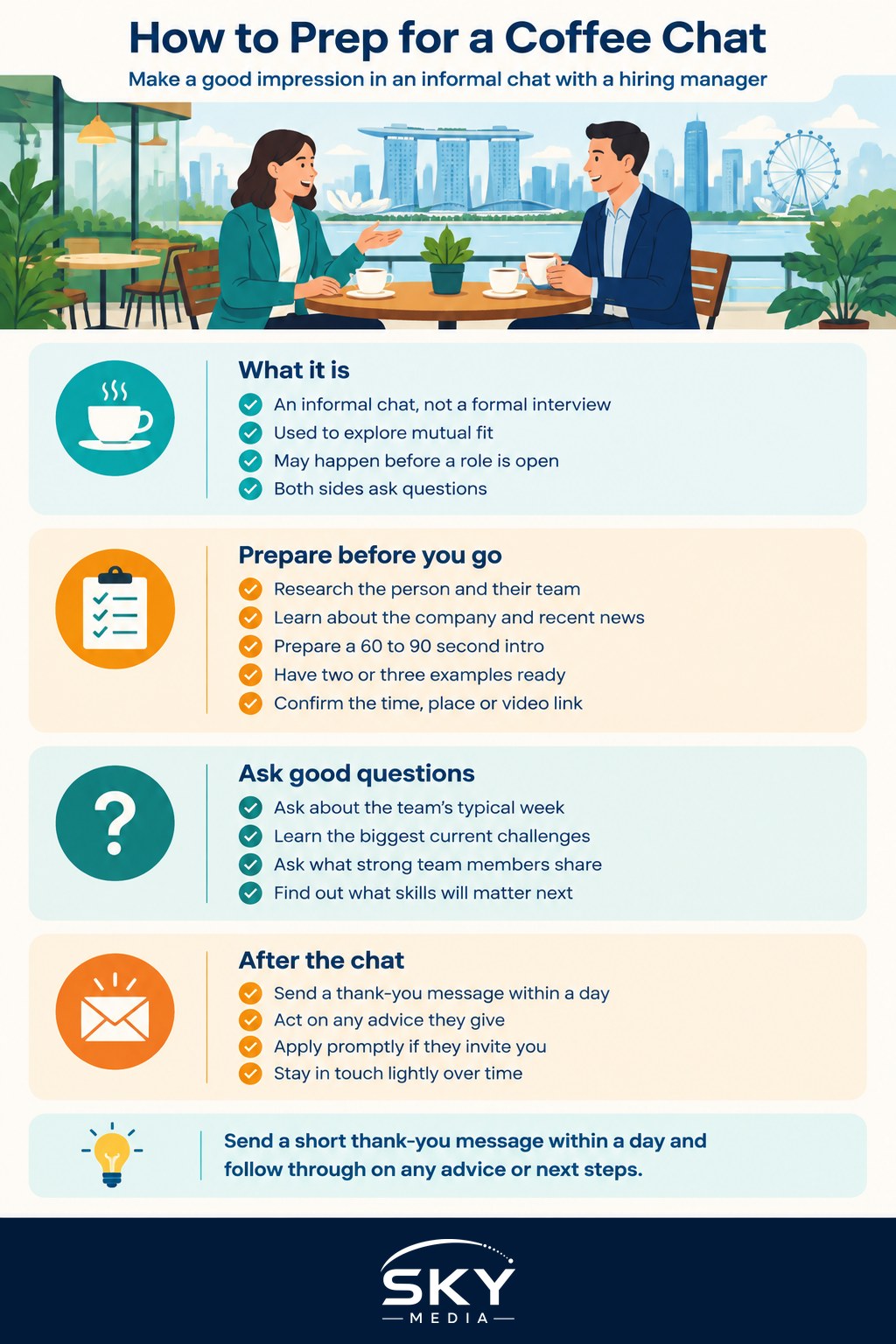
What a Coffee Chat Is, and What It Is Not
Coffee chats happen for different reasons. A hiring manager might meet you because:
- someone in their network recommended you,
- you reached out to learn about their team,
- a recruiter suggested an informal first conversation,
- they are building a pipeline for a role that is not yet open.
Whatever the reason, the conversation is usually exploratory. The hiring manager is trying to understand who you are, how you think and whether you might suit the team. You are trying to understand the team, the work and whether you would want to be there.
It is helpful to be clear about the differences from a formal interview.
| Aspect | Coffee chat | Formal interview |
|---|---|---|
| Purpose | Mutual exploration and building a relationship | Assessing you against a specific role |
| Structure | Loose, conversational, often led by curiosity | Set questions, often a scorecard or panel |
| Who asks questions | Both sides, roughly equally | Mostly the interviewer |
| Dress and setting | Smart casual, café, office or video call | Usually more formal |
| What you bring | Curiosity, a short story about yourself, good questions | Detailed examples, portfolio, references if requested |
| Outcome | An impression, a referral or an invitation to apply | A decision on the next round |
The most important thing to remember is that even though it is informal, you are still being assessed. Treat it as a professional conversation in a relaxed setting.
How to Prepare Beforehand
Preparation is what separates a forgettable chat from a memorable one.
Research the person. Look at their professional profile and any talks, articles or posts they have shared. Note their career path, how long they have been in their role and what their team does.
Research the organisation. Understand the company’s main products or services, recent news and how the team fits into the wider business. Annual reports, company websites and news coverage are good starting points.
Prepare your short story. You will almost certainly be asked some version of “Tell me about yourself.” Prepare a 60 to 90 second answer that covers where you are now, what you have done that is relevant, and why you are interested in their area. Keep it conversational, not rehearsed.
Have two or three examples ready. Even in an informal chat, it helps to have concrete examples of work you are proud of. Think about problems you solved, results you delivered and what you learned.
Clarify your goal. Are you exploring a career change, hoping to be considered for a specific role, or simply learning about the industry? Knowing your aim helps you steer the conversation and answer honestly if they ask what you are looking for.
Confirm the logistics. Check the time, place or video link, and how long they have. If you suggested the meeting, offer to come to a location convenient for them. Arrive a few minutes early.
Good Questions to Ask
Your questions show how you think. Aim for questions you cannot answer from the company website. Some useful ones:
- What does a typical week look like for your team?
- What are the biggest challenges the team is working on right now?
- What do the strongest people on your team have in common?
- How has the team changed over the past year or two?
- What skills do you think will matter most in this field in the next few years?
- What do you enjoy most about leading this team?
- Is there anything you would recommend I learn or read to understand your area better?
Prepare more questions than you need and let the conversation guide which ones you use. Listen carefully to the answers and follow up on what you hear. A natural follow-up question is often more impressive than a perfectly prepared one.
What to Avoid During the Chat
A few common mistakes can undermine an otherwise good conversation:
- Asking for a job outright in the first few minutes. It is fine to express interest, but let the conversation build first.
- Talking about salary and benefits too early. These matter, but they belong later in a formal process unless the hiring manager raises them.
- Running over time. Respect the time you were given. Offer to wrap up when it is nearly over.
- Criticising a current or past employer. Even if your reasons for leaving are valid, frame them positively.
- Treating it as one-sided. If you only talk about yourself, you miss the chance to learn and to show genuine interest.
- Being too casual. A relaxed setting does not mean slang, oversharing or checking your phone.
On payment, a simple courtesy goes a long way. If you invited them, offer to pay. If they invited you, a thank you is enough, though offering is still polite.
How to Follow Up Afterwards
Follow-up is where many people let the opportunity slip.
- Send a thank-you message within a day. Keep it short. Thank them for their time, mention one specific thing you found useful, and restate your interest if appropriate.
- Act on any advice. If they suggested a course, a book or a person to speak to, follow through, and let them know later that you did.
- Apply properly if invited. If they suggest you apply for a role, do it promptly and mention the conversation in your application if appropriate.
- Stay in touch lightly. A brief update every few months, such as a new skill you picked up or a project you completed, keeps the relationship warm without being pushy.
- Accept the outcome gracefully. Not every coffee chat leads to a job. Many lead to referrals, introductions or future opportunities instead.
Coffee Chats Over Video Calls
Many coffee chats now take place on video. The same principles apply, with a few extra points:
- Test your camera, microphone and connection beforehand.
- Choose a quiet, tidy background with good lighting.
- Look at the camera when speaking, not only at the screen.
- Keep notes nearby, but do not read from them.
- Close other applications so notifications do not distract you.
Whether it is in a café or on a screen, a coffee chat with a hiring manager is a chance to show who you are beyond your CV. Prepare thoughtfully, stay curious, and follow up well, and you give yourself the best chance of turning one conversation into the next step in your career.
Explore more: Networking in Singapore, Using LinkedIn in Singapore and Networking and LinkedIn for Newcomers.
Frequently Asked Questions
How do I ask a hiring manager for a coffee chat without being pushy? Send a short, specific message saying why you want to speak to them, what you hope to learn and that you are happy to work around their schedule. Do not ask for a job. Offering a video call or a brief meeting makes saying yes easier.
Should I bring my CV to a coffee chat? It is wise to have a copy ready, either printed or on your phone, but do not hand it over unless asked. The conversation is the main event. If the manager seems keen, you can offer to email it afterwards.
What if the hiring manager has no open role right now? That is quite normal, and the chat is still worthwhile. You can learn about the team, get advice and be remembered when something opens up. Do not pressure them for a vacancy. Stay in touch lightly and watch for future openings.
How long should a coffee chat with a hiring manager last? These chats are usually shorter than a formal interview. Ask in advance how much time they have, and stick to it. If the conversation is going well, they may extend, but wrapping up on time shows respect for their schedule.
When should I follow up if the hiring manager does not reply? Allow a couple of weeks before a polite, short nudge, since hiring managers are busy. Share a useful update, such as a course completed or a project finished, rather than just asking again. If there is still no reply, move on gracefully.
Further reading: How to Cold Email a Hiring Manager in Singapore · How to Prepare for a Career Returnship in Singapore · What Hiring Managers Mean by Good Culture Fit