

“We are looking for someone who is a good culture fit” is one of the most common phrases in hiring, and one of the least explained. For candidates preparing for a culture fit interview in Singapore, it can feel vague or even unfair. In practice, most hiring managers are looking for a fairly specific set of signals. Once you understand them, you can prepare more accurately than by memorising standard answers.
This guide explains what culture fit usually means, how interviewers test it, and how to show your real working style without pretending to be someone else.
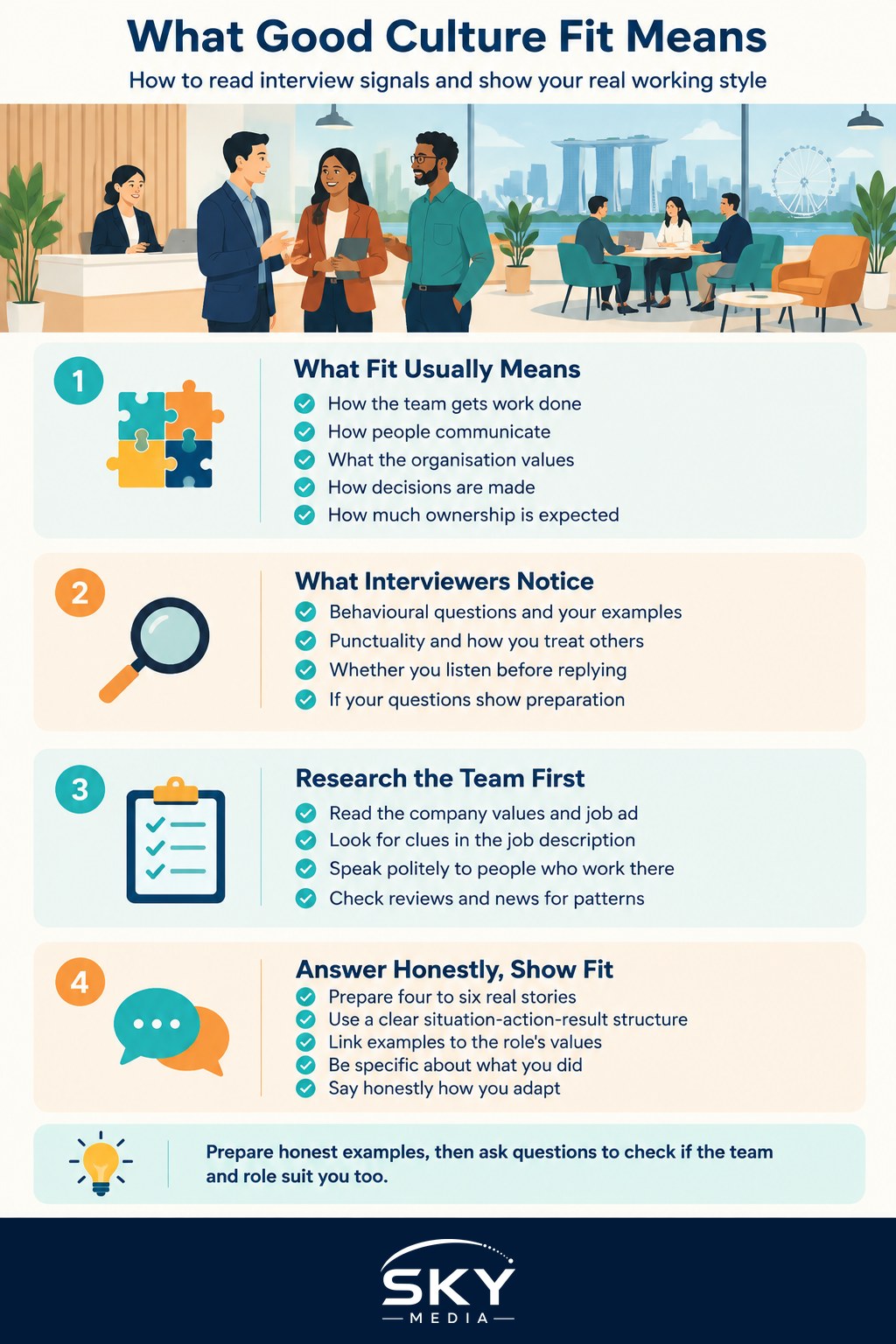
What Culture Fit Usually Means in Practice
Culture fit is rarely about personality alone. When a manager says they want a good fit, they usually mean someone who will work well with the team’s existing way of doing things, and who will not create avoidable friction. That covers several practical areas:
- How work gets done. Does the team work independently or collaboratively? Fast and flexible, or careful and process-driven?
- How people communicate. Direct or diplomatic? Mostly written or mostly in meetings? How are disagreements raised?
- What the organisation values. Customer focus, accuracy, speed, innovation, stability or service.
- How decisions are made. Top-down, consensus-based or delegated to individuals.
- Expectations around ownership. Will you be expected to take initiative, or follow clear instructions?
Good employers also think about “culture add”: someone who shares the core values but brings a different perspective. Fit should never be a reason to exclude people based on background, age, race, religion, gender or nationality. Singapore’s Tripartite Guidelines on Fair Employment Practices, and the workplace fairness rules overseen by MOM and TAFEP (Tripartite Alliance for Fair and Progressive Employment Practices), require hiring decisions to be based on merit. Check their websites for the current rules.
The Signals Interviewers Look For
Hiring managers usually test fit through behavioural questions, such as “Tell me about a time you disagreed with your manager”, and through how you behave during the process. The table below shows common questions and what they are really checking.
| Interview question | What the interviewer is looking for | What weakens your answer |
|---|---|---|
| Describe a time you disagreed with a colleague | Respectful disagreement, focus on the outcome | Blaming others or avoiding conflict entirely |
| What kind of manager do you work best with? | Self-awareness and realistic expectations | Describing an ideal that matches no real workplace |
| How do you handle changing priorities? | Flexibility and clear communication | Complaining about past employers |
| Why do you want to work here? | Genuine understanding of the organisation | A generic answer that fits any company |
| Tell me about a mistake you made | Honesty, ownership and learning | Choosing a “mistake” that is really a strength |
Beyond answers, interviewers notice behaviour: punctuality, how you treat reception staff, whether you listen before replying, and whether your questions show you have thought about the role.
How to Research a Company’s Culture Before the Interview
You cannot show fit for a culture you do not understand. Some practical sources:
- The company’s own materials. Career pages, annual reports and job ads often list values. Notice which words they repeat.
- The job description. Phrases like “fast-paced”, “highly structured” or “self-starter” tell you a lot about daily expectations.
- People who work there. A short, polite message to a current or former employee can reveal more than any website.
- Reviews and news. Treat anonymous reviews with caution, but look for patterns.
- The interview itself. Notice how the interviewers speak about their team and manager.
For a broader picture of local norms, read our guide to Singapore workplace culture, which covers hierarchy, communication styles and expectations that often come up in interviews here.
Preparing Honest Answers That Show Fit
The goal is not to pretend. If you shape yourself to fit a culture that does not suit you, you may get the job but struggle in it. Instead, prepare to show the parts of your real working style that match the role.
- Prepare four to six stories from past work, studies or volunteering that show how you collaborate, handle conflict, manage pressure and learn from mistakes.
- Use a clear structure. Describe the situation, what you did and what happened as a result. Keep each story to a couple of minutes.
- Link your stories to their values. If the company emphasises teamwork, choose examples where you helped a group succeed.
- Be specific. “I set up a weekly check-in so the project stayed on track” is more convincing than “I am a team player”.
- Acknowledge differences honestly. If you prefer more structure than the team seems to offer, say how you adapt rather than hiding it.
Questions to Ask the Interviewer
Culture fit works both ways. Asking good questions helps you decide whether you want the job, and it also shows maturity.
- How would you describe the way the team works day to day?
- How are disagreements usually handled?
- What does success look like in the first six months?
- How does the manager give feedback?
- What kind of person has done well in this team before?
Listen to the answers carefully. Vague replies, or answers that contradict the job description, are worth thinking about. Our guide to setting work goals with your manager can also help you understand what good management conversations should look like.
When Culture Fit Is Used Unfairly
Most of the time, culture fit is a legitimate concern. Sometimes, though, it is used as a vague reason to reject candidates for reasons that have nothing to do with the job. Warning signs include interviewers asking about your age, marital status, plans for children, religion or nationality when these are not relevant to the role.
If you believe you have faced unfair treatment, TAFEP provides guidance and a way to raise concerns. Check its website for the current process and what counts as discrimination under Singapore’s workplace fairness rules.
Seeing It From the Employer’s Side
If you are a hiring manager reading this, the same principles apply in reverse. Define what fit means for your team in concrete terms before interviewing, use the same questions for every candidate, and separate genuine working style from personal similarity. Our guide on how to hire and interview candidates covers structured interviewing in more detail.
Understood properly, culture fit is about whether a person and a workplace are likely to work well together. Preparing honestly, with clear examples and good questions, gives you the best chance of finding a role where you will actually thrive.
Frequently Asked Questions
Can I be rejected for not fitting the culture because of my age or race? Hiring decisions should be based on merit, and Singapore’s fair employment guidelines, overseen by MOM and TAFEP, set this expectation. Culture fit should never be a reason to exclude people by age, race, religion, gender or nationality.
How do I answer questions about culture fit if I have never worked in a company like this? Prepare four to six real stories showing how you collaborate, handle conflict and learn, then link them to the company’s stated values. Be honest about your style and how you adapt rather than pretending.
What should I do if the interviewer asks about my marital status or plans for children? Such questions may not be relevant to the role and can be a warning sign. TAFEP provides guidance and a way to raise concerns, so check its website for the current process and what counts as discrimination.
What questions should I ask an interviewer to judge the culture? Ask how the team works day to day, how disagreements are handled, how the manager gives feedback and what success looks like in the first six months. Vague answers that contradict the job description are worth thinking about.
What is the difference between culture fit and culture add? Culture fit is working well with the team’s existing ways, while culture add means sharing the core values but bringing a different perspective. Good employers weigh both and avoid using fit as a vague reason to reject people.
Further reading: How to Tell If a Company Is Really Hiring · How to Prepare for a Coffee Chat With a Hiring Manager