

A good application takes time. You tailor your resume, write a cover letter, fill in long online forms and sometimes complete assessments. So it is frustrating when weeks pass with no reply, and the same job ad keeps reappearing. Before you invest that effort, it is worth asking a simple question: is the company really hiring for this role right now, or is the listing something else?
Not every job ad represents a live, open vacancy. Some are stale, some are collecting resumes for the future, and some are open in name while an internal candidate is the likely choice. This guide shows how to read the signals so you can put your energy into applications with a real chance.
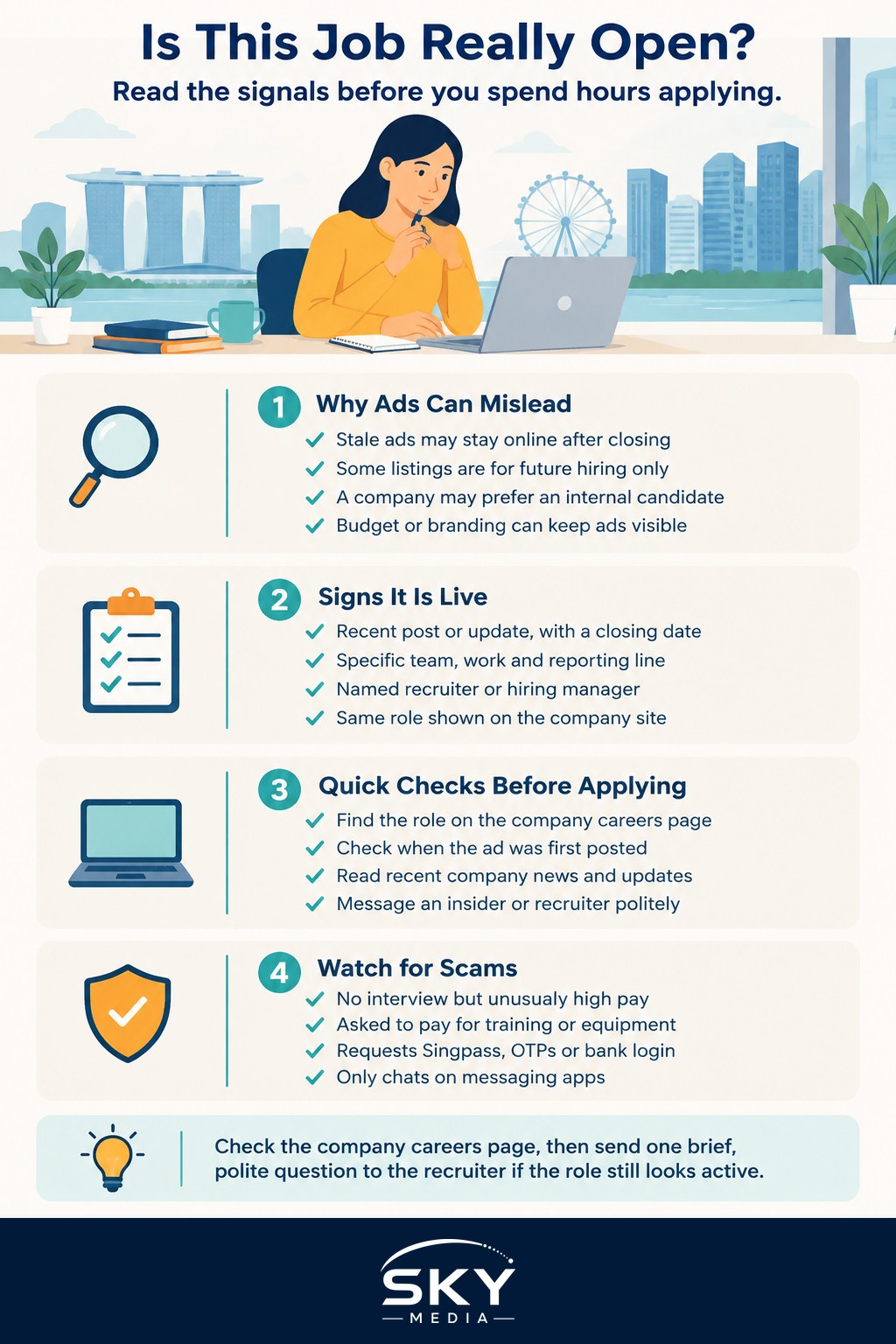
Why Some Job Ads Are Not Real Openings
Most companies are not trying to waste your time. Listings that do not lead to hires usually come from ordinary business reasons:
- Stale listings. The role was filled or frozen, but nobody took the ad down. Job boards and aggregators may also keep reposting old ads.
- Talent pooling. Some employers advertise roles they expect to need in future, so they have a ready pipeline of candidates. The ad may say “future opportunities” or nothing at all.
- Internal candidates. A team may already have someone in mind, such as a current employee or contractor, but still advertises to follow internal policy or to benchmark the market.
- Regulatory advertising. In Singapore, employers who want to hire a foreign professional on certain work passes are generally required under the Fair Consideration Framework to advertise the role on MyCareersFuture first, so local candidates have a fair chance. Most of these roles are genuinely open to all applicants, and fair hiring is expected under the Tripartite Guidelines on Fair Employment Practices, but it is one more reason an ad can exist even when the employer already has a preferred candidate.
- Budget uncertainty. Hiring approval may be pending, and the team posts early hoping budget comes through.
- Employer branding. Large firms sometimes keep evergreen listings open to signal growth.
Understanding these reasons helps you judge listings calmly rather than assuming every silence is personal.
Signs a Job Listing Is Live and Real
Look for several signals together rather than relying on one.
| Signal | Points to a live vacancy | Points to a stale or speculative ad |
|---|---|---|
| Posting date | Recently posted or updated, with a closing date | Very old, or reposted unchanged for months |
| Job description | Specific team, reporting line, projects and tools | Generic text that could fit any company |
| Hiring contact | Named recruiter or hiring manager | No contact, only a general inbox |
| Company website | Same role listed on the careers page | Role only appears on third-party boards |
| Company news | Expansion, new office, new contract or product launch | Recent layoffs, hiring freeze or restructuring |
| Application process | Clear stages and a timeline | Vague process with no indication of next steps |
| Recruiter response | Replies within a reasonable time with real questions | Automated reply only, with no follow-up |
A listing that ticks several boxes in the left column deserves your full effort. One with many signs on the right may still be worth a quick application, but probably not hours of customisation.
How to Check Before You Apply
A few minutes of research can save hours.
- Find the ad on the company’s own careers page. If it is there and recently updated, that is a good sign. If it only appears on an aggregator, the original may already be closed.
- Check the posting history. Many job platforms show when an ad was first posted. An ad reposted repeatedly with the same text may be evergreen or hard to fill.
- Look at the company’s recent news. Press releases, annual reports and announcements can show whether the business is growing or cutting back.
- Check the team on professional networks. If you can see someone has recently joined in that exact role, the vacancy may already be filled.
- Ask someone inside. A polite message to a current employee or alumni contact asking whether the team is actively hiring can give you an honest answer.
- Contact the recruiter. If a name is listed, a short, courteous email asking whether the role is still open and what the timeline looks like is perfectly acceptable.
When you write to a recruiter, keep it brief, mention the role title, and ask one or two specific questions. Avoid sounding as if you are accusing them of posting a fake ad.
Spotting Talent Pool and Internal-Only Situations
Talent pooling and internal hiring are not necessarily bad for you. Being in a company’s pipeline can lead to a call months later. The key is to set your expectations and effort accordingly.
Signs of a talent pool ad:
- Wording like “join our talent community” or “register your interest”.
- No specific team, start date or headcount.
- The same ad appears across several locations or departments.
Signs that an internal candidate may be favoured:
- Very narrow requirements that read like one person’s resume, such as experience with a specific internal system.
- A short posting window.
- The role sits in a small team where you can already see someone acting in the position.
For these, a concise, well-targeted application is fine. Save your deepest preparation for roles with clear signs of an active search.
Avoid Job Scams That Pose as Real Vacancies
A separate problem is fake job ads designed to scam applicants. These are not stale listings; they are traps. Be careful if an “employer”:
- Offers unusually high pay for simple work, or hires you without an interview.
- Asks you to pay for training, equipment or a work pass.
- Requests your Singpass details, bank login, one-time passwords or copies of your identity documents early in the process.
- Communicates only through messaging apps and avoids video calls or office visits.
Never share Singpass credentials or one-time passwords with anyone. If an offer seems suspicious, check the company’s registration through ACRA’s Bizfile service (the Accounting and Corporate Regulatory Authority’s business registry) and consult the official ScamShield resources or the police for current advice.
Make Your Effort Count
Once you have a better sense of which roles are real, adjust how you spend your time:
- Tier your applications. Give your strongest effort to live, well-matched roles. Use a solid standard version for speculative ones.
- Track everything. Keep a simple spreadsheet of roles, dates, contacts and follow-ups so you can spot patterns.
- Follow up once. If you hear nothing after a reasonable period, one polite follow-up is fine. After that, move on.
- Use networking. Many roles are filled through referrals. Conversations with people in your field often reveal openings before they are advertised.
- Prepare for interviews early. When a real opportunity comes, you want to be ready. Practising key answers, such as How to Answer “Tell Me About Yourself”, means you can respond quickly when a recruiter calls.
Job hunting involves some uncertainty no matter how careful you are. By learning to read the signals in a listing, you can stop pouring hours into ads that were never likely to lead anywhere, and focus on the companies that are genuinely ready to hire.
Explore more: Recognising Job Scams and Fake Offers.
Frequently Asked Questions
Should I still apply if a job ad has been up for months? Yes, but keep expectations modest and effort proportionate. A long-running ad may be evergreen, hard to fill or stale. A quick, tailored application costs little, and you can ask the recruiter whether the role is still open. Do not skip other, more recent roles while waiting.
Can I ask HR if an internal candidate has already been chosen? You can ask politely whether the role is still open and where it stands, but do not expect HR to share details about other candidates. A better question is about timeline and process. If the answers stay vague, treat it as a lower-odds application and spread your effort.
Is it better to apply directly or through a recruiter? Neither wins every time. Applying directly shows initiative and avoids duplicate submissions, while a recruiter may offer inside information and can advocate for you. Avoid applying through both routes for the same role, as it can cause confusion, and ask the recruiter which company they are submitting you to.
How long should I wait for a reply before assuming I was not selected? There is no fixed rule, since timelines depend on the company and hiring stage. Allow a reasonable period, such as the timeline stated in the ad or by the recruiter, plus extra over holidays. Follow up once politely, and if there is still no answer, carry on with your search.
What does a closing date mean on a job ad? It usually shows when applications are expected to stop being considered, but companies can close early, extend or keep reviewing later. Apply well before the date where you can, because some employers shortlist as applications arrive. If a role has no closing date, ask when decisions are likely.
Further reading: How to Cold Email a Hiring Manager in Singapore