

Putting a vehicle in your company’s name is a different exercise from buying a car for yourself. The company becomes the registered owner, its officers sign on its behalf, and the tax, insurance and accounting treatment all follow the business rather than you personally. This guide walks through company car registration in Singapore step by step, so business owners know what to prepare and which questions to settle before signing anything.
This is general information, not legal, tax or financial advice. Rules, fees and schemes change, so confirm current requirements with the Land Transport Authority (LTA), the Inland Revenue Authority of Singapore (IRAS) and your accountant before you commit.
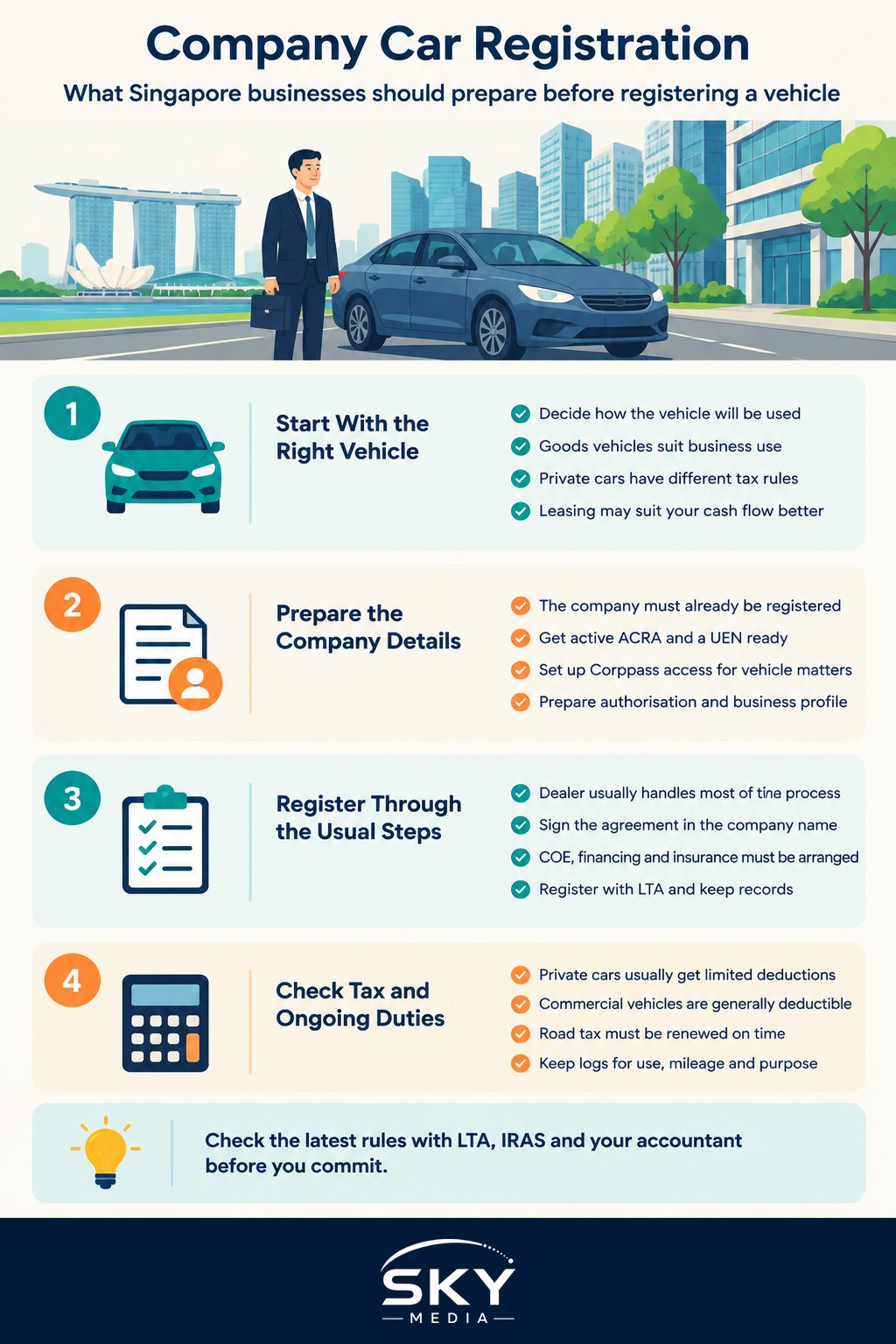
Decide Whether the Company Should Own the Vehicle
Before you look at models, ask why the business needs the vehicle and how it will be used. The answer affects the type of vehicle, the tax treatment and whether company ownership makes sense at all.
- Goods and commercial vehicles such as vans, lorries and pickups are built for business use. They are the most common company vehicles for trades, logistics, retail and F&B.
- Private passenger cars used for client visits or by directors are also often registered to companies, but the tax treatment is very different from commercial vehicles, as explained below.
- Leasing instead of buying is worth comparing. A lease avoids a large upfront payment, means the leasing company owns and registers the vehicle, and often bundles maintenance and insurance into one monthly fee.
Talk to your accountant about which option fits your cash flow and how the vehicle will appear in your accounts.
Get the Company’s Paperwork Ready
A vehicle can only be registered to a business that legally exists. If you are still setting up, start with our guide on how to register a company in Singapore.
You will typically need:
- An active entity registered with ACRA. ACRA, the Accounting and Corporate Regulatory Authority, registers businesses through its Bizfile portal and issues the Unique Entity Number (UEN) that identifies your company. Our explainer on registering a company with ACRA covers that process.
- Corppass access. Corppass is the corporate digital identity that lets authorised staff transact with government agencies online, including LTA’s OneMotoring portal. Your Corppass administrator must assign the right access to whoever will handle vehicle matters.
- Authorisation from the company. Dealers and insurers usually ask for evidence that the person signing is authorised to act for the company, such as a director’s letter or board resolution, plus the company’s business profile.
- Identification of the authorised person, and the company’s registered address for correspondence.
Check with LTA and your dealer for the exact documents they need at the time you buy.
The Registration Process, Step by Step
Most new vehicles in Singapore are bought through an authorised dealer, who usually handles much of the registration on the buyer’s behalf. Here is how the process generally runs when the buyer is a company.
| Step | What happens | Who usually handles it |
|---|---|---|
| Choose the vehicle and sign the sales agreement | The agreement is made in the company’s name and signed by an authorised person | Company and dealer |
| Secure a Certificate of Entitlement (COE) | A COE gives the right to own and use a vehicle for a set period, obtained through LTA’s bidding exercises in the correct category | Dealer bids, or company bids via OneMotoring |
| Arrange financing, if any | Bank or finance company loan in the company’s name, often with director guarantees | Company and lender |
| Buy motor insurance | Insurance must be in force before the vehicle can be registered and used on the road | Company, often arranged via the dealer |
| Register the vehicle with LTA | Registration fees and taxes are paid, the vehicle is registered under the company’s UEN and a number plate is issued | Dealer, using the company’s details |
| Collect the vehicle and log records | Keep the registration details, COE expiry date and road tax schedule in company records | Company |
A few points to understand along the way:
- COE categories matter. Cars, motorcycles, goods vehicles and buses fall into different categories, and premiums vary. Make sure the vehicle you choose is bid for in the right one.
- Taxes and fees are calculated by LTA. Registration involves fees and taxes such as the Additional Registration Fee (ARF), which depends on the vehicle’s value. Use LTA’s official information for current rates rather than relying on old figures.
- Road tax is an ongoing cost. Road tax must be renewed for the vehicle to stay on the road, and LTA sends reminders to the registered owner, which is your company.
Tax and GST Points to Check With IRAS
This is where company ownership differs most from personal ownership, and where many business owners get caught out.
- Private passenger cars. IRAS generally does not allow companies to deduct expenses on private passenger cars, such as running costs, and capital allowances are generally not available on them, with limited exceptions. Check IRAS guidance for the current position.
- Commercial vehicles. Expenses on goods vehicles used in the business are generally deductible, and capital allowances may be claimable. Again, confirm the details with IRAS or your accountant.
- GST. If your company is GST-registered, GST incurred on buying, hiring and maintaining motor cars is generally not claimable as input tax, with narrow exceptions, while commercial vehicles are treated differently. Our guide on GST registration for your business explains the basics of how GST works for businesses.
- Benefits to employees. If a director or employee uses a company car privately, that use may be a taxable benefit-in-kind that needs to be reported. IRAS publishes guidance on how this is assessed.
Because these rules are technical and can change, get your accountant to confirm the treatment before you choose between a car and a commercial vehicle.
Insurance, Running Costs and Records
Once registered, the vehicle is the company’s responsibility.
- Insurance. Tell the insurer that the vehicle is company-owned and list the named drivers. Policies for company vehicles can differ from personal policies, so read the wording on who may drive and for what purpose.
- Parking and ERP. Season parking, Electronic Road Pricing (ERP) charges and fines are incurred by the vehicle, so decide how drivers will claim or pay for them.
- Inspections. Some vehicle types require periodic LTA inspections. Your dealer or LTA can tell you what applies.
- A vehicle log. Record who uses the vehicle, mileage and business purpose. Good records support tax treatment and make it easier to handle fines and claims.
Moving a Personal Car Into a Company, and Other Common Questions
Can I transfer my personal car to my company? Ownership can usually be transferred between parties through LTA’s OneMotoring transfer process, with both sides confirming. Think carefully about the price, the tax position and any outstanding loan before doing so, and get advice first.
Can a sole proprietorship own a vehicle? A sole proprietorship is not a separate legal entity from its owner, so how the vehicle is registered and taxed can work differently from a private limited company. Check with LTA and your accountant.
Can a foreigner register a car under their company? Company registration depends on the entity, not the director’s nationality, but whether a pass holder may run or work for a business depends on Ministry of Manpower (MOM) rules for their pass. Check with MOM before acting.
What happens when the company closes? Vehicles are company assets, so they must be sold, transferred or deregistered as part of winding up.
Should my company lease a vehicle instead of buying one? It depends on cash flow and how the vehicle will be used. A lease avoids a large upfront payment, the leasing company registers the vehicle and maintenance and insurance are often bundled. Buying gives ownership. Compare both with your accountant before deciding.
Who in the company can sign for a vehicle purchase? Someone authorised to act for the company, usually a director. Dealers and insurers often want evidence of that authority, such as a director’s letter or board resolution, along with the business profile. Ask your dealer exactly which documents they need.
Why can’t I claim expenses on a company car but can on a van? IRAS generally treats private passenger cars differently from goods vehicles used in the business, so running costs and capital allowances are limited for the former. Rules and exceptions change, so check IRAS guidance or ask your accountant before choosing.
Do I have to tell the insurer the car belongs to my company? Yes. Tell the insurer the vehicle is company-owned and list the named drivers, since company policies can differ from personal ones on who may drive and for what purpose. Read the wording carefully before signing.
Do I need to keep a vehicle log for a company car? It is not a step in registration, but it is good practice. Recording who uses the vehicle, mileage and business purpose supports your tax treatment and makes fines, claims and employee private-use questions easier to handle. Your accountant can suggest a format.
Company car registration in Singapore is straightforward once the entity, Corppass access and authorisations are in place. The bigger decisions are which type of vehicle to buy and how it will be taxed, so settle those with your accountant first, then let your dealer and LTA’s OneMotoring guide you through the paperwork.
Official sources: OneMotoring
Further reading: Company Car vs Car Allowance in Singapore: Which Works Better? · Corporate Transport Options for Small Businesses in Singapore